AI demand sensing that catches real shifts in days without chasing one-off spikes

ConverSight’s demand sensing solution reads orders, shipments, and customer activity every day, so a real demand shift reaches the plan in days, not at month-end. One-off orders are held back, and real shifts go to your planner as a change to approve.

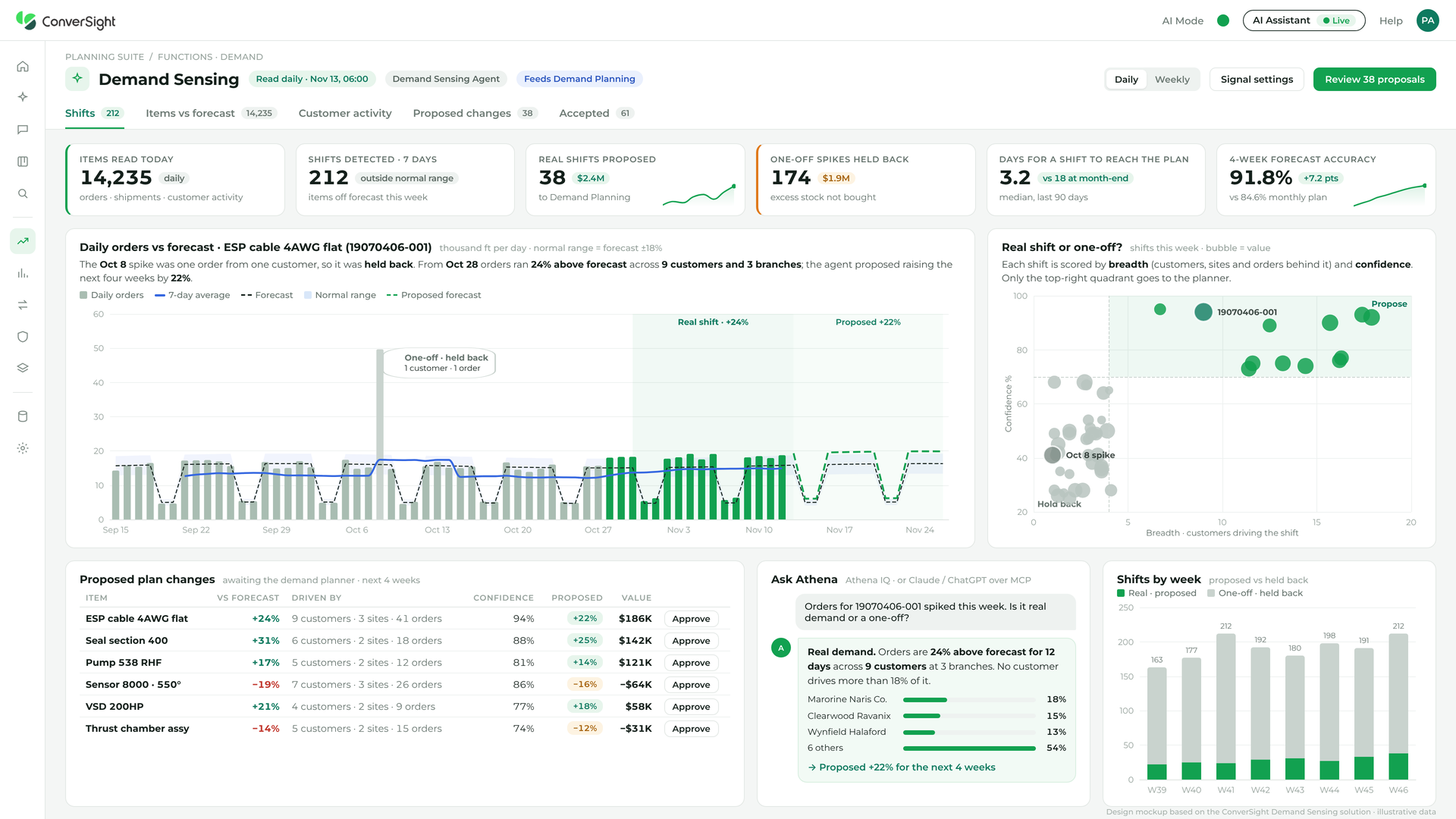
ConverSight demand sensing solution flagging real demand shifts and one-off spikes by item, day by day

Demand sensing solutions for the three problems that cost you the most

Where short-term demand usually slips past the plan, and how our demand sensing software fixes it.
THE PROBLEM

Shifts show up at month-end

Demand changes on a Tuesday, and the plan only reacts at the next monthly review, after the stockout.
THE FIX

Read every day, not every month

Orders and signals are checked daily against the forecast, so a shift surfaces while there’s still time to react.
THE PROBLEM

Every spike gets chased

One large order looks like a trend, the forecast jumps, and excess stock follows.
THE FIX

Real demand, separated from noise

Each shift is scored on how many customers, sites, and orders drive it, so one large order doesn’t move the whole plan.
THE PROBLEM

The planner finds out last

The committed plan stops matching the forecast item by item, and the gap only shows when stock runs short or piles up.
THE FIX

Shifts land as recommendations

Real shifts go to the demand planner as a proposed change to the plan, with the reason attached.
Food manufacturing · Fishbowl

Hodo Foods: Demand forecasting and smarter purchasing reduce stockouts

“AI-driven purchase recommendations and real-time demand forecasting replaced outdated, static reports – aligning production and purchasing with actual demand across the supply chain.”

CF
Christopher Funk
Controller, Hodo Foods
The result
35%
reduction in stockouts

How it works

The same four steps every day, on the data already in your ERP.
How It Works Read signals
Read signals
Daily orders, shipments, and customer activity, kept current.
How It Works Compare
Compare
Each item is checked against its forecast and its normal range.
How It Works Score
Score
Shifts are scored by breadth and confidence, real or one-off.
How It Works Propose
Propose
Real shifts go to Demand Planning as a change to approve. Our Demand Sensing Agent keeps watch between planning cycles.

Ask about demand shifts in plain language

Use Athena IQ, our AI assistant, or Claude or ChatGPT over MCP. Each one answers from the same numbers.
“Orders for SKU-2210 spiked this week. Is it real demand or a one-off?”
“Which items are running more than 20% above forecast this week?”
“Which customers are ordering earlier than usual?”

Legacy demand sensing software vs. ConverSight

Most demand sensing tools react to every change in recent sales, so one large order can move the whole plan. 
Ours scores each shift by how many customers, sites, and orders drive it, and proposes only the real ones.

Included
Partly, or with extra work
Not included
Legacy demand sensing software
ConverSight demand sensing
Deployment
A separate system fed by exports
Sits on the ERP you already run. Connects to Acumatica, Sage, NetSuite, Dynamics, and 150+ more.
How often demand is read
Weekly or monthly
Daily, item by item, from orders, shipments, and customer activity
Explaining the shift
A changed number with no reason
Every proposed change shows the customers and orders behind it
Spikes vs. trends
Every spike moves the forecast
Each shift scored by breadth and confidence
Planner control
The forecast is overwritten automatically
Real shifts proposed to the planner to approve
Link to the plan
A separate tool, exported to planning
Accepted shifts flow into demand planning on the same data
Which AI you use
The vendor’s model, take it or leave it
Athena IQ, or Claude and ChatGPT over MCP
Time to first value
Quarters of implementation and model tuning
Under 2 weeks

Demand sensing software questions, answered

What is demand sensing in the supply chain?

Demand sensing in the supply chain uses the latest orders and signals to update the short-term forecast, days or weeks ahead, so the plan reacts quickly to real changes in demand. ConverSight reads orders and customer activity daily, separates real shifts from one-off spikes, and proposes changes for your planner to approve.

How is demand sensing different from demand planning and forecasting?

Demand forecasting and demand planning look months ahead, using history to build the plan. Demand sensing watches the next few weeks, daily, and proposes changes to that plan when real demand moves. It complements the plan rather than replacing it.

Does it change the plan on its own?

No. Real shifts are proposed to the planner, who decides what goes into the plan.

What signals does it read?

Orders, shipments, and customer activity from your ERP, plus POS and eCommerce data where those systems are connected, read every day.

Who needs demand sensing solutions?

Teams whose demand moves faster than their planning cycle: distributors with many customers, manufacturers with volatile orders, and retailers running promotions. If a monthly forecast often misses what happened this week, demand sensing closes the gap.

Where planning teams go next

Each one runs on the same copy of your ERP data, so adding it isn’t a new project.
Demand Planning
DEMAND AND S&OP

Demand Planning

Builds the plan and explains every revision.
Sales & Operations Planning
DEMAND AND S&OP

S&OP Planning

Prepares the decisions before the S&OP meeting.
Inventory Forecasting
INVENTORY

Inventory Forecasting

Projects where each SKU’s stock will be, weeks ahead.
Supply Planning
SUPPLY & PRODUCTION

Supply Planning

Matches on-order supply to projected demand, by location.
25+ solutions on the same data.

See demand sensing in action