AI demand planning that explains its forecast without giving up control
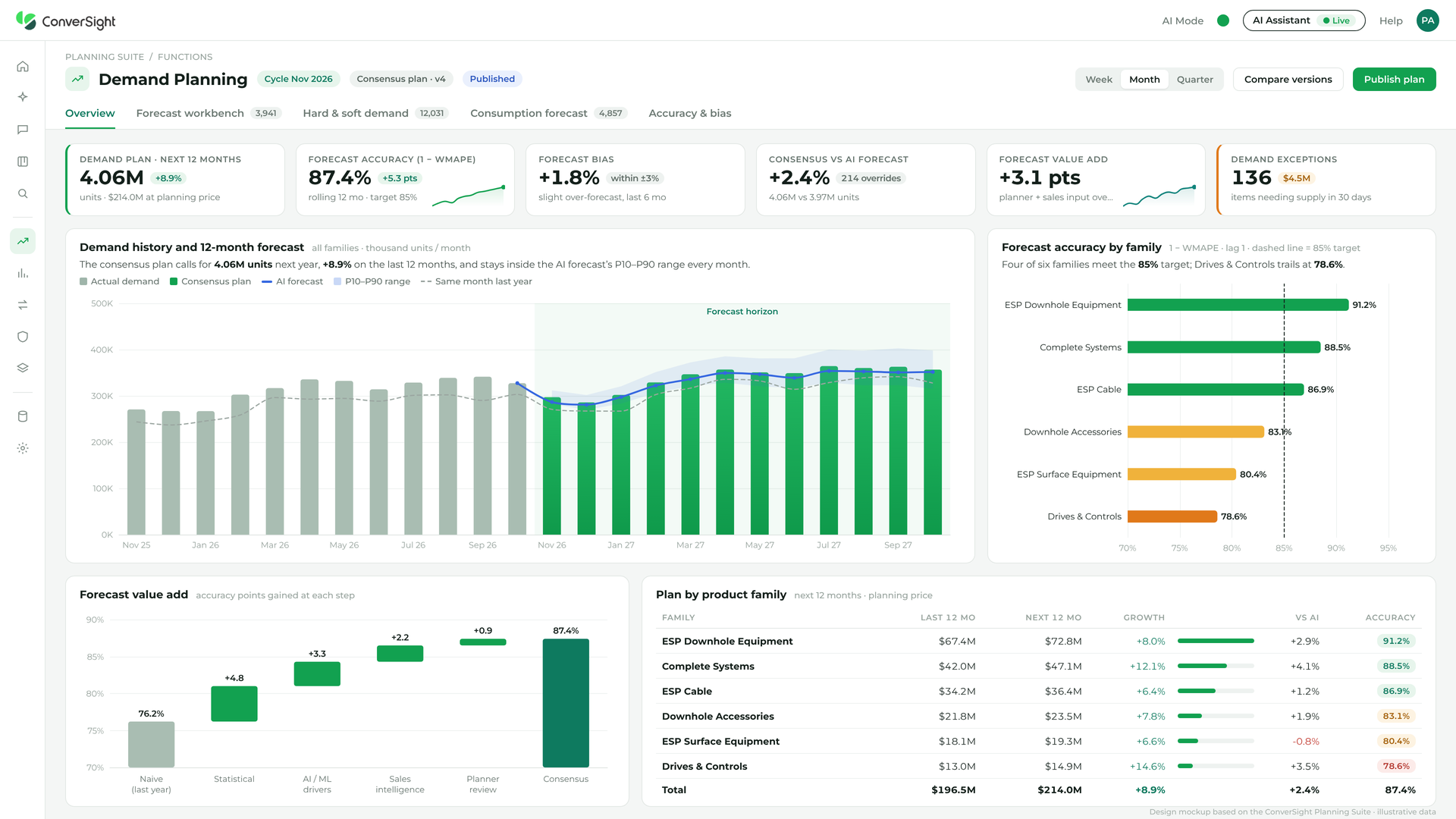
ConverSight’s demand planning software shows why every forecast changed, so planners can accept, adjust, or reject each change with the reason in front of them. Sales orders are checked against real supply, and nothing drives purchasing or production until your team commits it.
Opus Art Supplies buys with confidence in its forecast
“It's given our team a level of confidence in purchasing that we simply didn't have before, and that's changed how we plan for the business going forward.”
SB
Susannah Blundell
Director of Purchasing and Logistics, Opus Art Supplies
The same four steps every planning cycle, on the data already in your ERP.
Reads your orders
Orders, shipments, and history flow from your ERP into Digital Cube, kept current.
Forecasts every item
An AI forecast at day level for each item, with the signal behind every revision.
Planners commit
Review the forecast, agree the numbers with sales, and commit them to the Final Plan. It opens at zero, so nothing is planned by accident.
Drives the rest
The Final Plan feeds supply, material, and production planning. Our Demand Sensing agent flags real demand shifts between cycles for approval in Decision Hub.
Ask about your demand plan in plain language
Use Athena IQ, ConverSight's AI assistant and analyst, or Claude or ChatGPT over MCP.
“Why did the Q3 forecast jump in the Northeast, and should I accept it?”
“Which sales orders over $50K aren’t covered by supply?”
“Show items where the plan is more than 20% below the AI forecast.”
Legacy demand planning software vs. ConverSight
Most demand planning software stops at a statistical forecast that planners can’t question. Ours explains every revision and turns the forecast into a plan your team commits.
Included
Partly, or with extra work
Not included
Legacy demand planning software
ConverSight demand planning
Deployment
Often a separate planning database fed by exports
Sits on the ERP you already run. Connects to Acumatica, Sage, NetSuite, Dynamics, and others (150+ connectors).
Explaining the forecast
A number with no reason attached
Every revision shows the signal behind it
Orders vs. Supply
Checked in a separate report
Every open sales order checked against the plan and real supply, in dollars
Planner control
Overrides kept in spreadsheets
The Final Plan opens at zero. Only what planners commit is planned downstream.
Demand and supply planning
Demand planned in isolation from supply
The Final Plan feeds supply, material, and production planning, and the revenue projection
Demand planning software forecasts how much customers will buy, item by item, and turns that forecast into the plan that supply, production, and purchasing work from. Most tools stop at a statistical forecast. ConverSight explains each revision and checks open sales orders against real supply, so planners commit a plan they trust.
Which demand planning software features matter most?
Look for an AI forecast at item level that explains each revision, a check of open sales orders against real supply, review lists sorted by value, a plan that only changes when planners commit, and a direct link to your ERP. The plan should also feed supply and production planning without exports.
Can we tailor it to how we plan?
Yes. Demand Planner is built from a blueprint in App Studio, so screens, rules, and workflow can be adjusted in plain language with Athena IQ inside App Studio.
Do planners have to accept the forecast?
No. The Final Plan opens at zero, and only what a planner commits is planned downstream. The AI forecast is a starting point to review, not an automatic plan.
Which ERPs does it work with?
Acumatica, Fishbowl, Sage, SAP, NetSuite, Microsoft Dynamics, and Katana, among more than 150 connectors.
Where planning teams go next
Each one runs on the same copy of your ERP data, so adding it isn’t a new project.
Demand and S&OP
Demand Sensing
Picks up short-term demand shifts from live signals.
We use cookies to ensure that we give you the best experience on our website. If you continue to use this site we will assume that you are happy with it.