Connecting Claude to your ERP is easy. The hidden costs are not.
“Can we just plug Claude into our ERP?”
There’s been a lot of discussion around this topic lately, especially as AI and MCP continue to evolve.
The short answer: You can. But for reporting and everyday business questions, you probably shouldn’t. The issue is where Claude reads its data from.
The Problem with Connecting AI Straight to Your ERP
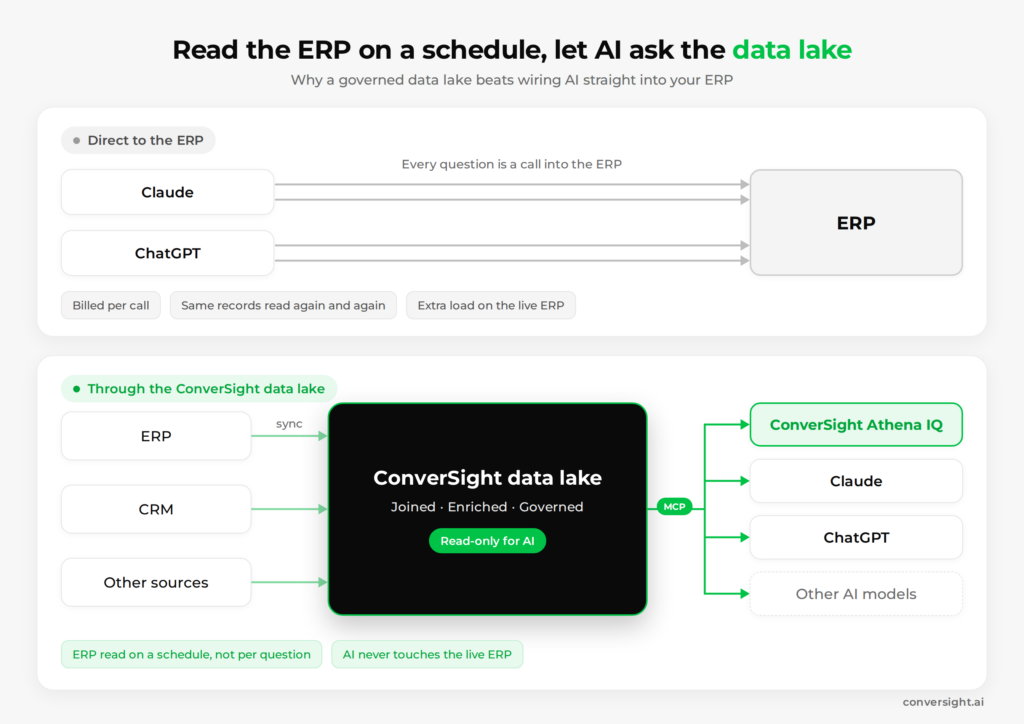
When Claude talks directly to your ERP, every question can become a live request into the system that runs your business. That costs you in three ways.
1. AI Activity Is Becoming a Line Item
Software vendors have always charged per user. AI breaks that model, because one agent can do the work of many people. So the largest vendors are starting to price AI activity separately. Here’s where three of them stand as of October 2026:
| Vendor | What’s changing | Where it stands |
|---|---|---|
| Salesforce | Plans to charge Flex Credits for MCP and API calls from AI agents registered on its platform | Announced. Rate listed as TBA on the rate card; metering not yet active |
| SAP | Moving away from per-user subscriptions toward pricing based on AI use | Said by CEO Christian Klein in a Bloomberg interview, March 2026 |
| HubSpot | AI agent work uses HubSpot Credits on top of user seats | Outcome-based agent pricing since April 2026 |
In practice, AI activity is turning into a line item on top of what you already pay for the AI tool. One question is cheap. Thousands of questions, follow-ups, and retries add up to a cost nobody budgeted for.
2. AI Reads the Same Data Over and Over
AI tools do a lot of work behind the scenes. Ask “How did our margin change by customer last quarter?” and the AI may pull customers, invoices, and costs. Ask a follow-up, like “just the top 20,” and it pulls them all again.
If ten people ask similar questions, your ERP answers the same thing ten times. Add retries and dashboard refreshes, and the count climbs fast.
3. Your ERP Slows Down for Everyone
Your ERP is built to process orders and invoices, not to answer analytics questions. Heavy AI queries compete with your team entering orders, shipping, and closing the books. When the system slows, the people doing the real work feel it first.
There’s also a safety concern. Depending on how it’s set up, a live connection can let AI change data, not just read it. For accounting and inventory, that should never happen by accident.
A Better Way: ERP to Data Lake to AI
Instead of letting AI query your ERP all day, ConverSight syncs your ERP data into a governed data lake on a schedule you set. Claude, or any model you choose, connects to the data lake through MCP. It never queries your ERP directly.
Think of it like a library. Instead of sending every reader into the archive, you make one organized copy and let everyone read from that.
The result:
Your ERP is read on a schedule, no matter how many questions people ask. Every follow-up, retry, and dashboard refresh goes to the data lake, which is built for exactly this kind of work.
What You Get Beyond the Savings
Fewer ERP reads are the quick win. Better answers are the bigger one.
- All your data in one place. ERP, CRM, e-commerce, warehouse, and spreadsheet data sit side by side, so AI can connect dots no single system can see.
- One version of the numbers. Business rules, like how you calculate margin, are set once. Every answer uses the same definitions.
- Data AI can understand. Claude sees clear business names like “Customer” and “Gross Margin,” not cryptic ERP table codes. That means fewer wrong guesses about what a field means.
- Read-only on your ERP data. AI can analyze, explain, and recommend. It can’t change your accounting records.
- The same permissions you have today. People see the same data through Claude that they can see in the ERP.
- Reports and AI agree. Dashboards and AI answers come from the same source, so the numbers match.
How ConverSight Makes It Work
This is the job ConverSight’s Data Platform was built for. It brings your ERP and other business data together into one governed, AI-ready layer, with your business definitions built in. MCP then connects it to Claude, ChatGPT, or ConverSight’s native co-pilot, Athena.
Your ERP keeps running the business. Your AI works from data you own.
The Bottom Line
Connecting AI straight to your ERP looks like a shortcut. In reality, it means reading the same records thousands of times, adding costs nobody planned for, and putting pressure on your most important system.
A data lake fixes that. Read your ERP on your schedule, and let AI answer every question from connected, governed data.
Want to see how this works? Book a demo.