AI Product Design Turns Challenges into Opportunities
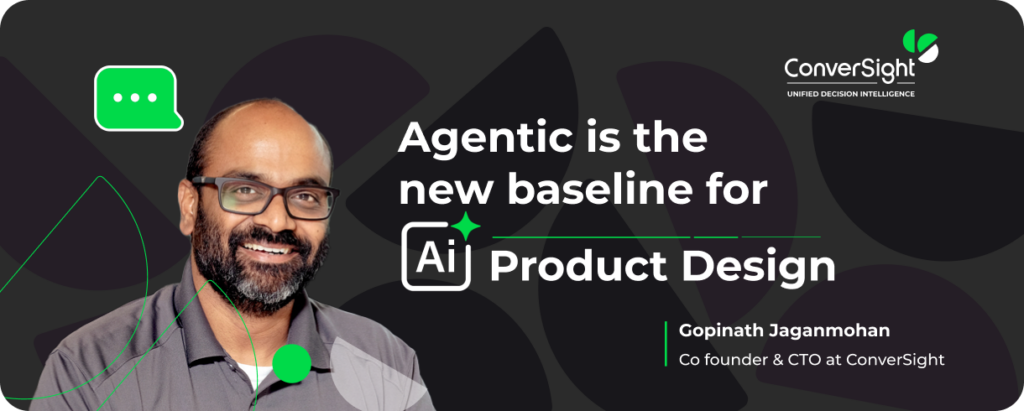
By Gopi, CTO at ConverSight
The industry is currently undergoing a fundamental shift in product development, moving away from traditional manual lifecycles toward AI engineering. This evolution isn’t just about adding new features; it’s about a structural change in the “how” of building software.
At ConverSight, we’ve observed this transition firsthand by integrating agentic tools and workflows into the core of our development process. Here is how the broader landscape is changing:
1. From Enhancement to Core Infrastructure
Modern supply chain platforms are no longer treating AI as a “bolt-on” feature. The industry is moving toward agentic workflows, where AI isn’t just a chatbot but a core component of the development architecture. This allows for more dynamic, autonomous systems that can handle complex logic without constant manual intervention.
2. Overcoming the Skepticism Barrier
The initial hesitation often seen among senior engineering talent is being replaced by a culture of rapid experimentation. As veteran developers integrate AI into their daily stacks, the industry is seeing a significant shift in technical sentiment. The focus is moving from “Will AI replace us?” to “How can AI handle the cognitive load of routine tasks?”
3. The Reallocation of Human Capital
The most profound change in the sector is the streamlining of workflows. By automating the “plumbing” of software development—boilerplate code, routine testing, and basic debugging—engineering teams are reclaiming time for:
- Architectural innovation
- Complex problem-solving
- Strategic product evolution
4. Moving Beyond Incrementalism
The end goal for modern tech organizations is no longer just a 5% or 10% gain in efficiency. The industry is aiming for a fundamental operational reset. When agentic AI is embedded at the foundational level, it transforms the team’s output from iterative updates to high-velocity, high-value delivery.
From “Vibe Coding” to High-Fidelity Prototypes
One of the most visible changes has been in our approach to UI/UX design. We reskilled our UX specialist to create ReactApps. Initially, it felt like “vibe coding,” but quickly evolved into a powerful accelerator.
Now, instead of static wireframes, we build fully functional UI prototypes that align precisely with our vision—before they even reach a UI developer. This shift has cut our cycle times dramatically and made the design-to-development handoff seamless.
AI has turned prototyping into an iterative, high-velocity process, allowing us to experiment, refine, and deliver experiences that enhance performance and functionality faster than ever before.
An AI-First Culture Across the Organization
What began in the development team quickly spread across DevOps, QA, and beyond. We’ve cultivated an AI-first culture-not just adopting tools, but rethinking how we work, experiment, and deliver value.
Just recently, our QA team demonstrated how they’ve embedded AI into CI/CD pipelines. Using AI agents, they now automate test case creation, prioritize high-impact tests, and even execute them autonomously. The result is faster cycles, stronger reliability, and higher confidence in every release.
This cultural shift has empowered teams to innovate boldly, experiment freely, and embrace continuous learning.
What This New Velocity Has Enabled
The accelerated pace fueled by AI has allowed us to launch major initiatives that would have taken far longer otherwise. A few highlights:
- A More Intelligent Workflow: We developed UniFlow, our workflow engine built on AWS ASL (Amazon States Language). Unlike standard step flows, UniFlow integrates LLM and agentic AI capabilities—enabling dynamic, intelligent automation of complex supply chain decisions.
- Accelerated WebApp Development: With our new RAPID webApp process, UX teams now build working ReactApps that AI agents refine into high-fidelity prototypes. These are handed to developers, cutting cycle times dramatically. Backed by ConverSight’s robust architecture, these apps are faster to build, scalable, and easier to maintain.
- Expanding Our Platform Vision: This new speed enabled the launch of MarketSpace, a major addition to our platform, alongside improvements to the core ConverSight ecosystem and our foundational AI agent. Together, these enhance decision-making power for our customers.
Looking Ahead
By leaning into AI, we’ve not only adapted—we’ve accelerated.
At ConverSight we’re proud to be AI-first: in the products we deliver, in the way we build, and in the culture we foster. This transformation has positioned us to move faster, innovate deeper, and lead in shaping the future of decision intelligence.
And trust me, we’re just getting started.