Adaptive, faster, and more connected supply chains with Agentic AI
Why Supply Chains Need More Than Intelligence — They Need Action
Today, supply chains operate under constant pressure. Demand spikes, port delays, and supplier setbacks ripple across the entire network — and teams are left managing the fallout from systems that were never built to respond. Legacy ERPs record what happened. BI storyboards show what’s happening. AI point tools promise intelligence but never connect. The result is slower decisions, higher costs, and customers waiting longer than they should. The missing piece isn’t more data or better reports. It’s action.
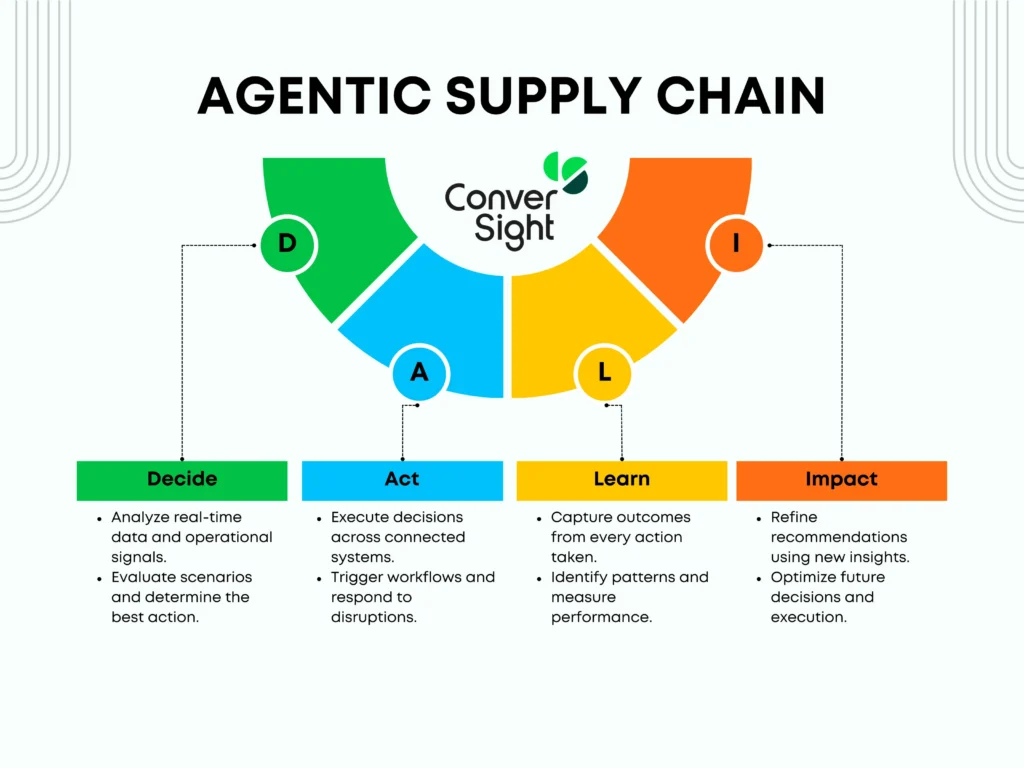
This is where Agentic AI changes the model. Unlike traditional AI that stops at insight, agentic AI closes the loop — it recommends the best path forward, executes across connected systems, and learns from every outcome. Supply chain teams move from reactive firefighting to confident, autonomous operations.
Curious how leading supply chain teams are using Agentic AI to make smarter, faster decisions? Explore ConverSight’s Agentic AI.
What Makes AI “Agentic” — and Why It Changes Everything
The word “agentic” comes from agency — the capacity to act independently toward a goal. Agentic AI isn’t just smarter analytics. It’s AI that takes ownership of outcomes, not just outputs.
Here’s the clearest way to understand the difference:
- Predictive AI tells you what will happen: “This shipment has a 90% chance of being late.”
- Generative AI tells you what to do: “Here are three alternative routes and draft emails for affected customers.”
- Agentic AI does it: “The shipment is at risk. I’ve rerouted it via the next best carrier, updated the ETA in the system, and notified the customer — here’s a summary of what was done and why.”
The shift from generating recommendations to executing decisions is what separates agentic AI from everything that came before it. It’s not a feature upgrade — it’s a different operating model. For supply chain specifically, this matters because supply chains are time-sensitive, interconnected, and consequence-heavy. A delay in one node ripples across the entire network. The faster a decision is made and executed, the lower the cost of disruption. Agentic AI compresses the time between signal and action to near zero.
Crucially, agentic AI doesn’t operate on instinct. It acts within defined boundaries — your business rules, your constraints, your priorities. It knows that one supplier carries higher lead time risk, that a certain warehouse is near capacity, that a specific customer tier requires priority fulfillment. Every decision it makes is shaped by context it has been given and context it has learned.
The Anatomy of an Agentic Supply Chain
An agentic supply chain isn’t a single product or module — it’s a new operational architecture. Three layers work together in a continuous loop.
Layer 1: The Intelligence Layer — Decision Models
Decision models are the brain. They continuously analyze data across demand, inventory, logistics, and supplier performance — synthesizing signals from every connected system into a unified view of what’s true right now. Unlike traditional forecasting, decision models don’t produce a single prediction. They evaluate multiple scenarios, weigh tradeoffs, apply business rules, and generate the best available recommendation given current conditions.
Decision models are what make the agent smart. Without them, an agent is just automation. With them, it’s judgment at scale.
Layer 2: The Action Layer — Agent Execution
The agent is the muscle. When the decision model surfaces a recommendation, the agent executes it — across every connected system, without waiting for a human to log in, review a dashboard, and take action manually.
Adjusting a reorder quantity. Rerouting a shipment. Reallocating stock between locations. Notifying a supplier. Drafting and sending a customer update. These are no longer tasks that sit in someone’s inbox. The agent handles them at the speed of the data — escalating to a human only when the decision genuinely requires judgment that the model can’t provide.
Layer 3: The Learning Layer — The Closed Loop
Every action the agent takes generates an outcome. Every outcome feeds back into the decision models. Over time, the platform learns what worked and what didn’t — improving forecast accuracy, refining risk thresholds, and calibrating recommendations to the specific patterns of your operation.
What Agentic AI Actually Does Across the Supply Chain
The closed loop isn’t abstract — it shows up in specific, measurable ways across every function of the supply chain. Here’s what agentic AI looks like in practice.
Demand Forecasting and Inventory Management
Traditional forecasting produces a number. Agentic AI produces a decision — and executes it.
ConverSight’s decision models ingest historical sales, real-time consumer signals, promotional calendars, supply constraints, and external variables to generate multi-scenario forecasts. Athena doesn’t stop at the forecast. She acts on it: triggering replenishment orders, adjusting safety stock levels, reallocating inventory between locations, and flagging demand drift before it creates a stockout or overstock situation.
- Multi-scenario demand planning across locations, SKUs, and customer segments
- Automated reorder and replenishment execution based on real-time signals
- Safety stock adjustments triggered dynamically — not on fixed review cycles
- Early detection of demand drift before it becomes an operational problem
Logistics and Route Optimization
When a disruption hits — weather, port congestion, carrier failure — the traditional response is manual: calls, emails, scrambling. Agentic AI responds in real time, without waiting to be asked.
Athena continuously monitors transportation data across traffic patterns, fuel costs, port status, driver availability, and carrier performance. When a disruption is detected, she doesn’t flag it for someone to handle. She acts — selecting the best alternative route, updating the ETA across systems, and notifying the customer automatically.
- Real-time route recalculation when disruptions are detected
- Automated carrier selection with cost and time tradeoffs evaluated instantly
- Customer communications triggered and sent — not queued for manual follow-up
- Delivery schedule updates propagated across connected systems automatically
Inventory and Warehouse Execution
Warehouses are full of decisions that happen dozens of times a day: where to slot a SKU, how to route a pick, how to allocate staff across shifts. Most of these are made by habit, not intelligence. Agentic AI replaces habit with continuous optimization.
ConverSight analyzes SKU velocity, layout efficiency, equipment capacity, and historical throughput — and dynamically adjusts how the warehouse operates. Picking paths are updated in real time. Slotting is recalibrated as velocity changes. Staff allocation recommendations are generated based on incoming order patterns.
- Dynamic picking paths updated based on real-time inventory movement
- Slotting adjustments driven by live SKU velocity — not manual periodic reviews
- Shift staffing recommendations generated from incoming demand signals
- What-if scenario execution to test new workflows before committing
Supplier Risk and Relationship Management
Supplier failures rarely arrive without warning. The signals are there — in lead time trends, quality metrics, order fill rates, and external risk indicators. Most organizations miss them because they’re buried in spreadsheets that no one has time to analyze.
Athena monitors supplier data continuously and acts on what she finds. When a supplier’s reliability score drops below threshold, she surfaces an alternative automatically — before the delay becomes a disruption. When an escalation is needed, she drafts and sends the communication.
- Supplier risk scores updated continuously with early warning alerts
- Alternative supplier options surfaced automatically when risk thresholds are crossed
- Vendor performance summaries generated without manual reporting
- Escalation communications triggered based on predefined business rules
Human-in-the-Loop vs. Fully Autonomous: Finding the Right Balance
One of the most common questions about agentic AI is also the most important one: how much should the AI decide on its own?
Instead, the answer isn’t a setting — it’s a design decision that should reflect the stakes, reversibility, and complexity of each type of action. Not all supply chain decisions carry the same risk, and the right level of autonomy should match the consequence of getting it wrong.
Where Full Autonomy Works Well
High-frequency, rules-based decisions are ideal for autonomous execution. Actions such as triggering replenishment orders, rerouting low-value shipments, or sending routine customer updates follow predictable logic and can be executed faster without human intervention.
Where Human Review Adds Value
High-stakes or strategically complex decisions still require human oversight. Examples include approving large unplanned purchases, exiting supplier relationships, or responding to major disruptions affecting multiple customers. In these situations, Agentic AI provides analysis, recommendations, and prepared actions, while the final decision remains with the user.
How ConverSight Manages This Balance
ConverSight allows organizations to define the level of autonomy that fits their operations. Business rules determine which actions are executed automatically and which require approval. Confidence thresholds, approval workflows, and complete action visibility ensure teams remain in control at every step.
The goal is not to replace people. Instead, it is to automate routine decisions so teams can focus on strategic decisions that require experience, judgment, and business context.
The Measurable Outcomes of Agentic AI in Supply Chain
Consequently, agentic AI delivers outcomes that go far beyond automation. By closing the loop between data, decisions, and execution, organizations operate with greater confidence, speed, and precision. Over 1,500 organizations are already running on ConverSight’s agentic supply chain platform — and the impact shows up in three consistent areas.
Resilience and Agility
Agentic AI gives supply chain teams the ability to anticipate disruptions, evaluate alternatives, and respond before problems escalate. Instead of scrambling when demand shifts or a supplier fails, teams rely on AI contingency plans that keep operations running — and get smarter with every decision cycle.
Significant Cost Reduction
Through optimized inventory levels, reduced stockouts, smarter procurement, and efficient logistics execution, agentic AI eliminates avoidable operational expenses. From freight savings to carrying cost reductions, organizations consistently unlock significant annual savings — without rip-and-replace infrastructure changes.
Efficiency Across Every Function
Manual planning tasks, repetitive data analysis, and spreadsheet-driven decision cycles are replaced with agent-executed workflows. Planners, buyers, and analysts shift their focus to strategic decisions — improving productivity across the entire supply chain function.
A Practical Guide to Implementing Agentic AI in Supply Chain
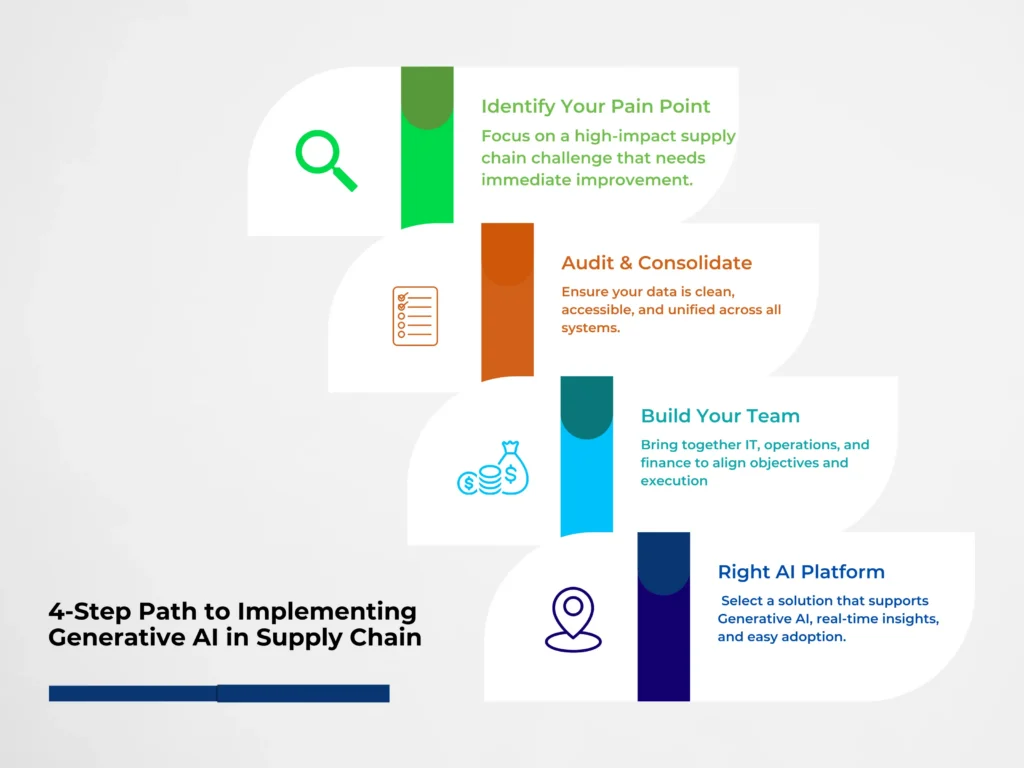
Fortunately, getting started with agentic AI doesn’t require a full infrastructure overhaul. Success comes from identifying the right entry point, ensuring data is accessible, and aligning teams around a shared objective.
Step 1: Identify Your Highest-Impact Pain Point
Start with a single, measurable challenge — constant stockouts, inaccurate forecasts, poor logistics visibility, or supplier risk. Starting focused ensures faster time-to-value and builds internal momentum with a visible, replicable win.
Step 2: Audit and Connect Your Data
Agentic AI performs at the quality of the data it receives. Assess where your data lives today — ERP, WMS, TMS, spreadsheets — and identify gaps or inconsistencies. ConverSight’s unified data layer handles most of this connectivity, but knowing your data landscape upfront accelerates integration and improves initial output quality.
Step 3: Align a Cross-Functional Team
Successful deployment requires alignment across supply chain operations, IT, and finance. Operations brings process knowledge and real-world validation. IT manages system integration. Finance tracks ROI. When all three are aligned from the start, adoption moves faster and results are easier to measure.
Step 4: Choose a Platform Built for the Full Loop
Look for an agentic AI platform that integrates across your existing systems without rip-and-replace, supports both assisted and fully autonomous execution, and scales from a single use case to full supply chain coverage. The right platform meets you where you are — AI assistant, copilot, or autonomous agent — and grows with you from there.
ConverSight: The Agentic Supply Chain Platform
Furthermore, ConverSight is the category creator in Unified Decision Intelligence — the agentic supply chain platform where decision models recommend, agents execute, and every outcome learns. Built specifically for supply chain operations, ConverSight replaces the fragmented stack of ERPs, dashboards, and disconnected AI tools with a single closed-loop intelligence platform.
Unified Data Connectivity
ConverSight integrates with ERP, TMS, WMS, finance, sales, and procurement systems to create a trusted, connected view of supply chain operations. Teams gain visibility across demand, inventory, logistics, and supplier performance without manual data consolidation.
Decision Models Across the Supply Chain
ConverSight’s decision models continuously analyze operational data to generate recommendations across forecasting, inventory management, logistics planning, and supplier risk. Every recommendation is tailored to business rules, priorities, and constraints.
Athena — AI Employee That Recommends and Executes
Athena is ConverSight’s AI employee and execution engine. Teams can interact with supply chain data in natural language to quickly understand trends, risks, and opportunities. When recommendations are approved, Athena can execute actions such as inventory adjustments, shipment rerouting, supplier notifications, and customer updates across connected systems.
Automated Insights and Real-Time Actions
ConverSight continuously monitors KPIs, anomalies, and operational changes, transforming signals into alerts, recommendations, and automated actions. This helps teams respond faster to disruptions and opportunities while reducing manual effort.
The Learning Loop
Every action and outcome feeds back into the platform’s decision models. As a result, forecasts become more accurate, recommendations improve, and the system continuously adapts to the unique patterns of your supply chain.
Meet Athena — the conversational AI transforming how supply chain teams analyze, plan, and act. Learn more
The Loop Is Already Closing — Start Your Journey
Agentic AI is no longer a futuristic concept—it’s a powerful competitive advantage for businesses that want to operate with greater speed, precision, and resilience. Companies adopting Agentic AI in Supply Chain are already seeing measurable impact: faster decision-making, fewer manual errors, reduced operational costs, and improved service levels across every stage of the value chain.
By transforming complex data into recommendations, scenarios, and automated actions, Agentic AI shifts organizations from reactive firefighting to proactive, insight-driven operations. Whether your priority is forecasting accuracy, inventory control, logistics optimization, or supplier risk management, the right Agentic AI platform can accelerate your transformation and ensure your business stays ahead of disruption.
ConverSight meets you where you are. Start with an AI assistant, move to a copilot, scale to full autonomous execution — without ripping out the systems you already have.
Ready to close the loop? See how ConverSight takes you from data to decision to done. Request a demo