AI inventory optimization that frees up cash. Without risking service.
ConverSight’s inventory optimization software checks every SKU-location in your ERP each week and ranks what to transfer, hold, or liquidate. Planners work a short list, and Finance sees what each change does to cash.
Inventory optimization for the three problems that cost you the most
Where inventory planning usually breaks, and how ConverSight’s inventory optimization tools fix it.
THE PROBLEM
Cash sits in stock that doesn’t move
Dead and slow stock hide inside the inventory total, so the cash tied up in them only shows at the annual count.
THE FIX
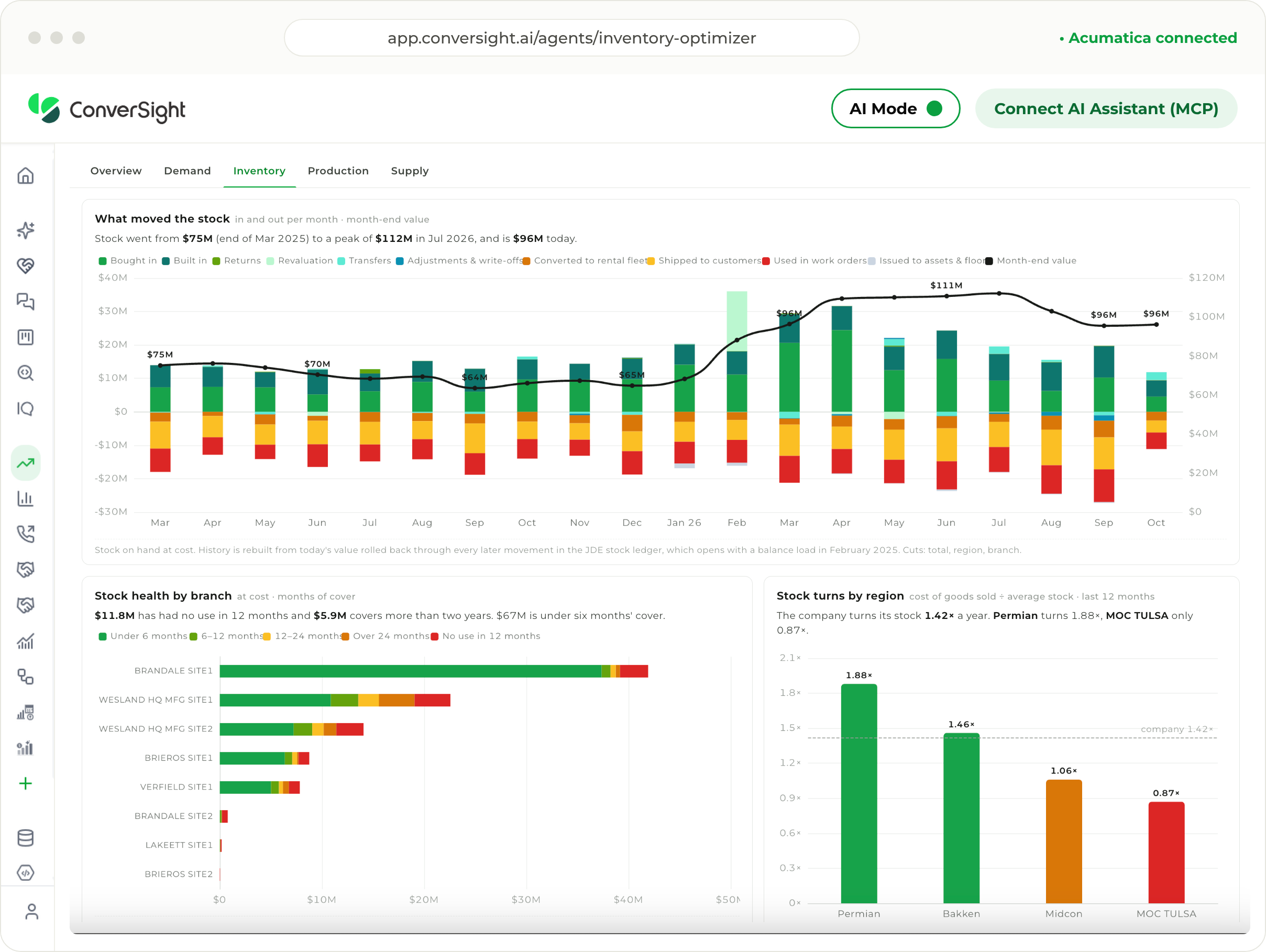
Dead and slow stock, ranked in dollars
Every class shows its top items by dollars on hand, turns, and days of supply. Open an item to hold, transfer, or liquidate it.
Dead
$1.42M
Slow
$1.35M
Healthy
$0.88M
THE PROBLEM
Buffers set by hand, years ago
Safety stock was set by rule of thumb for old demand, and nobody can say what each buffer costs or what service it buys.
THE FIX
A policy for every SKU-location, with the math shown
Each SKU-location gets its own service level, safety stock, and make-to-stock or make-to-order setting, based on its demand variability. Finance can trace every number.
Safety stock = z(98%) × σ demand × √lead time
2.05 × 41 units × √3 wks = 146 units
THE PROBLEM
Excess in one place, stockouts in another
Fast movers stock out while months of cover sit in the wrong branch, and the network total hides both.
THE FIX
Transfers before purchases
Multi-echelon inventory optimization plans your plants, DCs, and branches as one pool. When another site already holds the stock, ConverSight recommends a transfer before a new purchase.
The same four steps every planning cycle, on the data already in your ERP.
Measure
Turns on trailing 12-month cost of goods, days of supply, and dead and slow stock, by class.
Set policy
Service level, safety stock, and stocking strategy for each SKU-location.
Project
See where stock will fall below safety stock in the weeks ahead.
Act
Our Inventory Optimizer agent sends each hold, transfer, or liquidation to Decision Hub for a planner to approve.
Ask about your stock in plain language
Use Athena IQ, ConverSight’s native co-pilot, or Claude or ChatGPT over MCP. Each one answers from the same numbers.
“Where is cash tied up in stock with no demand?”
“Which items will fall below safety stock next month?”
“What happens to turns if we raise service level on A items to 98%?”
Legacy stock optimization software vs. ConverSight
Most inventory optimization software stops at a policy table of safety stock, reorder points, and order quantities. ConverSight turns that table into a ranked list of actions your planners approve.
Included
Partly, or with extra work
Not included
Legacy stock optimization software
ConverSight inventory optimization
Deployment
A second system of record to maintain and reconcile
Sits on the ERP you already run, with no parallel master data. Connects to Acumatica, Sage, NetSuite, Dynamics, and 150+ more.
Connected planning
Inventory policy in isolation
Shares one set of numbers with your demand, supply, procurement, and S&OP solutions
Approvals
Planners override static min/max by hand
Held for planner approval by default. Routine reorders under a limit you set can close on their own. Every action is logged.
Explaining a flag
Raise a report request with a planning analyst
Ask in plain language why any SKU-location is flagged, and see the driver
Inventory optimization software sets how much of each item to stock at each location. It uses demand variability, lead time, and a target service level to set safety stock, reorder points, and order quantities at the lowest carrying cost. ConverSight goes a step further: it ranks the actions that follow from the policy, so planners work a short list instead of a spreadsheet.
What is the difference between inventory management and inventory optimization?
Inventory management tracks counts, movements, and transactions. Inventory optimization sets the policy for each SKU-location against a service level target and a carrying cost budget. Most ERPs manage inventory well and optimize it poorly.
What is multi-echelon inventory optimization (MEIO)?
Multi-echelon inventory optimization sets stock levels across every tier of a network (plants, distribution centers, and branches) as one system instead of planning each site alone. Because the tiers buffer the same demand, planning them together hits the same fill rate with less total inventory.
Will it place orders or cut stock on its own?
Only within rules you set. By default, every purchase order waits for a planner’s approval. Policies are set per SKU-location from its service level, so items at risk are flagged before they run short. Every change writes back to your ERP with an audit trail.
Which ERPs does it work with?
Acumatica, Fishbowl, Sage, SAP, NetSuite, Microsoft Dynamics, and Katana, among more than 150 connectors.
Where planning teams go next
Each one runs on the same copy of your ERP data, so adding it isn’t a new project.
POLICY
Inventory Planning
Sets reorder points and order quantities for each SKU-location.
We use cookies to ensure that we give you the best experience on our website. If you continue to use this site we will assume that you are happy with it.