Rethinking Your Workforce? Why AI Employees Belong in Your 2025 Supply Chain Org Chart
The Rise of AI Employees: Why the Workforce is Evolving
The modern supply chain is a complex web of moving parts, volatile demand shifts, and relentless customer expectations. Traditionally, meeting these challenges has relied heavily on human labor — from warehouse supervisors to data analysts. But in 2025, the definition of “workforce” is undergoing a profound shift: intelligence has become the new labor.
The shift is being fueled by AI Employees — intelligent, autonomous digital workers designed to perform business-critical tasks, provide insights, and make decisions in real time. Unlike automation of the past, AI Employees aren’t just programmed to follow a rigid set of rules. They learn, adapt, and integrate seamlessly into business ecosystems.
For senior leaders, this transformation means it’s no longer about whether to hire AI Employees, but how quickly you can integrate them to remain competitive. Speed, cost-efficiency, and scalability are the new cornerstones of advantage — and AI Employees deliver all three.
What is an AI Employee?
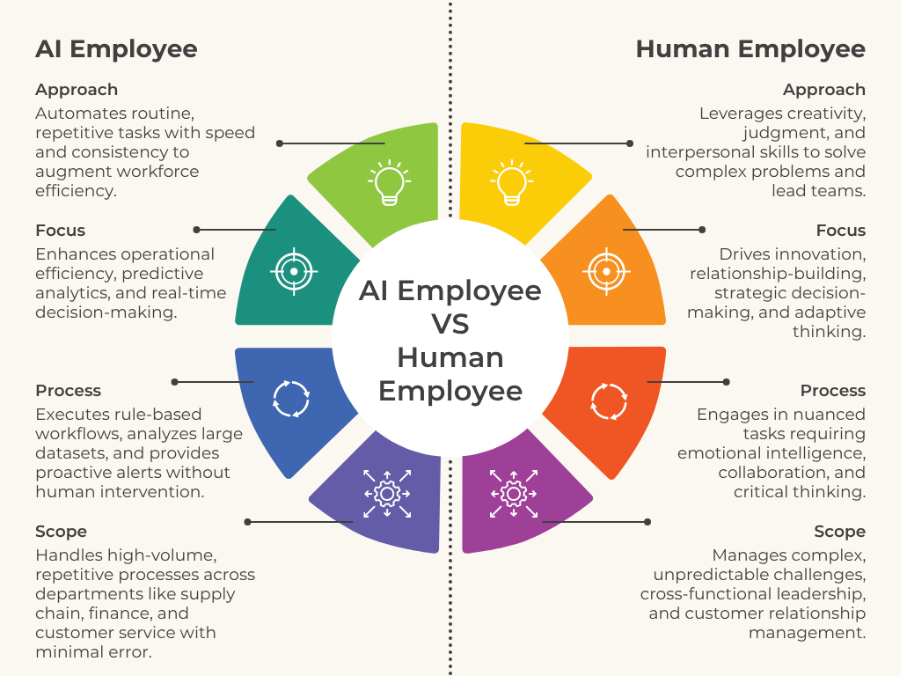
An AI Employee is a virtual, intelligent team member equipped with advanced capabilities such as decision support, conversation intelligence, process automation, predictive analytics, and contextual recommendations — all designed to work alongside human colleagues to enhance performance and outcomes.
How they differ from other automation tools:
- RPA (Robotic Process Automation): Executes repetitive workflows but lacks adaptability.
- Chatbots: Respond to pre-defined queries but rarely understand context deeply.
- Traditional automation: Speeds up processes but doesn’t generate insights or adapt to new situations.
AI Employees go further — they can analyze large datasets, understand business context, and make proactive recommendations.
Early adopters across manufacturing, logistics, and retail have already reported measurable ROI. For example, global retailers using AI Employees for demand forecasting have reduced stockouts by up to 30% while freeing human staff for higher-value tasks.
More Than Bots: How AI Employees Empower Business Teams
In 2025, AI Employees are no longer experimental tools — they are embedded, decision-making partners driving measurable results across business operations. Unlike traditional software tools that require human initiation and oversight, AI Employees proactively monitor, analyze, and act in ways that directly impact supply chain performance.
For leadership:
- Cost optimization at scale: AI Employees can simultaneously manage hundreds of operational processes, from supplier performance monitoring to order accuracy checks, without additional staffing costs.
- Faster decision cycles: Instead of waiting days for reports, executives can ask, “Which suppliers caused delays last quarter?” and receive instant, contextual answers supported by data.
- Scalable expertise: AI Employees retain and apply organizational knowledge consistently, ensuring best practices are followed across regions, shifts, and departments.
For operational teams:
- Exception management: AI Employees flag anomalies in inventory, logistics routes, or procurement costs, allowing staff to focus on resolution instead of detection.
- Real-time operational visibility: They pull live data from ERP, WMS, and CRM systems into a single conversational interface, reducing the need to navigate multiple dashboards.
- Performance benchmarking: AI Employees track KPIs continuously, alerting teams when performance deviates from targets and suggesting corrective actions.
Why this matters:
In high-stakes supply chain environments, speed, accuracy, and foresight are critical. AI Employees don’t just reduce workloads — they enhance decision quality and ensure organizations can pivot quickly in response to market shifts, disruptions, or opportunities.
Inside the Mind of an AI Employee: Core Capabilities
An AI Employee isn’t a single function—it’s a suite of interconnected capabilities designed to think, respond, and act in alignment with business goals. These capabilities enable organizations to handle complexity at scale:
- Natural Language Understanding (NLU): Interprets questions like “Which SKUs are at risk of stockout in the next two weeks?” and responds with data-backed insights in seconds.
- Automated Task Handling: Executes repetitive processes such as generating daily shipment reports or updating inventory counts without manual intervention.
- Predictive Intelligence: Anticipates issues like supplier delays or equipment failures before they occur, allowing teams to act preemptively.
- Contextual Recommendations: Suggests next best actions such as rerouting shipments or adjusting safety stock based on historical patterns and current trends.
- Real-Time Reporting & Alerts: Monitors live operational data, flagging exceptions immediately rather than at the end of a reporting cycle.
AI Assistant: The Human-Friendly Face of the AI Employee
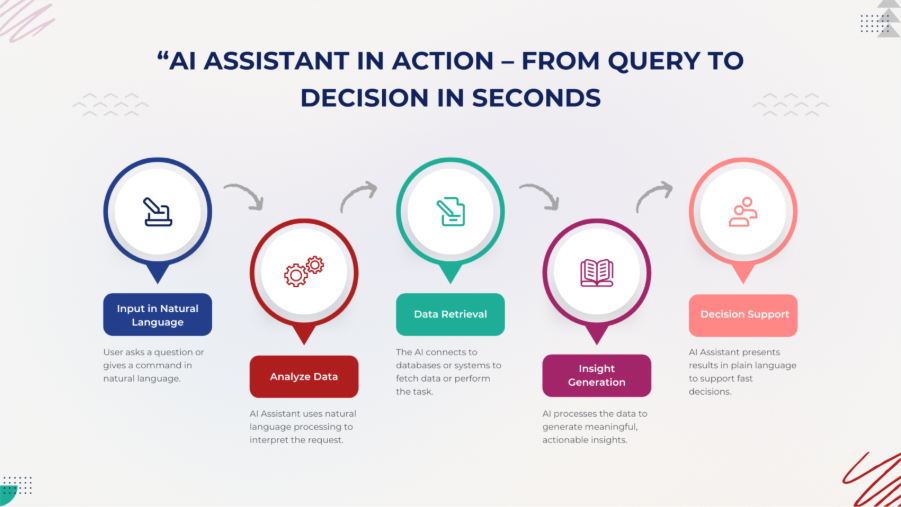
An AI Assistant serves as the intuitive, user-facing interface of an AI Employee, bridging the gap between sophisticated back-end intelligence and the people who need to act on it. Functioning as a conversational layer, it enables users to interact with the AI Employee naturally, without requiring deep technical expertise or specialized training.
Through conversational interaction, AI Assistants allow users to request data, execute tasks, and receive decision support in plain, human language. Whether it’s answering a data query, generating an operational report, or recommending the best course of action, the AI Assistant transforms complex AI capabilities into straightforward, actionable outputs.
This accessibility is particularly valuable for non-technical teams, who may be unfamiliar with analytics platforms or AI workflows. By translating requests into AI-understandable commands and delivering responses in clear, contextual language, AI Assistants remove the intimidation factor and open advanced capabilities to a broader workforce.
Well-known examples include Athena, which specializes in conversational analytics for various domains including supply chain and business operations; Microsoft Copilot, embedded into productivity tools like Word and Excel; and Google Duet AI, designed to enhance collaboration within Google Workspace. Each of these demonstrates how AI Assistants integrate seamlessly into existing work environments, making AI-powered insights part of the everyday workflow.
Key benefits of AI Assistants include:
- Reduced training and adoption friction – Teams can start using AI capabilities with minimal onboarding.
- Faster decision-making – Data and insights are delivered instantly in response to direct queries.
- Insights in plain language – Users receive information in clear, actionable terms, without technical jargon.
Challenges and Considerations Before Hiring an AI Employee
While AI Employees offer transformational potential for supply chain operations, organizations often face practical barriers in their adoption. From technical hurdles to cultural resistance, these challenges can slow progress and dilute impact if not addressed systematically. Below is a closer look at the most common obstacles — and how ConverSight is purpose-built to overcome them.
Technical Complexity and Integration
Many supply chains still rely on a patchwork of legacy systems, siloed databases, and manual processes. Integrating an AI Employee into such environments can appear daunting, especially when IT teams are already stretched thin.
How ConverSight helps: With no-code/low-code setup and pre-built ERP/CRM connectors for platforms like SAP and Oracle, ConverSight reduces the integration burden, enabling faster deployment without heavy custom development.
Integration with Existing Systems
Beyond initial technical complexity, maintaining seamless interoperability over time is critical. AI Employees must continuously pull, process, and push data between systems without disrupting existing workflows.
How ConverSight helps: The platform is designed with robust API architecture, ensuring compatibility with both on-premise and cloud-based applications, so organizations can expand AI capabilities without overhauling their core infrastructure.
Data Security and Compliance
AI-driven operations rely on continuous access to operational and transactional data — often sensitive in nature. Without strict safeguards, organizations risk exposing proprietary information or violating regulations.
How ConverSight helps: Enterprise-grade security protocols, including SOC 2 compliance, encryption, and configurable data residency options (on-premise or cloud), ensure data remains protected and never shared beyond authorized environments.
Ethical and Compliance Considerations
As AI takes a more active role in decision-making, ethical governance becomes essential. Bias in algorithms, opaque decision logic, and compliance with evolving global regulations can all introduce risk.
How ConverSight helps: The system incorporates explainable AI frameworks, ensuring every recommendation is transparent and traceable, while compliance modules align operations with industry-specific regulations.
Change Management and Adoption
Even the most advanced AI systems fail without human adoption. Resistance often stems from fear of job displacement or mistrust of AI recommendations.
How ConverSight helps: By offering an intuitive conversational interface — similar to Slack or Teams — and providing ready-made change management templates, ConverSight helps employees adapt quickly and view AI as an enabler rather than a threat.
Cost and ROI Uncertainty
Deploying AI Employees requires investment in technology, training, and sometimes infrastructure. The challenge lies in justifying these costs before measurable benefits are realized.
How ConverSight helps: Subscription-based pricing models, combined with quick-win pilots such as reducing stockouts or automating inventory alerts, provide early ROI evidence to build confidence and stakeholder buy-in.
Scalability and Use Case Selection
Some organizations get stuck in “pilot purgatory” — running isolated tests without scaling to enterprise-wide adoption. This is often due to unclear priorities or overly complex starting points.
How ConverSight helps: ConverSight provides a proven framework for identifying high-impact, low-effort use cases, enabling organizations to scale AI Employee deployments methodically and successfully.
Key Takeaway:
Athena is the AI Employee built for adaptability. Capable of working across industries and functions, it integrates seamlessly with over 130+ systems to deliver insights, streamline operations, and help organizations overcome adoption, integration, and scalability challenges from day one.
Where AI Employees Are Already Delivering ROI
AI Employees have moved beyond theory and are actively driving value across multiple industries. They empower organizations to streamline operations, enhance decision-making, and optimize resource allocation.
Supply Chain Optimization
In logistics and distribution, AI Employees provide accurate demand forecasting, automate replenishment processes, and identify potential disruptions before they impact the supply chain. This leads to reduced inventory costs, minimized stock shortages, and improved cash flow management.
Procurement and Vendor Management
AI Employees assist procurement teams by monitoring supplier reliability, highlighting savings opportunities, and managing contract renewals efficiently. For example, manufacturers benefit from early alerts about delayed shipments, allowing them to take corrective actions proactively.
Financial Planning and Analysis (FP&A)
Finance teams leverage AI Employees to receive timely updates on budget variances, run scenario analyses, and predict cash flow trends. These insights support faster, more confident financial decisions without waiting for traditional reporting cycles.
Manufacturing Process Improvement
By analyzing equipment performance and production data, AI Employees recommend maintenance schedules and process adjustments. This reduces unplanned downtime, improves product quality, and increases overall operational efficiency.
Cross-Functional Decision Support
AI Employees integrate seamlessly with ERP, CRM, and analytics platforms, consolidating data into an intuitive conversational interface. This accessibility allows sales, operations, and finance teams to collaborate with consistent, real-time insights, regardless of technical background.
Athena accelerates these benefits by connecting with over 130 enterprise systems, enabling organizations to realize measurable outcomes rapidly and with minimal disruption.
How ConverSight’s AI Employee Athena Transforms Businesses
ConverSight’s AI Employee, Athena, is engineered to deliver powerful AI-driven capabilities while minimizing the complexity and resource demands typically associated with advanced technology deployment. Athena enables organizations to unlock actionable insights from disparate data sources through an intuitive, conversational interface designed for business users and executives alike.
Unified Data Access
Athena seamlessly integrates data from ERP systems, CRM platforms, spreadsheets, and data lakes, providing a consolidated view across business functions. This unified access eliminates silos, ensuring decision-makers have a complete and up-to-date picture of operational performance without navigating multiple tools.
Conversational User Interface
Athena’s natural language interface empowers users to query real-time KPIs, generate reports, and gain insights simply by asking questions in plain language. This removes the need for specialized training or technical expertise, accelerating adoption and enabling faster decision-making across teams.
Predictive Analytics and Anomaly Detection
Athena leverages advanced machine learning models to anticipate trends, forecast demand, and detect anomalies before they escalate into issues. Automated alerts notify stakeholders proactively, helping to prevent disruptions and optimize resource allocation.
Contextual Storyboards for Informed Decisions
Beyond raw data, Athena presents insights within contextual storyboards tailored to specific roles and business scenarios. These visual narratives guide users through complex data, supporting better understanding and confident decision-making.
Enterprise-Ready and Scalable
Designed with executives in mind but fully supported by IT, Athena is built to scale seamlessly with your organization’s needs. Pre-configured for supply chain and operational workflows, it requires minimal IT intervention, reducing time to value while ensuring robust security and compliance.
By integrating Athena into your business ecosystem, organizations can transform data into a strategic asset, empowering teams to act decisively and drive growth in today’s competitive environment.
Getting Started: How to Onboard Your First AI Employee
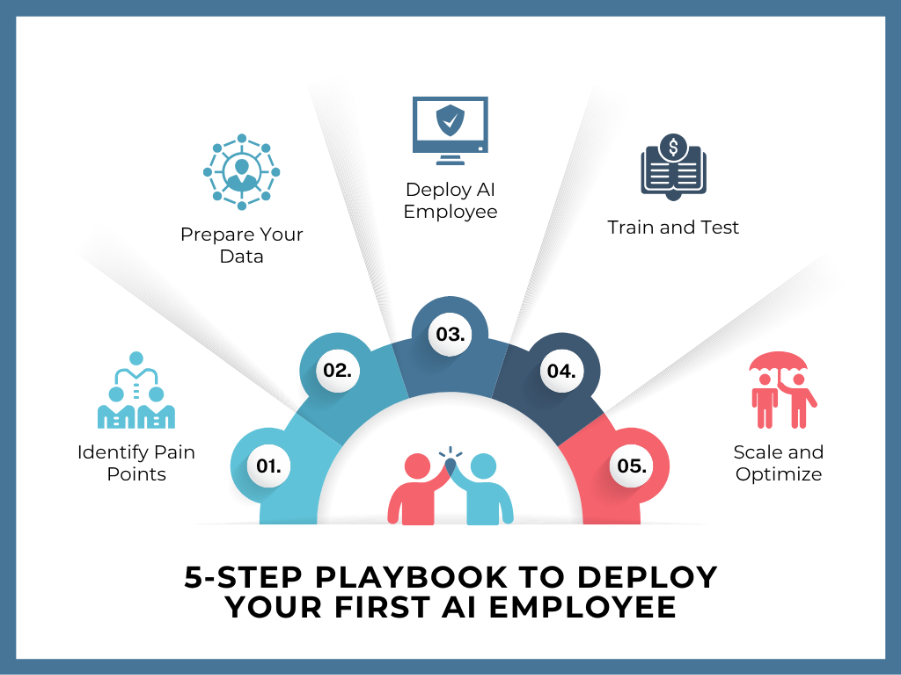
Successfully introducing an AI Employee begins with a clear, structured approach that ensures measurable impact and smooth adoption across your organization. Here are the key steps to get started:
Define the Use Case: Start by identifying a repetitive, insight-intensive task that would benefit from automation and real-time intelligence. Examples include daily sales reporting, inventory forecasting, or supplier performance monitoring. Focusing on a well-defined use case helps deliver quick wins and builds momentum.
Select the Right Pilot Environment: Choose a department or function where data is readily accessible and outcomes can be tracked effectively. This targeted approach allows you to test the AI Employee’s capabilities in a controlled setting, providing valuable feedback and demonstrating tangible business value.
Involve Cross-Functional Stakeholders: Early alignment between IT teams, department leaders, and end users is critical to fostering trust and driving adoption. Engaging all relevant parties ensures that technical requirements, business goals, and user needs are addressed from the outset.
Leverage Athena
Athena, ConverSight’s embedded AI assistant, serves as your organization’s first AI Employee. It interprets natural language queries, generates actionable insights, and executes tasks—all without requiring specialized technical skills. This lowers barriers to adoption and accelerates decision-making.
Track Success and Scale
Monitor key performance indicators such as user engagement, decision turnaround times, and operational improvements. Use these insights to refine the AI Employee’s role and expand its deployment to additional teams and processes.
Conclusion
AI Employees have moved beyond being a mere trend—they represent a fundamental strategic advantage in today’s competitive landscape. By integrating AI-driven intelligence into your workforce, your organization can unlock faster decision-making, greater operational efficiency, and improved business outcomes. ConverSight provides a practical and intelligent approach to adopting AI Employees, enabling you to harness their full potential with ease and confidence. As supply chain challenges grow increasingly complex, adding an AI Employee like Athena to your organizational structure is no longer optional—it’s essential for staying ahead.
→ Request a Live Demo and discover how ConverSight can transform your business with Athena.