
Stop reacting to demand. Start deciding ahead of it.
What is Demand Forecasting and Why It Matters
Every business decision—whether it involves inventory, production, or customer delivery—starts with a single question: how much will customers actually need? Demand forecasting answers this question by estimating future demand for products or services within a specific time frame.
Demand forecasting replaces intuition with structure. It gives businesses a reliable way to anticipate demand before it materializes. By analyzing past performance and observing market signals, organizations can prepare for what lies ahead instead of scrambling to respond after demand shifts occur.
In practical business operations, demand forecasting acts as a bridge between customer expectations and internal execution. It shapes inventory levels, production capacity, and resource allocation across locations and channels.
Why Demand Forecasting Matters for Business Performance
Markets rarely remain stable. Customer preferences change, sales cycles fluctuate, and external factors such as promotions or supply disruptions can alter demand with little warning. Demand forecasting provides the visibility needed to manage this uncertainty with confidence.
When forecasts are accurate, businesses can make informed decisions rather than conservative or aggressive guesses. This clarity helps organizations avoid tying up capital in unnecessary stock while still meeting customer demand consistently. Over time, this balance leads to stronger financial control and more predictable operations.
From a strategic perspective, demand forecasting supports better coordination between teams. Sales, operations, procurement, and finance all rely on a shared understanding of future demand. A reliable forecast ensures these functions work from the same assumptions, reducing misalignment and last-minute firefighting.
Key Elements of Demand Forecasting
Effective demand forecasting depends on the quality and relevance of the inputs used. The following elements form the foundation of reliable forecasts:
- Historical Sales Data: Past sales performance reveals demand trends, growth patterns, repeat purchases, and product life cycles. It establishes what typically happens under similar conditions — and gives decision models the baseline they need to generate accurate projections.
- Market-Driven Factors: External influences such as price changes, promotions, seasonality, competitor activity, and economic conditions significantly affect demand. Including these factors ensures forecasts reflect real market behaviour rather than isolated internal patterns.
- Demand Signals: Shifts in buying preferences, purchasing frequency, channel selection, and consumption habits offer early indicators of demand changes. Capturing these signals continuously — not just at planning intervals — improves responsiveness. It also gives the agent the context needed to act at the right moment.
Together, these elements allow organizations to move beyond static, point-in-time projections and develop forecasts that adapt continuously to evolving market conditions.
Business Impact of Accurate Demand Forecasting
The accuracy of demand forecasts directly affects business performance across every function.
- Prevents Shortages and Overstock: Accurate forecasts reduce the risk of stockouts and excess inventory — improving working capital efficiency and keeping fulfillment commitments intact.
- Improves Production and Supply Chain Planning: Organizations align production schedules, procurement plans, and supplier commitments with actual demand expectations — rather than adjusting after the fact.
- Strengthens Customer Trust: Reliable product availability and consistent delivery timelines build customer confidence and protect long-term relationships.
How Businesses Perform Demand Forecasting
Once organizations understand the importance of demand forecasting, the next challenge is determining how to do it effectively. There is no single method that works for every business. Companies choose forecasting approaches based on factors such as data availability, product maturity, demand volatility, and planning horizons.
At a high level, demand forecasting methods fall into three categories: qualitative, quantitative, and hybrid. Each serves a distinct purpose and is often applied at different stages of business growth or market stability. Understanding how these methods work helps organizations select the right approach for each scenario — rather than applying a single model across the entire catalog.
In an agentic supply chain, this selection doesn’t happen manually. Decision models evaluate which forecasting approach performs best for each product, location, and demand pattern — and continuously refine that selection as outcomes feed back into the loop.
Qualitative Forecasting Methods
Qualitative forecasting methods rely on structured judgment and expert insight to estimate future demand — particularly when historical data is insufficient, unreliable, or simply doesn’t exist yet. They are most effective for capturing demand drivers that haven’t yet appeared in data: upcoming customer contracts, new market entries, or emerging demand trends that no model has seen before.
Common qualitative models include:
- Delphi Method: Uses multiple rounds of anonymous expert input to reach a consensus forecast. Useful for long-term forecasting and strategic planning where uncertainty is high and data is limited.
- Sales Force Composite: Aggregates demand estimates from sales teams based on pipeline visibility and customer interactions. Effective for short-term forecasts and region-specific demand projections — particularly where sales relationships surface signals that systems don’t yet capture.
- Market Research and Consumer Surveys: Gathers customer intent and preference data to anticipate demand shifts, particularly for new products or market expansions where no purchase history exists.
- Executive Opinion: Draws on leadership experience to forecast demand when quick directional decisions are required and time doesn’t allow for full quantitative analysis.
Qualitative models are not a replacement for data — they are a complement to it. In an agentic supply chain, qualitative signals — from sales teams, market research, and leadership input — feed into the decision models alongside quantitative data, giving the platform context that numbers alone can’t provide.
Quantitative Forecasting Methods
Quantitative forecasting methods use mathematical and statistical models to analyze historical demand data and project future outcomes. These models are best suited for environments with stable demand patterns and sufficient data history — and they form the computational backbone of any serious demand forecasting operation.
Widely used quantitative models include:
- Time Series Models (Moving Average, Exponential Smoothing): Identify trends and seasonality in historical demand to forecast near-term demand. Widely used for inventory and replenishment planning where demand follows predictable patterns.
- ARIMA Models: Capture trend, seasonality, and randomness in demand data — making them useful for medium-term forecasting in relatively stable markets where cyclical patterns repeat reliably.
- Regression Models: Estimate demand based on influencing variables such as price, promotions, or economic indicators. Useful for understanding cause-and-effect relationships between business actions and demand outcomes.
- Machine Learning Models: Analyze large, complex datasets to identify non-linear patterns across products, locations, and channels — improving forecast accuracy at scale where traditional statistical models fall short.
Quantitative models provide consistency and scalability across supply chains and large product portfolios. But no single model covers every scenario — demand patterns shift, new products launch, and market conditions change faster than any fixed model can track. In an agentic supply chain, ConverSight’s decision models run multiple quantitative approaches simultaneously. They select and weight by SKU, location, and demand pattern — updating continuously as outcomes feed back into the loop.
Hybrid Demand Forecasting Approaches
Hybrid forecasting approaches combine qualitative inputs with quantitative models to deliver more accurate, context-aware forecasts. This approach recognizes that neither data nor human judgment alone can fully explain demand behaviour — and that the most reliable forecasts draw on both.
Examples of hybrid approaches include:
- Forecast Baseline with Planner Adjustments: Statistical or machine learning models generate an initial forecast, which planners refine based on known events — promotions, supply constraints, or market changes. The model provides the analytical foundation; the planner adds the business context the model doesn’t yet have.
- Demand Sensing Models: Combine real-time data signals with historical trends and expert input to adjust short-term forecasts dynamically. Instead of waiting for a weekly planning cycle, demand sensing updates the forecast as new signals arrive — giving teams a continuously current view of near-term demand.
- Collaborative Forecasting (S&OP / IBP): Integrates inputs from sales, operations, finance, and marketing into a unified forecast that balances demand and supply considerations. Everyone works from the same number — reducing the misalignment that occurs when functions plan from different assumptions.
Hybrid models are particularly effective in volatile or highly competitive markets where demand is influenced by multiple, rapidly changing factors. In an agentic supply chain, this blending happens continuously and automatically. Qualitative signals feed into the decision models alongside quantitative data. The agent acts on the combined output — without waiting for a manual planning cycle.
Demand Forecasting Software
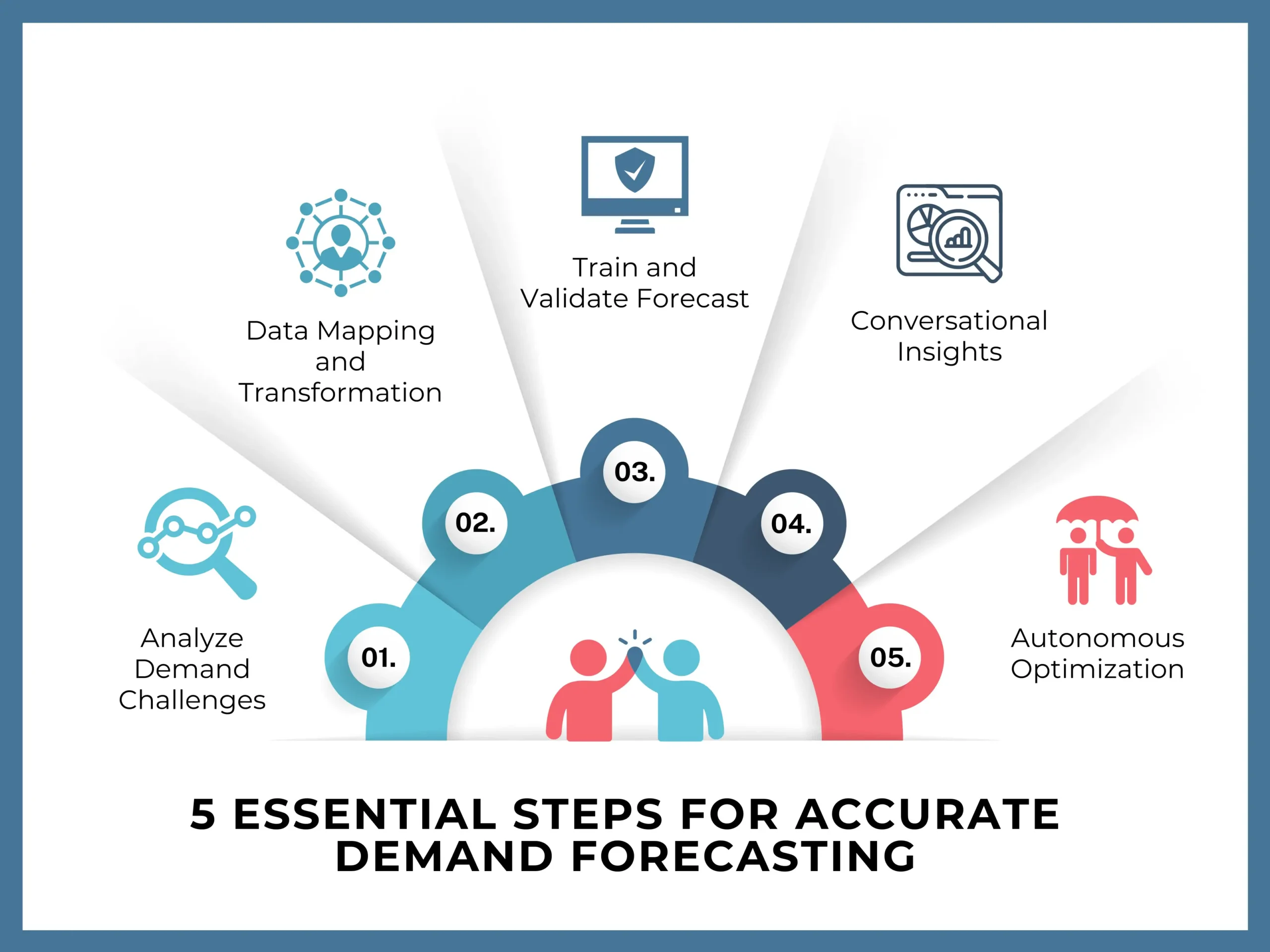
As businesses scale and demand patterns become more complex, manual spreadsheets, static models, and disconnected data sources slow decision-making and erode forecast reliability. Demand forecasting software addresses these challenges — automating data processing, applying multiple forecasting models, and continuously learning from new inputs.
Modern demand forecasting software doesn’t just improve accuracy. It connects the forecast to execution. Instead of relying on periodic planning cycles, organizations get a continuously updated view of demand changes. In an agentic supply chain, those changes trigger decisions and actions automatically — no human login required.
Why Traditional Forecasting Methods Fall Short
Not all demand forecasting tools deliver the same value. To support enterprise-grade planning and agentic execution, software must offer capabilities that address both analytical complexity and operational usability.
- Multi-Model Forecasting: The platform should support statistical, machine learning, and deep learning models — applying different approaches based on product behaviour, demand variability, and planning horizon. No single model fits every SKU.
- Automated Model Selection: Automatic evaluation and tuning of forecasting models reduces manual intervention and ensures consistent performance across thousands of products and locations — without requiring a data scientist to manage each one.
- Seamless ERP and System Integration: Direct integration with ERP, WMS, and connected business systems ensures forecasts are grounded in real operational data and execution happens without delays or manual data duplication.
- Scenario Planning and What-If Analysis: The ability to simulate scenarios — promotions, price changes, supply constraints — helps planners evaluate outcomes before committing resources. In an agentic platform, scenario outputs can trigger pre-configured execution paths automatically.
- Natural Language Interaction: Teams should be able to interact with forecast data in plain language — asking questions, exploring anomalies, and running analyses without relying on IT or data science teams. Forecasting should be accessible to the people closest to the business, not just those closest to the data.
How Well Will It Work with Your ERP and Data Systems?
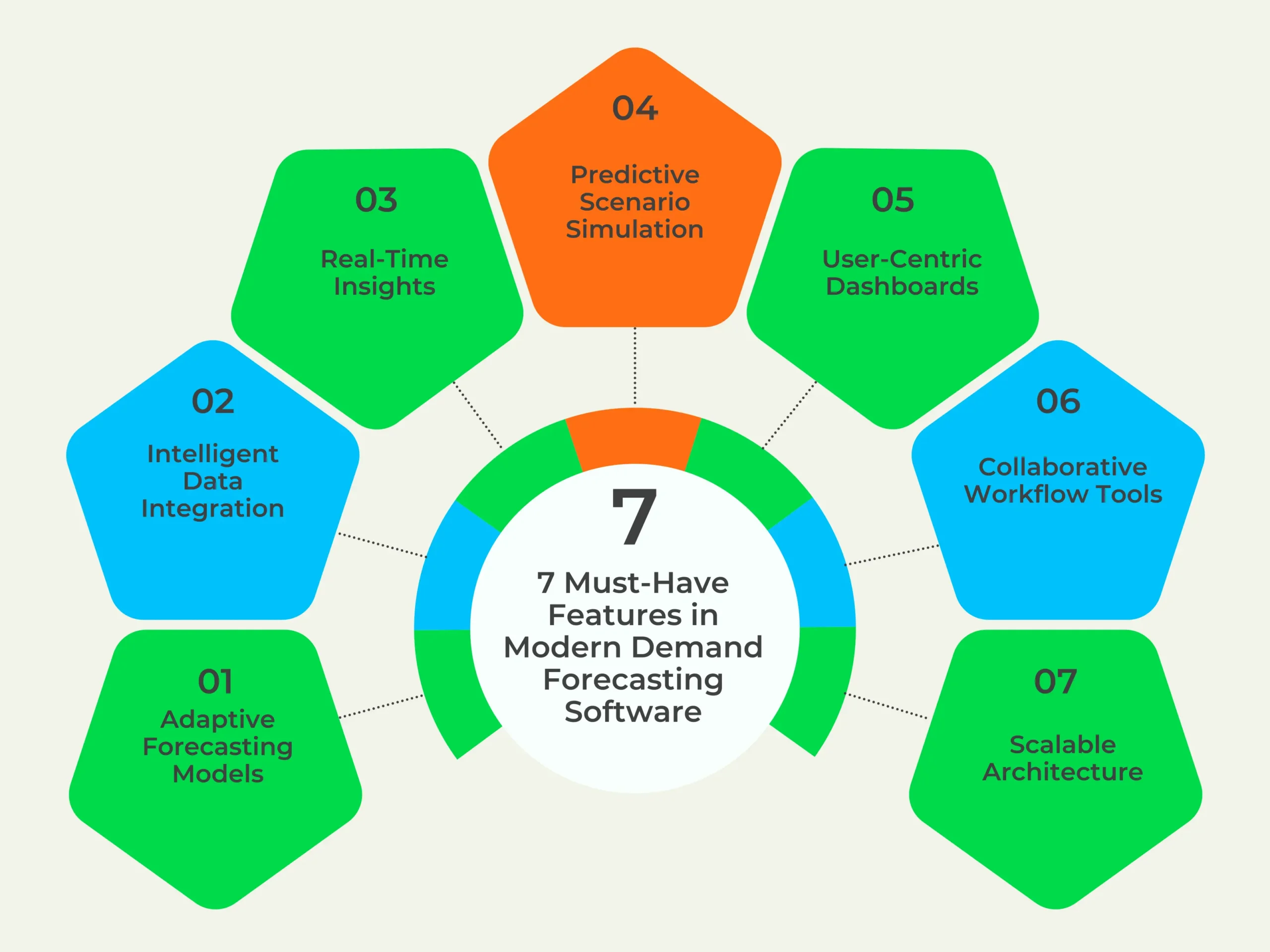
Modern demand forecasting software delivers its full potential when it integrates seamlessly with a business’s existing systems. Forecasting is most effective when it can access accurate, timely, and comprehensive data from across the enterprise — especially from ERP systems that manage inventory, procurement, sales, production, and financial operations.
When properly integrated, demand forecasts connect directly to execution. Forecasts reflect real-time inventory levels, upcoming orders, supplier lead times, and production schedules — and in an agentic supply chain, that connection means decisions are triggered automatically as conditions change. Planning stays aligned with operational reality without requiring manual data pulls, system switching, or periodic reconciliation.
Key Integration Capabilities to Evaluate
To get full value from demand forecasting software, organizations should assess the following integration capabilities before deployment:
Pre-Built ERP Connectors:
Native integrations with leading ERP platforms — SAP, Oracle, Microsoft Dynamics, NetSuite, Acumatica, and Infor — simplify deployment and ensure smooth, reliable data flow between systems from day one.
Custom API Support:
Flexible API connectivity allows integration with specialized, internally developed, or less common business systems — enabling consistent data exchange across diverse technology environments without custom development for every connection.
Automated Data Refresh:
Configurable schedules — real-time, hourly, or daily — ensure the forecasting engine always operates on the latest operational data. When data is current, forecasts are current — and the decisions the agent makes are grounded in what’s actually happening, not what was true at the last export.
Support for Cloud and On-Premise Systems:
Secure integration across both cloud-based and on-premise platforms provides flexibility for hybrid IT environments — ensuring consistent data availability across every business unit, regardless of where systems are hosted.
Data Mapping and Transformation:
Built-in capabilities for standardizing data formats ensure that information from multiple sources is accurately interpreted by the forecasting engine — eliminating the inconsistencies that typically exist when data moves between systems.
Business Areas That Benefit from Demand Forecasting
Demand forecasting is not confined to a single function or industry. Its impact spans multiple business areas — enabling organizations to anticipate market needs, optimize resources, and act before demand creates pressure. When forecasts are accurate and connected to execution, every function that touches the supply chain operates with greater speed, lower cost, and stronger service levels.
Retail and E-Commerce
Retailers and e-commerce businesses operate in highly dynamic markets where customer demand can fluctuate dramatically based on seasons, promotions, or emerging trends. The margin between the right inventory level and a costly overstock or stockout is thin — and the consequences of getting it wrong show up immediately in revenue and customer experience.
- Optimized stock levels: Accurate forecasts ensure warehouses and fulfillment centers maintain the right quantities across SKUs — reducing overstocks that tie up capital and stockouts that lose sales
- Demand spike anticipation: Surges during seasonal events, promotions, or product launches are planned for in advance — not scrambled for after they hit
- Consistent product availability: Popular products stay available across channels, reducing lost sales and protecting long-term customer relationships
Manufacturing and Production
Manufacturers must align production schedules with market demand to avoid overproduction or underutilization of resources. When forecasts are accurate and connected to production planning systems, factories operate efficiently and delivery commitments are met without last-minute adjustments.
- Aligned production schedules: Forecasts guide factory planning and workforce allocation to match expected demand — before capacity constraints create delays
- Optimized resource utilization: Capacity management and raw material procurement stay in step with actual demand rather than lagging behind it
- Bottleneck prevention: Shifts in order volume and lead times are identified early — reducing delays before they cascade across the production floor
Consumer Packaged Goods (CPG) and FMCG
In CPG and FMCG sectors, products move quickly and consumer preferences evolve constantly. Accurate demand forecasting allows these businesses to anticipate demand shifts, optimize distribution, and prevent stock shortages before they reach the shelf.
- Fast-moving inventory management: Forecasts keep pace with rapid consumption cycles and high product turnover — ensuring replenishment happens before gaps appear
- Promotion and pricing impact analysis: The demand impact of campaigns, discounts, or packaging changes is modeled in advance — not discovered after the fact
- Distributor and retail allocation: Consistent shelf availability is maintained across distribution channels, protecting both revenue and brand presence
Logistics and Supply Chain Management
Logistics operations require precise planning to balance efficiency with service quality. Demand forecasting gives logistics teams the foresight to allocate resources and plan capacity before demand creates strain — rather than reacting to volume after it arrives.
- Capacity planning: Shipment volumes, warehouse utilization, and fleet requirements are anticipated and planned — not scrambled for at peak periods
- Cost efficiency: Logistics resources align with actual demand — minimizing unnecessary transportation spend and storage costs
- Proactive disruption management: Potential delays and bottlenecks are identified before they affect delivery schedules — giving teams time to act rather than react
Pharmaceuticals and Healthcare
In pharmaceutical and healthcare operations, demand forecasting carries consequences beyond operational efficiency. Accurate forecasting ensures essential medicines and medical equipment are available when and where they are needed — with no margin for error.
- Medicine and equipment availability: Demand for critical drugs, medical supplies, and equipment is anticipated accurately — preventing shortages that directly affect patient care
- Regulated production planning: Manufacturing stays aligned with regulatory constraints, shelf life requirements, and seasonal demand shifts — without last-minute adjustments that create compliance risk
- Supply continuity for patient outcomes: Essential healthcare products reach the right locations at the right time — supporting consistent care delivery across every point in the supply chain
Choosing a Demand Forecasting Solution That Grows With Your Business
Selecting a demand forecasting solution is a strategic decision, not just a software purchase. The right platform scales with your business, integrates with existing systems, and adapts to evolving needs — without re-implementation every time complexity increases. It meets you at your current level of AI maturity and grows as your organization is ready.
ConverSight’s AI Employee: Closing the Loop on Demand Forecasting
Athena is ConverSight’s AI employee that operates across your supply chain continuously. She doesn’t just surface forecasts. She acts on them — adjusting inventory, triggering reorders, updating production schedules, and notifying the right people — within the guardrails your team has defined.
AI Demand Sensing: When a signal crosses a defined threshold, Athena acts on it before the shift becomes a problem.
Multi-Model Forecasting: Athena selects and weights forecasting algorithms by product, location, and demand pattern — applying the method most suited to each SKU automatically.
Execution Connected to Your Systems: Athena integrates directly with ERP, CRM, WMS, IMS, and MRP platforms. Forecasts don’t sit in a report. They trigger actions within configured approval limits.
One Platform, Every Stage of the Loop: Every function — procurement, production, sales, finance — works from the same real-time demand signal. The forecast, the decision, and the action happen in the same loop.
Demand Forecasting as a Foundation for the Closed Loop
Demand forecasting provides the structure organizations need to plan and act with precision across inventory, production, and supply chain operations. When forecasts are accurate and connected to execution, businesses respond to demand changes before they create operational pressure — and maintain consistency across every function that touches the supply chain.
The organizations pulling ahead today have closed the gap between what the forecast says and what the supply chain does. Every demand signal flows into a decision. That decision triggers action. The outcome sharpens the next forecast. That is the closed loop — and it is what separates supply chains that react from supply chains that lead.
ConverSight brings that loop to life. Decision models that select the right forecasting approach for every SKU and demand pattern. Athena that acts on those forecasts — triggering reorders, adjusting inventory, updating production schedules — continuously, within the guardrails your team has defined. And a learning loop that makes every forecast more accurate than the last.
From data to decision to done.
Ready to close the loop on demand forecasting? Book a demo →