Boost Accuracy and Agility with the Best Demand Forecasting Strategies
Why Demand Forecasting Is the Game-Changer
Demand forecasting has shifted from a back-office function to a strategic advantage. In a market where demand swings overnight and customer expectations keep rising, accurate forecasting determines whether a business stays efficient, profitable, and competitive. Relying on static spreadsheets or a single forecasting method often leads to the usual problems: overbuying, stockouts, excess inventory, and missed opportunities. That’s why more organizations are adopting a Model Portfolio Approach—using different models for different SKU behaviours. Fast movers, seasonal items, slow-moving products, and intermittent-demand parts each require their own forecasting strategy. This diversification boosts accuracy, agility, and planning speed.
When done right, forecasting reduces carrying costs, prevents service-level failures, supports production planning, and accelerates decision-making. It doesn’t just predict the future—it helps businesses prepare for it, operate proactively, and scale with confidence. In this blog, we’ll break down the fundamentals of demand forecasting models, explore when to use each one, and show how ConverSight makes the entire process smarter, faster, and easier to scale — from data to decision to done.

Forecasting Demystified: What Demand Forecasting Models Really Do
At their core, demand forecasting models are tools designed to answer one of the most important questions in business: “How much should we produce, purchase, or stock for the future?” These models use historical data, statistical patterns, machine learning, or AI algorithms to estimate upcoming demand with as much accuracy as possible. While the techniques vary—from simple moving averages to advanced deep learning—their purpose remains the same: translate past behavior into a forecast the business can plan around.
Modern forecasting models bring structure, intelligence, and repeatability to this critical process. They analyze patterns that humans often miss: long-term trends, seasonal curves, price-driven fluctuations, promotions, demand spikes, and even subtle signals hidden deep in time-series data. Some models learn continuously as fresh data arrives. Others compare multiple patterns at once or adjust forecasting weights automatically. This analytical power allows teams to make proactive decisions instead of reacting to surprises.
This is where the Model Portfolio Approach comes into play. Just as no two products behave the same way, no single forecasting model works best for every SKU. Consider a simple example:
- Fast movers with steady daily sales often perform well with methods like moving averages or exponential smoothing.
- Slow-moving or intermittent items—common in B2B or industrial distribution—need specialized models like Croston’s that can handle sporadic demand.
- Seasonal SKUs, such as beverages, apparel, or holiday products, benefit from models like Holt-Winters that capture recurring demand patterns.
By applying different models to different product behaviors, businesses dramatically improve forecasting accuracy and resilience. Instead of forcing a single method to fit every scenario, a model portfolio adapts dynamically giving leaders clarity, control, and confidence in every demand cycle.
The 7 Go-To Demand Forecasting Models Every Business Needs
There is no one-size-fits-all solution in demand forecasting. Every product behaves differently—some move fast, some sell sporadically, and some spike only during specific seasons. That’s why the most successful organizations rely on a diversified “Model Portfolio” instead of depending on a single forecasting technique. Below are the seven essential models businesses use today, each suited to unique patterns and operating environments.
Naive & Baseline Models: Start Simple, Think Big
The most fundamental forecasting method assumes “tomorrow will look like today.” Naive models simply project the last observed value into the future. While they may sound overly simplistic, they serve as important baseline benchmarks.
These models work best for stable, low-variability SKUs—products where demand rarely fluctuates. Because they require almost no computation, they are fast, transparent, and easy to implement. Many organizations use them as a reference point when evaluating more advanced models.
However, their simplicity is also their weakness. In environments with volatile demand, promotions, or seasonality, naive forecasts can quickly become inaccurate, leading to suboptimal supply chain decisions.
Weighted Moving Average (WMA): Smarter Short-Term Predictions
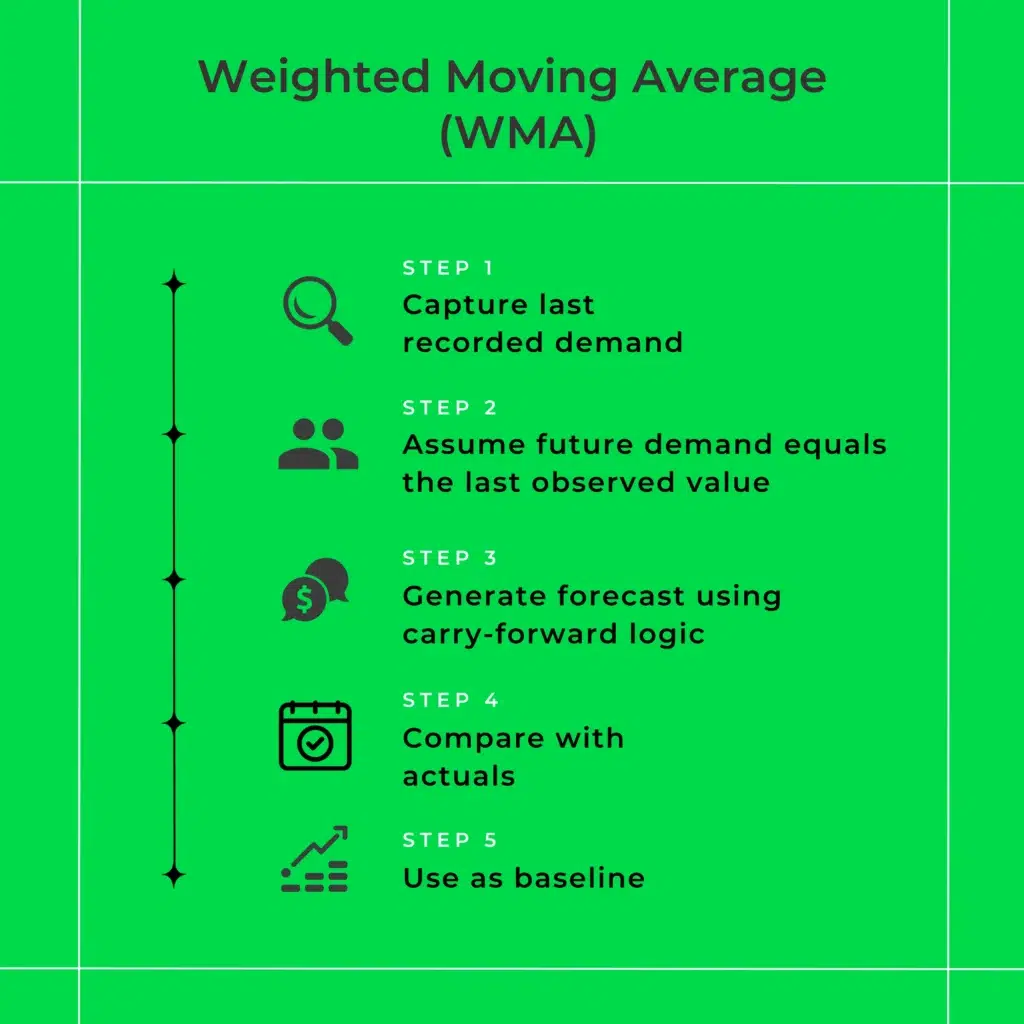
WMA improves on simple averages by giving more importance to recent data. This makes it ideal for short-term operational planning, where the most recent demand patterns matter more than older ones.
For example, if a product has experienced a recent upward trend, WMA responds faster than a simple moving average, reducing lag and improving responsiveness. This makes it a preferred model for retail, consumer goods, and fast-turn inventory items.
WMA is straightforward to understand, but it still does not incorporate deeper trends, seasonality, or external factors. It’s ideal for simple, short-range forecasts—but limited for long-term strategy.
Holt-Winters Triple Exponential Smoothing: Catch Trends Before They Hit
Holt-Winters is a powerhouse for SKUs that show trend + seasonality. It analyzes three key components:
- Level (baseline demand)
- Trend (direction of growth/decline)
- Seasonality (recurring demand patterns)
This model excels for businesses with predictable seasonal cycles—beverages, apparel, furniture, and holiday-driven items. Its ability to adjust continuously makes it a favorite for both short-term and long-term planning. It’s particularly useful for companies managing hundreds or thousands of SKUs with moderate complexity, where automated seasonal adjustment is a must.

Croston’s Method: Tame the Irregular Demand Beast
Not all products sell regularly. Some items—especially in industrial distribution, automotive parts, HVAC components, or machinery—have highly intermittent demand.
Traditional models fail here because they assume consistent patterns. Croston’s Method solves this by separately forecasting:
- The size of demand
- The interval between demand occurrences
This makes it a perfect model for slow-moving SKUs, spare parts, and service-based industries where demand events are sporadic but critical. If your catalog contains long-tail items, Croston’s Method often delivers significant accuracy improvements.
Causal Impact Models: Forecast with Context
Demand doesn’t move in isolation. Prices change, competitors launch new products, weather fluctuates, promotions run, and marketing campaigns influence buying behavior.
Causal models incorporate these external drivers to improve accuracy. Instead of treating demand as a standalone data series, they use additional inputs such as:
- Promotions
- Pricing changes
- Advertising spend
- Economic indicators
- Weather patterns
- Competitor activity
These models make scenario planning possible — letting companies simulate the impact of running a promotion, changing price strategy, or adding a new retail location.
Ensemble Forecasting: Strength in Numbers
Ensemble forecasting combines multiple models and blends their predictions into a single, more reliable output. Think of it as a forecasting “committee” where each model votes.
This hybrid approach reduces the risk of error because:
- One model may capture seasonality better
- Another may respond better to trends
- A third may handle short-term fluctuations
By merging these strengths, ensemble forecasts consistently outperform individual models, especially for complex, high-variability SKUs. It’s commonly used in sectors like retail, CPG, and e-commerce, where demand patterns shift quickly and unpredictably.
Deep Learning (LSTM/GRU): Future-Proof Your Forecasting
Deep learning models, particularly LSTM (Long Short-Term Memory) and GRU (Gated Recurrent Unit) networks, are the most advanced forecasting tools available today. They are designed to learn long-term dependencies and detect intricate patterns in large datasets.
These models are ideal for:
- High-variability products
- Multi-step forecasting
- Multi-channel retail
- Markets influenced by many external factors
- Organizations with rich, high-volume historical data
Deep learning can capture nonlinear relationships and hidden demand signals that traditional statistical models cannot, making them highly valuable in dynamic industries like fashion, electronics, automotive, and e-commerce.
Pick the Right Model: How to Match Model to Product
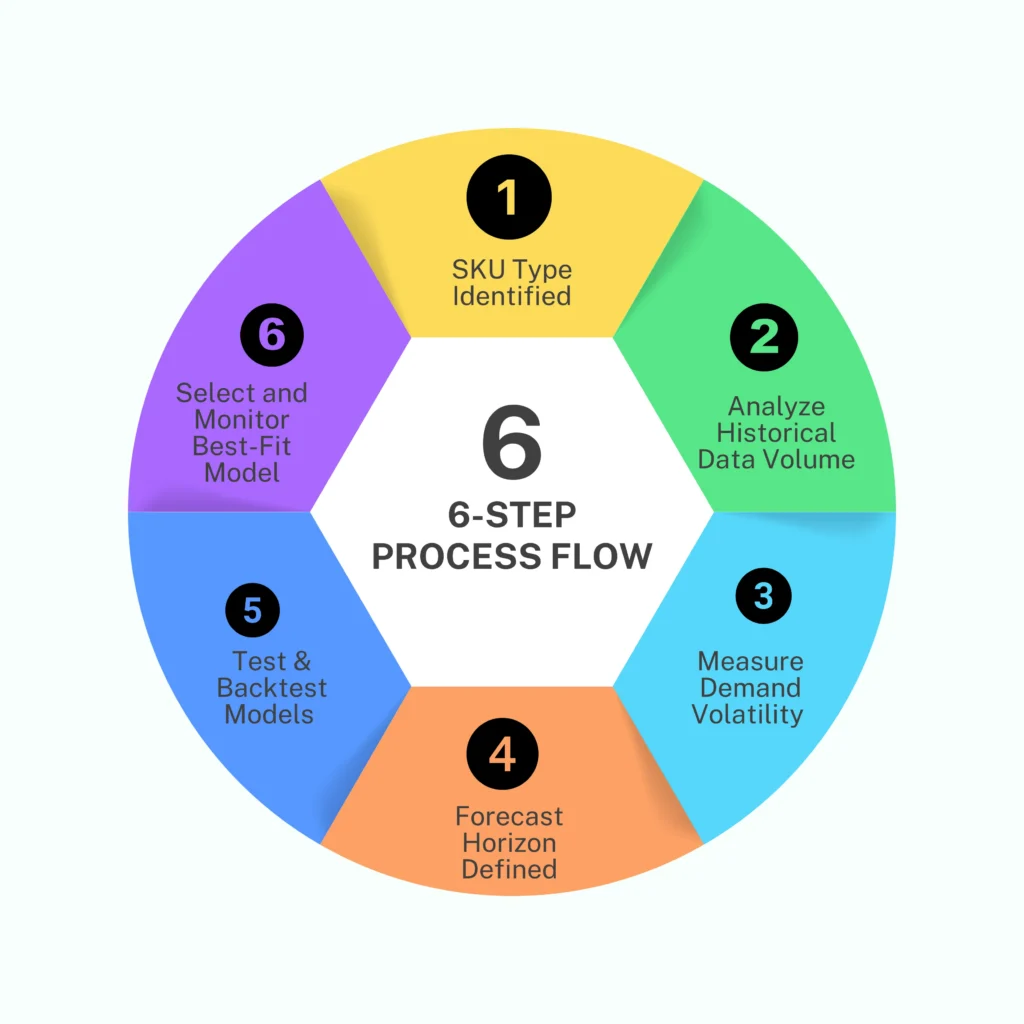
Every SKU behaves differently depending on how often it sells, how volatile demand is, and how much historical data exists. Treating all products the same is one of the fastest ways to reduce forecast accuracy. To solve this, leading organizations use a Model Selection Matrix. This framework helps teams map forecasting models to product behavior using four key dimensions:
Key Factors in the Model Selection Matrix
- SKU Type: Fast movers, slow movers, seasonal items, and long-tail spare parts each show distinct demand patterns that require different modeling approaches.
- Data Size & Quality: SKUs with long, clean historical records can support advanced models, while limited or sparse data performs better with simpler statistical methods.
- Demand Volatility: Stable products benefit from smoothing models, while highly volatile or promotion-driven items need adaptive or ensemble approaches.
- Forecasting Horizon: Short-term operational forecasts differ from long-term strategic planning, often requiring different models altogether.
Forecasting Is an Ongoing Process
Model selection is not a one-time decision. Markets change, customer behavior evolves, and product lifecycles shift. That’s why experimentation, backtesting, and continuous monitoring are critical.
High-performing teams regularly:
- Compare model performance using historical data
- Switch models when accuracy declines
- Retrain models as new data arrives
By aligning the right model to the right product—and revisiting that choice continuously—businesses can dramatically improve forecast accuracy, inventory efficiency, and decision-making speed.
Avoid the Pitfalls: 5 Common Forecasting Mistakes
Even the best forecasting models can fail if the foundations are weak. Many businesses struggle not because they lack sophisticated tools, but because they fall into predictable traps that quietly erode accuracy. Avoiding these pitfalls is just as important as choosing the right model.
1. Single-Model Overreliance
One of the biggest mistakes companies make is depending on one forecasting method for all SKUs. Demand patterns vary widely—what works for a stable product will fail miserably for a volatile or seasonal one. Relying on a single model also causes blind spots when market conditions shift. The smarter approach is a model portfolio, where each SKU is matched with the method that suits it best.
2. Ignoring External Factors
Internal data alone rarely tells the full story. Promotions, economic changes, weather shifts, competitor pricing, supply chain delays, and even social media trends influence demand. Models that don’t include these inputs often produce unrealistic forecasts. Causal models or AI approaches help bring real-world context into demand planning.
3. Not Segmenting SKUs by Demand Patterns
Treating all items the same leads to inaccurate planning. High-volume products, intermittent spare parts, and seasonal goods each behave differently. Without segmentation—ABC classification, demand volatility grouping, or lifecycle mapping—businesses risk misallocating inventory or producing irrelevant forecast outputs.
4. Skipping Backtesting
Backtesting is the reality check of forecasting. It reveals whether a model would have predicted past demand accurately. Without it, businesses rely on assumptions instead of evidence. Effective forecasting teams backtest regularly, compare models, and choose the one with the lowest error.
5. Overlooking Continuous Model Monitoring
Demand forecasting is not a “set it and forget it” activity. Customer behavior evolves, promotions change, and supply chains shift. Even the strongest model degrades over time. Continuous monitoring ensures the system recalibrates—or switches models—whenever performance dips.
Avoid these pitfalls, and forecasting transforms from a gamble into a controlled discipline — one that drives smarter inventory, capacity, and financial decisions every day.
ConverSight in Action: Smarter Demand Forecasting Without the Guesswork
Most companies know what forecasting models are—but very few have the time, resources, or data science expertise to operationalize them consistently across thousands of SKUs. That’s where ConverSight truly stands apart. Instead of manually testing models, cleaning datasets, or stitching together reports across systems, ConverSight brings an intelligent, automated forecasting engine built for real-world complexity.
- Model Fit Engine: Every product behaves differently—some are steady performers, some spike during promotions, and others move unpredictably. ConverSight’s Model Fit Engine evaluates multiple model options (Holt-Winters, Croston’s, ensembles, causal models, LSTM, and more) and automatically selects the most accurate one for each SKU. No manual testing, no analysts running spreadsheets—just the right model, every time.
- Automated Data Readiness: One of the biggest hurdles in forecasting is poor data quality. ConverSight eliminates this barrier with automated data preparation. It cleans missing values, handles outliers, standardizes date formats, normalizes historical datasets, and ensures forecasting input is always in top condition. This foundation alone improves forecast accuracy significantly.
- Scenario Modeling with Athena: Whether you’re adjusting pricing, planning promotions, or preparing for supply disruptions, Athena allows teams to simulate outcomes instantly. “What if demand drops 20%?”, “What if supplier lead times increase by five days?” These answers arrive in seconds—not hours—letting teams stress-test decisions before acting.
- Continuous Learning: Demand patterns shift as markets evolve. ConverSight’s forecasting engine retrains models continuously as new data flows in—ERP transactions, POS updates, supplier data, seasonality trends, and more. This ensures forecasts are always aligned to current demand realities, not last quarter’s assumptions.
- Unified Multi-System View: Forecasting accuracy skyrockets when systems work together. ConverSight connects to ERPs, warehouse systems, e-commerce platforms, supplier portals, and POS data to deliver a 360° view of inventory, demand, and movement trends. No more siloed spreadsheets or disconnected reports—just clean, real-time visibility.
Ready to take your demand forecasting to the next level? Explore ConverSight’s solutions – Click Here.
ConverSight Success Stories in Demand Forecasting
Midway Corp – Inventory Optimization & Forecast Accuracy
Midway Corp faced persistent operational challenges—chronic overbuying, slow-moving inventory piling up in the warehouse, and manual reporting processes inside Acumatica that were too slow to support real-time decisions. Their teams struggled to identify which SKUs were truly needed and which were quietly draining working capital.
After deploying ConverSight, the transformation was immediate and measurable:
- Forecast accuracy climbed significantly, giving planners confidence in replenishment and production decisions.
- Purchase recommendations aligned buying patterns directly with true demand signals, eliminating guesswork.
- Scenario modeling uncovered nearly $1.2M in hidden dead stock, allowing leadership to proactively course-correct.
- Real-time storyboards and automated insights replaced multi-day spreadsheet reporting cycles, enabling faster, evidence-backed responses.
Outcome: Midway gained tighter control over inventory, eliminated excess stock, and achieved clear visibility into problematic SKUs—leading to better decisions and stronger cash flow.
Cascadia Motion – 80% Faster Reporting with Forecasting
Cascadia Motion relied heavily on Excel-based forecasting that made it difficult to track demand shifts, supplier constraints, or inventory risks across their fast-moving operations. The lack of automation slowed down planning cycles and limited the accuracy of their supplier and production outlook.
With ConverSight, they rebuilt their forecasting process from the ground up:
- Automated forecasting replaced manual spreadsheet calculations, improving accuracy and freeing up hours each week.
- Supplier performance insights made it easy to identify delays, risks, and inconsistencies across their network.
- Interactive storyboards allowed teams to spot issues in seconds instead of hours.
- Aligned supply–demand signals ensured the right materials were available at the right time.
Outcome: Cascadia achieved an 80% reduction in reporting time, improved visibility across suppliers and demand patterns, and built a scalable forecasting framework that supports ongoing growth.
Read more about real-world success with ConverSight — Case Studies.
Looking Ahead: The Future of Demand Forecasting
Demand forecasting is moving toward a model portfolio mindset—no single technique wins across every product, every season, or every shift in market behavior. The future belongs to businesses that blend statistical, causal, and AI-based models and adapt them dynamically.
ConverSight makes this evolution practical. Instead of manually testing models, teams get automated model selection, data prep, and real-time scenario testing—all without the complexity. Agility, accuracy, and continuous learning are becoming the new competitive advantage, especially as demand patterns grow more unpredictable.
See ConverSight in action — request a demo today and experience smarter demand forecasting firsthand.