Get a complete understanding of the key differences between conversational AI and AI Employee, and what to choose for your business.
The Evolution Is Here
Artificial intelligence has been quietly reshaping the way businesses operate for years. Many companies started small — installing chatbots on their websites, giving voice assistants a place in the office, or using simple automation to answer routine queries. These tools fall under the umbrella of conversational AI – systems designed to understand and respond to human language.
But something is changing. We’re now seeing a new type of digital worker emerge: the AI Employee. These aren’t just talking assistants; they’re doers. They connect to your systems, make decisions, and carry out complex tasks from start to finish.
If conversational AI is like a receptionist greeting you at the door, an AI Employee is the operations manager who takes the request, finds the solution, and delivers results — all without handing it off to someone else. Understanding the difference between the two isn’t just an exercise in tech jargon; it’s a business decision that can determine how efficiently you run today and how ready you are for tomorrow.
What is Conversational AI?
Conversational AI refers to technology that uses natural language processing to understand and respond to human input. You see it in:
- Customer service chatbots answering questions like “How do I reset my password?”
- Voice assistants scheduling your next meeting or setting reminders
- Help desk bots walking users through troubleshooting
These tools excel at interaction. They make systems accessible without requiring the user to dig through menus or manuals. But they’re limited: they don’t make decisions, and they rarely act beyond retrieving information or triggering a simple predefined command.
Think of conversational AI as an intelligent guide. It can tell you where to go, but it won’t drive you there.
What’s an AI Employee?
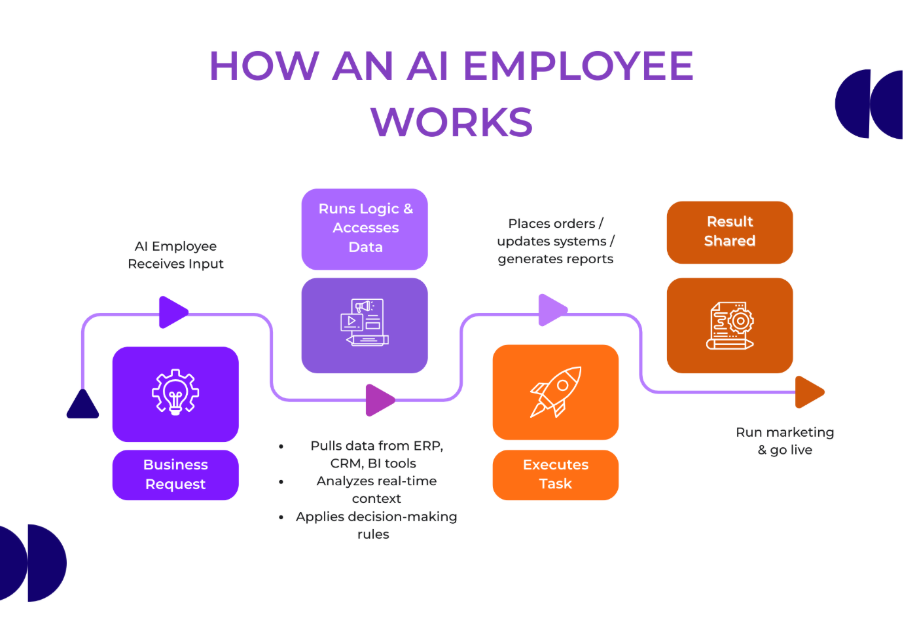
An AI Employee is a digital worker designed not just to converse, but to act. These systems plug into your existing tech stack – ERP, CRM, BI tools, and more – to carry out multi-step processes end to end.
Instead of simply telling you that inventory is low, an AI Employee will forecast demand, place a replenishment order, and adjust delivery schedules. Instead of summarizing last quarter’s sales data, it will analyze performance trends and recommend targeted actions to improve lagging product categories.
They’re proactive, self-sufficient, and built to handle the kinds of repetitive, rules-based tasks that often slow human teams down.
Real-World Impact
Picture an AI Employee in inventory management predicting low stock levels based on forecast trends and automatically placing replenishment orders. In finance, it could compile and reconcile monthly reports while flagging unusual transactions. In sales, it might detect underperforming SKUs and recommend promotions, bundling strategies, or price adjustments.
Why It Matters
AI Employees don’t just respond — they act, think, and learn over time. They scale effortlessly without the costs of hiring, training, or office space, and they work 24/7 to deliver measurable results across the organization. By integrating decision-making with execution, they bridge the gap between strategy and action, helping businesses operate with greater speed, accuracy, and efficiency.
Key Differences at a Glance
At first glance, conversational AI and AI Employees may seem like variations of the same idea. After all, both understand natural language, and both can connect to data sources. The real difference lies in capability and autonomy.
- Conversational AI delivers answers.
- AI Employees deliver outcomes.
Conversational AI vs AI Employee

That difference is critical when your business goals go beyond improving customer experience to automating business functions. Conversational AI is great for scaling communication. AI Employees scale execution.
Why Conversational AI Isn’t Enough Anymore
Conversational AI has been a game-changer for many organizations, making it easier for employees and customers to get quick answers. A chatbot that can look up order statuses or a voice assistant that schedules a meeting has its place. But as businesses demand more speed, precision, and autonomy in their operations, these tools reveal their biggest limitation — they stop short of action.
Today’s enterprises don’t just need someone to tell them what’s happening; they need systems that can decide what to do next and then actually do it. That means:
- Data-driven decisions, not just data access – Instead of surfacing a sales report, businesses need AI to recommend the exact actions to improve next month’s numbers.
- Workflow automation, not just query handling – Instead of telling you a shipment is delayed, AI should automatically reroute orders or trigger backup suppliers.
- Fewer hand-offs between humans and systems – Every manual step adds delays; the future belongs to AI that moves work forward without waiting for human intervention.
In short, conversational AI is great at starting a conversation — but modern businesses need AI that can finish the job.
The Rise of AI Employees in the Enterprise
The demand for speed, accuracy, and proactive problem-solving is fueling the adoption of AI Employees across industries. These digital teammates are becoming core drivers of efficiency and growth because they combine the communication skills of conversational AI with the execution power of automation and decision intelligence.
Finance – An AI Employee can monitor cash flows in real time, flag unusual spending patterns, and even suggest budget reallocations before small issues become costly mistakes.
Supply Chain – Instead of simply alerting managers when inventory is low, it calculates lead times, forecasts demand, and automatically triggers reorders to avoid stockouts.
Sales – By analyzing pipeline activity, it can identify which deals are at risk, notify the right sales reps, and even recommend tailored outreach strategies to re-engage prospects.
Customer Voice: Athena has significantly improved our demand forecasting accuracy. We previously struggled with predicting seasonal spikes, but Athena’s advanced modeling and adaptive learning have helped us refine our approach. By continuously analyzing SKU-level data, we can now make better decisions and optimize our supply chain planning. The ability to freeze forecasts for key periods and validate predictions with actual sales data has given us greater confidence in our planning. The improvements we’ve seen in forecast accuracy are game-changing for our operations.
Ruby Gangwar, Senior Planning Manager, House of Spices.
Where ConverSight Fits In
At ConverSight, we go beyond building chatbots. We design AI Employees that think, act, and collaborate like human teammates — without the limits of human capacity.
Meet Athena, our AI-powered decision intelligence assistant. Athena is more than a conversational interface; she’s a strategic partner that:
- Connects seamlessly with your ERP, CRM, and BI tools to access the data that drives your business.
- Automates end-to-end processes like forecasting, reporting, and procurement, so you can move from decision to action instantly.
- Learns from your organization’s behavior, continuously optimizing workflows and recommendations over time.
The result? Faster decisions, fewer errors, and teams empowered to focus on high-value strategic work.
Not Either-Or: They Work Best Together
It’s not about choosing between conversational AI and AI Employees — it’s about recognizing their complementary roles.
- Conversational AI acts as the front-end, engaging users, understanding requests, and making the interaction seamless.
- AI Employees serve as the execution engine, running the logic, pulling the data, and completing the work.
With ConverSight, you can “Chat with Athena” to initiate a task, and Athena — as your AI Employee — will execute it, monitor progress, and return results with insights on next steps. It’s a unified experience where conversation meets completion.
Download the Athena Whitepaper
Which One Does Your Business Need Right Now?
The right choice depends on where your organization is in its AI maturity journey.
If your primary goal is to improve user experience — making it easier for employees or customers to get information — start with conversational AI.
If your aim is to automate business functions and reduce manual intervention, it’s time to invest in AI Employees.
For many, the smartest move is a hybrid approach: begin with conversational AI as the entry point, then layer in AI Employees for execution. This allows you to scale capabilities gradually, while capturing ROI at every stage.
Conclusion: From Talk to Action
The shift from conversational AI to AI Employees marks a turning point for enterprises. It’s the difference between having a helpful assistant who tells you the weather, and having a capable partner who books your flights, checks you into your hotel, and arranges your meeting schedule — all without you asking twice.
Businesses that embrace AI Employees early gain an operational advantage: faster decision-making, reduced costs, and a workforce that never sleeps.
Ready to turn your AI from a passive listener into a proactive team member?
Start with ConverSight — and let Athena take your business from talk to action.