Turn AI insights into actionable growth and innovation.
Why AI in Automotive is Essential for Enterprise Success
The automotive industry is experiencing a major transformation driven by evolving customer expectations, rising costs, and complex global operations. Artificial Intelligence (AI) has become essential for enterprises to make predictive, data-driven decisions and streamline operations across design, manufacturing, logistics, and aftersales.
AI enables real-time, predictive operations that allow companies to respond swiftly to disruptions, optimize production, and enhance overall efficiency. Organizations that delay AI adoption risk slower decision-making, higher operational costs, and a loss of competitive advantage, while AI-powered enterprises gain agility, accuracy, and measurable business impact.
Learn how ConverSight enhances automotive decision-making → Automotive Solution Page
AI Agents and Assistants
AI agents and AI assistants are redefining the way automotive enterprises operate and make decisions. These intelligent systems are the new workforce—an ecosystem of digital collaborators that enhance efficiency and accelerate time-to-decision.
AI Agents are autonomous systems designed to perform specific tasks, make decisions, and act on real-time data. They can monitor production parameters, initiate actions such as reordering inventory, or adjust logistics schedules based on live inputs—all with minimal human intervention.
AI Assistants, on the other hand, are designed to augment human intelligence. They provide insights, recommendations, and guided actions that help decision-makers evaluate complex scenarios with greater confidence.
Key Differences Between AI Agents and Assistants:
- Autonomy: Agents operate autonomously; Assistants require human input or validation.
- Execution: Agents execute tasks directly, while Assistants suggest actions.
- Intervention: Agents minimize manual involvement; Assistants depend on collaboration.
Automotive Examples:
- Inventory Auto-Replenishment (AI Agent): Automatically orders parts based on consumption and predictive demand patterns.
- Production Schedule Recommendations (AI Assistant): Provides planners with optimized production timelines based on supply and capacity insights.
Together, AI agents and assistants create a cohesive intelligence network that amplifies human expertise and operational agility.
Intelligent Operations with AI Agents and Assistants
AI agents and assistants form the foundation of intelligent operations in the automotive industry, combining automation, real-time analytics, and decision intelligence to create adaptive, self-optimizing ecosystems. From manufacturing to supply management, AI agents monitor production capacity, material availability, and shipment progress, acting instantly on deviations. AI assistants contextualize this data for decision-makers, presenting insights in an intuitive format to guide strategic choices.
For example, when sensor data signals an equipment anomaly, an AI agent can schedule maintenance automatically while an AI assistant informs managers of potential output impacts. Similarly, if demand forecasts shift, the system recommends revised production schedules, updates material requirements, and notifies suppliers—all with minimal manual intervention.
Key Benefits for Automotive Leaders:
- Faster decision cycles with proactive insights and alerts
- Optimized inventory and demand synchronization
- Reduced stockouts and production delays through predictive actions
- Improved coordination across departments and supplier networks
Real-World Examples:
- Predictive Maintenance Scheduling to reduce downtime and extend asset life
- AI Demand Forecasting for precise production and procurement alignment
- Automated Assembly Adjustments based on live performance metrics
- Real-Time Inventory Monitoring ensuring continuous production flow
By integrating AI agents and assistants, automotive enterprises create a dynamic operating model—one where every decision is informed by data, every process is responsive, and every outcome is optimized in real time.
Explore how ConverSight’s AI Agent transforms automotive supply chains → Agentic AI for Supply Chain Webinar
Automotive Analytics: Driving Data-Backed Decisions
Modern automotive operations generate vast amounts of data every day—from production lines, suppliers, logistics networks, to connected vehicles on the road. While this data is abundant, executives cannot rely on raw numbers alone. What they need are actionable insights that enable faster, more confident decision-making across production, supply chain, and service operations.
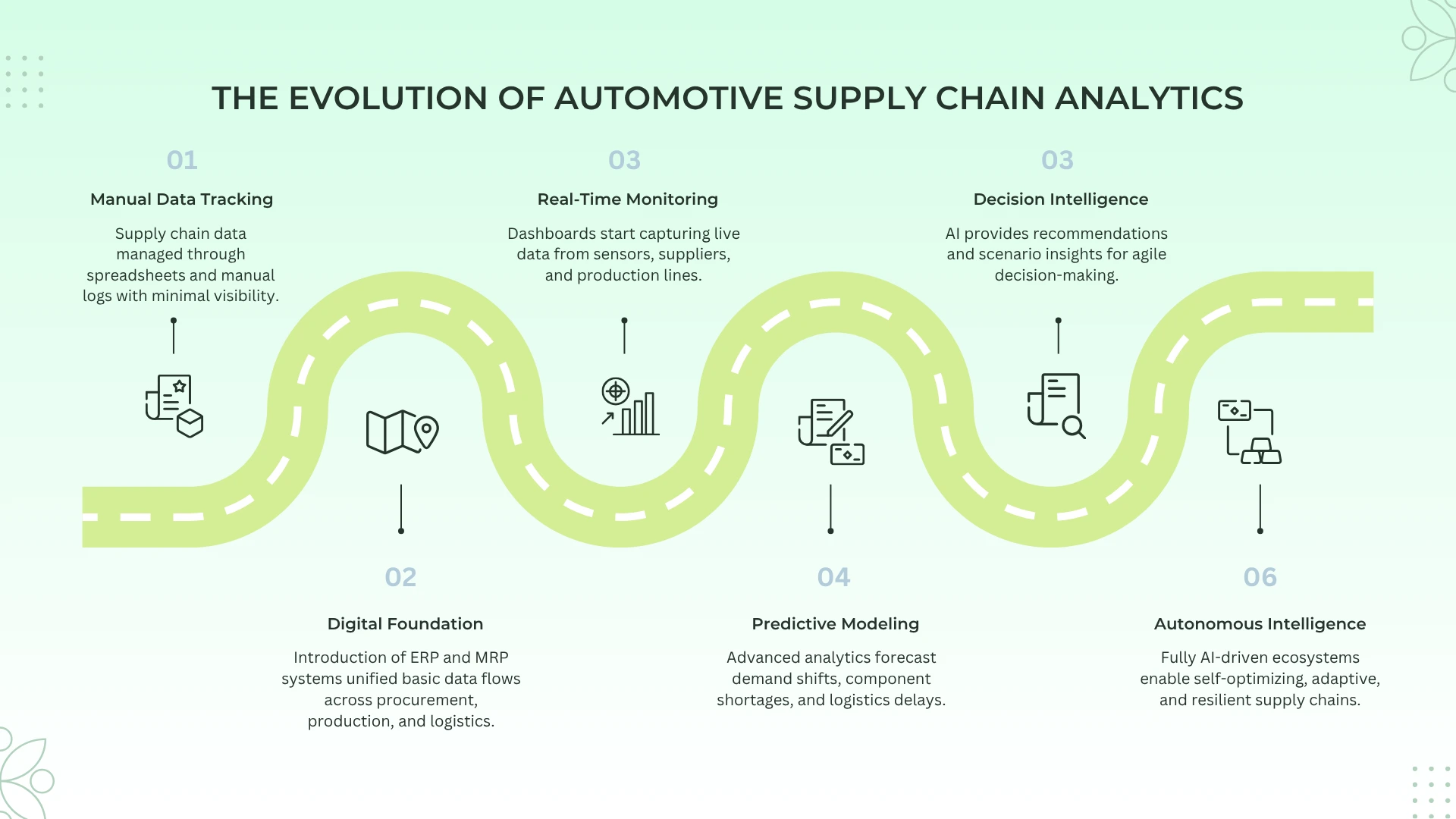
AI plays a critical role in transforming this data into intelligence, offering visibility across the entire automotive ecosystem. By interpreting data in real time, AI helps leaders anticipate disruptions, optimize operations, and align production with market demand. The evolution of analytics in automotive decision-making can be seen across four key layers:
Descriptive Analytics
Descriptive analytics focuses on understanding historical performance. It aggregates data from production, supplier performance, delivery timelines, and inventory levels to provide executives with a clear picture of past operations. For example, descriptive analytics can highlight which production lines frequently experience delays or which suppliers consistently deliver late.
Outcome: Provides a foundation for informed decisions, helping leaders identify patterns, inefficiencies, and areas for operational improvement.
Predictive Analytics
Predictive analytics leverages historical and real-time data to anticipate what might happen next. AI models forecast demand fluctuations, potential supply disruptions, and inventory shortages before they occur. For instance, predictive analytics can alert planners to upcoming shortages in critical components, enabling proactive procurement or production adjustments.
Outcome: Reduces stockouts, prevents production delays, and enhances overall supply chain reliability.
Prescriptive Analytics
Prescriptive analytics goes beyond prediction to recommend the best course of action. It evaluates multiple factors—supplier performance, production capacity, and logistics constraints—to suggest actions such as adjusting production schedules, rerouting shipments, or reallocating inventory across facilities.
Outcome: Optimizes operational efficiency, reduces costs, and ensures alignment between production outputs and market demand.
Autonomous Analytics
Autonomous analytics allows AI systems to take action independently based on the insights derived from the other layers. For example, inventory levels can be automatically adjusted, production schedules updated in real time, and logistics rerouted without human intervention.
Outcome: Minimizes manual decision loops, accelerates responsiveness to disruptions, and maintains seamless operational continuity.
By combining these analytics layers, automotive enterprises can turn raw data into strategic advantage, enabling faster, smarter, and more confident decision-making at every level of the organization. AI-driven analytics transforms the supply chain from a reactive function into a predictive and prescriptive system that continuously adapts to market demands.
AI in Automotive Manufacturing
Overview: AI is becoming a critical enabler in automotive manufacturing, connecting production operations with the broader supply chain. By leveraging real-time data from machines, production lines, and suppliers, manufacturers can make proactive, data-driven decisions that enhance operational efficiency. This integration transforms traditional manufacturing into a connected ecosystem where information flows seamlessly, enabling faster responses to market demands and reducing operational risks.
Where AI Applies in Automotive Manufacturing:
- Just-in-Time Production Planning:
Aligns manufacturing schedules with demand forecasts to ensure components are available exactly when needed. This reduces excess inventory, lowers carrying costs, and keeps the supply chain responsive to market fluctuations.
- Predictive Demand Forecasting:
Anticipates the need for parts and components by analyzing historical production data, supplier trends, and market signals. Helps prevent stockouts, avoids overproduction, and ensures smooth production continuity.
- Quality Assurance Integration:
Monitors assembly processes in real time to detect defects early. This minimizes disruptions, reduces waste, and maintains consistent product quality throughout the supply chain.
- Automated Equipment Maintenance:
Predicts potential machinery failures before they occur and schedules maintenance proactively. This minimizes unplanned downtime, maximizes equipment utilization, and ensures continuous production flow.
Automotive AI Companies Driving Innovation
With numerous AI companies shaping the automotive landscape, the top innovators in 2025 stand out for their ability to optimize production, enhance supply chain operations, and enable autonomous mobility. Here’s a breakdown of leading vendors, emphasizing business value and ideal fit:
NVIDIA
Provides enterprise-grade AI platforms for predictive maintenance, production analytics, and real-time supply chain monitoring. Ideal for large manufacturers that require high-performance computing and deep learning capabilities to reduce downtime, improve efficiency, and enable data-driven decision-making across complex operations.
Waymo
Leads in autonomous vehicle technology, enabling connected fleet logistics and efficient parts delivery. Best suited for companies exploring autonomous mobility, last-mile delivery, or intelligent fleet management to enhance operational predictability and reduce transportation costs.
Bosch
Delivers AI-driven quality control, predictive demand forecasting, and manufacturing optimization solutions. Perfect for manufacturers and suppliers seeking to minimize defects, streamline production schedules, and improve supplier collaboration and throughput.
Continental
Offers intelligent supply chain platforms integrating sensors, production lines, and logistics data. Ideal for enterprises needing end-to-end visibility, faster decision-making, and enhanced supplier performance in dynamic manufacturing and distribution environments.
Zoox
Specializes in autonomous mobility solutions for self-driving vehicles. Best for automotive companies implementing autonomous delivery fleets or urban mobility initiatives, providing AI intelligence for route optimization, operational efficiency, and predictive maintenance.
AImotive
Provides AI software for autonomous vehicle perception, simulation, and testing. Well-suited for OEMs and suppliers developing autonomous technologies or advanced mobility solutions, emphasizing safety, simulation-driven development, and scalable AI integration.
How AI in Automotive Industry is Solving Real-Time Challenges
The automotive industry operates in a fast-paced environment where even small delays or inefficiencies can cascade into significant operational and financial impacts. AI is helping enterprises navigate these real-time challenges by turning data into actionable intelligence, enabling proactive decisions across procurement, manufacturing, distribution, inventory, production planning, and supply chain operations.
Procurement
- Challenge: Supplier delays, lack of visibility into delivery performance, and unpredictable lead times can disrupt production schedules.
- AI Solution: Predictive supplier analytics and automated monitoring provide early alerts on potential disruptions, allowing procurement teams to secure alternative sources and maintain continuity.
Manufacturing
- Challenge: Production inefficiencies, unplanned downtime, and misaligned operations with supply chain demand affect throughput and costs.
- AI Solution: AI-driven predictive maintenance and real-time monitoring optimize equipment utilization, reduce downtime, and ensure production stays aligned with demand.
Inventory Management
- Challenge: Stockouts, excess inventory, or misaligned stock across warehouses compromise production flow and capital efficiency.
- AI Solution: Real-time inventory tracking combined with predictive auto-replenishment maintains optimal stock levels, ensuring materials are available when and where they are needed.
Production Planning
- Challenge: Inaccurate forecasts can lead to production overcapacity or shortages, impacting the ability to meet market demand.
- AI Solution: Predictive demand forecasting integrates market trends, order data, and supply chain inputs to create responsive, accurate production plans.
Volume Simulation
- Challenge: Anticipating the effects of production changes on the supply chain is complex and prone to errors.
- AI Solution: AI-driven simulations evaluate multiple scenarios, helping leaders assess potential impacts and make informed operational adjustments.
Materials Requirement Planning (MRP)
- Challenge: Manual planning and delayed data inputs create bottlenecks and material shortages.
- AI Solution: AI-based MRP dynamically adjusts orders and schedules in real time, ensuring smooth production flow and alignment with supply chain demands.
ConverSight: Enabling Supply Chain Excellence in Automotive Industry
ConverSight integrates ERP, MES, CRM, and supply chain systems to provide a unified operational view, empowering automotive leaders to make faster and smarter decisions across production, inventory, and logistics.
Demand Forecasting & Scenario Simulation:
- Aggregates open, firm, and tentative orders to provide accurate parts visibility, enabling teams to anticipate material requirements and align production with demand effectively.
- Offers what-if scenario simulations that allow teams to evaluate potential market shifts, supplier delays, or production changes, ensuring proactive planning and minimizing disruptions.
Inventory & Material Requirements Planning (MRP):
- Combines historical trends and real-time orders to dynamically adjust schedules, keeping production aligned with actual demand and reducing bottlenecks.
- Helps minimize stockouts and excess inventory by maintaining the optimal balance between available stock and projected requirements, improving operational efficiency.
Real-Time Decisioning & Alerts:
- Provides actionable insights that replace traditional manual reporting, allowing leaders to respond quickly to emerging challenges and opportunities.
- Generates proactive alerts and natural-language summaries, ensuring executives and operational teams can act before minor issues escalate into major disruptions.
Risk & Supplier Performance Analysis:
- Evaluates supplier health, lead-time variability, and critical part risks to give a clear view of potential vulnerabilities in the supply chain.
- Enables smarter procurement and sourcing decisions by integrating supplier performance metrics and risk scores into planning workflows.
Seamless Integration & Agile Decision Workflows:
- Consolidates data from ERP, MES, IoT devices, supplier systems, and logistics networks into a single source of truth for better visibility.
- Supports collaborative, cross-functional decision-making, allowing teams to align around the same information and react to changes with agility.
See why automotive leaders trust ConverSight → Daimler Case Study
Unlocking Strategic Advantage
AI applications in automotive—from predictive analytics to intelligent manufacturing—deliver clear business benefits, including faster decisions, optimized production, and improved efficiency. ConverSight empowers enterprises with actionable insights and real-time intelligence to drive growth and innovation.
Transform Automotive Operations with AI → Request a Demo