From demand signal to autonomous action — how modern supply chains stop guessing and start deciding.
The Importance of Demand Forecasting in Modern Supply Chains
Modern supply chains are moving through a period defined by rapid shifts, unpredictable disruptions, and intensifying customer expectations. Businesses operate with larger SKU portfolios, shorter product life cycles, and a growing mix of sales channels — from e-commerce to wholesale distribution. Each of these shifts introduces more variables, more noise, and more decisions that must be made with speed and accuracy. In this environment, guessing future demand is no longer an option.
Demand forecasting has emerged as one of the most critical capabilities that separates prepared organizations from reactive ones. When forecasts are accurate, companies purchase smarter, produce efficiently, and deliver consistently. When forecasts fail, the impact ripples across procurement, production, inventory management, logistics, and customer service. It is this tight link between demand accuracy and operational performance that is leading businesses to rethink how they forecast — and how quickly those forecasts translate into action.
As global volatility becomes the norm, organizations are recognizing that forecasting methods driven by manual spreadsheets and isolated data can no longer keep up. Demand signals come from multiple sources — sales data, ERP systems, marketing campaigns, supplier constraints, market shifts, and macroeconomic trends. Navigating this complexity requires a platform that doesn’t just interpret patterns, but connects those patterns directly to decisions — and executes them. This is the context in which demand forecasting has evolved from a planning ritual into a strategic pillar of the modern supply chain.
What Is Demand Forecasting?
Demand forecasting is the practice of estimating future customer demand using historical data, market indicators, seasonal patterns, and external business drivers. It gives supply chain teams a forward-looking view of how products will perform — enabling decisions that support operational continuity, inventory efficiency, and financial stability. In an agentic supply chain, demand forecasting is more than a planning exercise. It is the first link in the closed loop — the signal that triggers everything that follows.
How Demand Forecasting Works
Demand forecasting assembles the signals that influence buying behaviour and converts them into measurable predictions. Historical sales data provides the baseline, while additional inputs — promotional calendars, pricing strategies, economic conditions, and competitive activity — add context to expected market shifts.
These data points are analyzed through forecasting models that identify patterns, detect seasonality, and estimate future demand volumes across products, locations, and customer segments. The result is a structured projection that organizations rely on for planning inventory, production, procurement, and supply chain capacity. In an agentic system, that projection doesn’t sit in a report — it triggers action.
Why Demand Forecasting Is Essential for Businesses
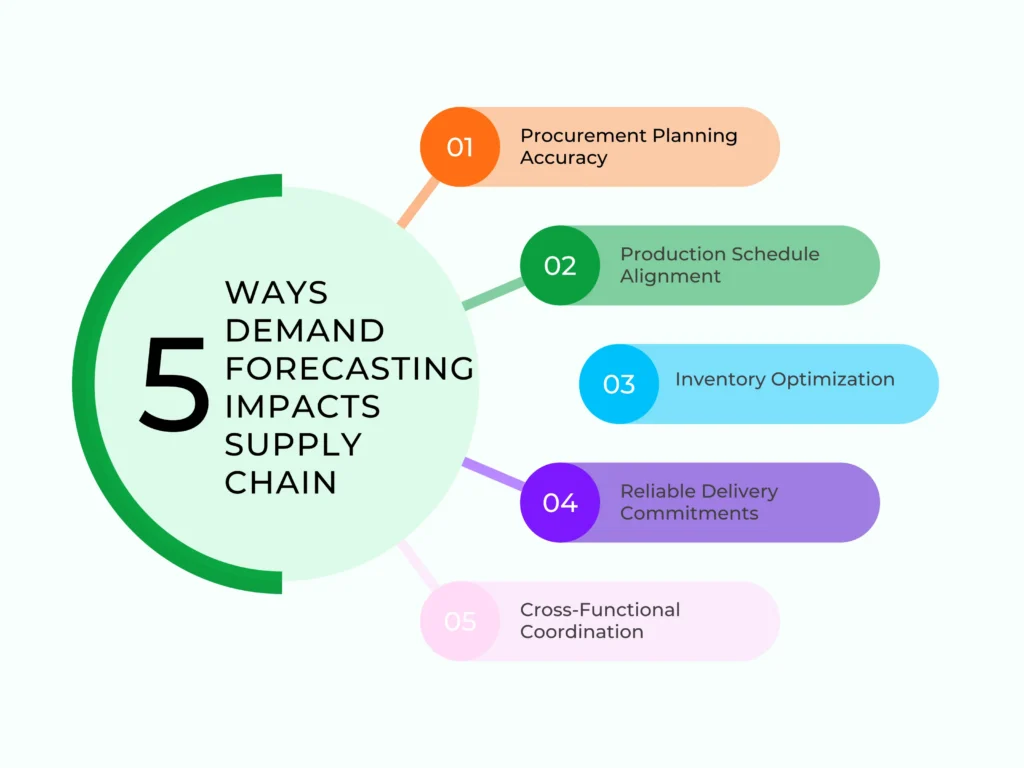
Accurate forecasting strengthens decision-making across every function. In inventory management, it maintains appropriate stock levels by anticipating consumption patterns before shortages or surpluses develop. In procurement, it guides purchasing schedules and supplier negotiations, reducing the risk of emergency orders at premium prices. Production planning teams align capacity and labour needs with projected demand, improving efficiency and minimizing downtime.
Beyond operations, demand forecasting supports synchronized planning across sales, marketing, and finance. Sales and marketing coordinate campaigns with projected buying peaks. Finance teams build budgets, plan cash flows, and evaluate business performance from demand projections they can trust. When forecasting is accurate and connected to execution, the entire organization operates with greater alignment, lower cost, and faster response — not just greater confidence.
Learn how agentic AI is transforming demand forecasting with ConverSight.
Why Demand Planning and Forecasting Matter
Demand planning and forecasting represent a critical evolution from isolated prediction to coordinated execution. While forecasting estimates future demand, demand planning converts those projections into aligned actions across the organization. Together, they shift businesses from reactive responses to deliberate, forward-looking operations that connect demand signals directly to execution.
In modern supply chains, demand is no longer linear or predictable. Market fluctuations, customer behaviour shifts, and external disruptions require organizations to operate with a shared understanding of what lies ahead. Demand planning and forecasting create that shared intelligence — a structured, continuously updated foundation that enables teams to anticipate change, prepare resources, and act with speed rather than urgency.
The Strategic Value of Demand Planning and Forecasting
From Prediction to Execution: Forecasts alone do not drive results. Demand planning bridges the gap by converting projected demand into coordinated actions — for inventory, procurement, production, and capacity. In an agentic supply chain, these actions don’t wait for a planner to initiate them. The moment the forecast signals a need, the agent acts — within the business rules your team has defined.
A Unified View: Demand planning establishes a single source of truth across every function. Operations, procurement, sales, and finance work from the same real-time outlook — reducing misalignment and eliminating the conflicting assumptions that lead to inefficiencies and missed opportunities.
Proactive Inventory Alignment: Aligning inventory levels, workforce availability, and production capacity with expected demand in advance helps organizations avoid last-minute adjustments that are expensive and disruptive. Stockouts are anticipated and prevented — not discovered and managed. Excess inventory is avoided before it accumulates, not written off after.
Stronger SLA Adherence and Customer Confidence: Accurate demand planning enables organizations to meet contractual and operational SLAs with greater consistency. When inventory, production, and logistics are planned against a reliable demand signal, delivery timelines and fill-rate commitments are easier to honour — reducing SLA breaches and strengthening long-term customer trust.
Resilience Through Continuous Alignment: The supply chains that absorb disruption best aren’t the ones with the most buffer stock. They’re the ones with the fastest, most accurate feedback loop between demand signals and operational decisions. By continuously aligning demand projections with supply chain execution, organizations adapt faster to change while maintaining control over cost, performance, and growth.
Demand Forecasting in Supply Chain
Accurate demand forecasts give teams a clear picture of expected customer needs — enabling coordinated planning across procurement, production, inventory, and logistics. When demand signals are understood early and connected to execution, organizations stop reacting to disruptions and start getting ahead of them.
Demand Forecasting
At the heart of supply chain planning, demand forecasting translates historical sales, market trends, and external signals into structured projections that guide operational decisions. Accurate forecasts prevent overproduction, reduce missed sales opportunities, and ensure resources are deployed where they are needed most — before demand creates pressure, not after.
Procurement Planning
Forecast-driven procurement enables organizations to purchase materials in line with anticipated demand — before shortages force emergency orders at premium prices. Teams optimize order quantities, secure favourable supplier terms, and manage lead times proactively. In an agentic supply chain, purchase orders are generated and routed automatically when demand signals cross defined thresholds, within approval limits set by the business.
Manufacturing and Production
Production teams rely on forecasts to schedule manufacturing runs, allocate labour, and manage equipment utilization. Aligning output with predicted demand prevents bottlenecks, minimizes downtime, and ensures the right products are available without overextending resources. When demand shifts, production schedules adjust automatically — keeping operations aligned to reality, not last week’s plan.
Inventory Management
Maintaining the right inventory balance is one of the most financially consequential decisions in supply chain operations. Demand-driven inventory strategies prevent stockouts that impact revenue while avoiding surplus stock that ties up capital. Accurate forecasting informs replenishment cycles, safety stock levels, and warehouse distribution decisions — supporting cost control and service objectives simultaneously.
Supply Chain Monitoring
Tracking supply chain performance against forecasted demand enables early detection of deviations before they become disruptions. By monitoring key metrics — order fulfillment, lead times, and inventory turnover — against the forecast baseline, organizations identify gaps early and adjust plans dynamically. In an agentic supply chain, this monitoring runs continuously. Athena flags deviations, surfaces the cause, and executes the corrective action — without waiting for the weekly review meeting.
Demand Forecasting Models
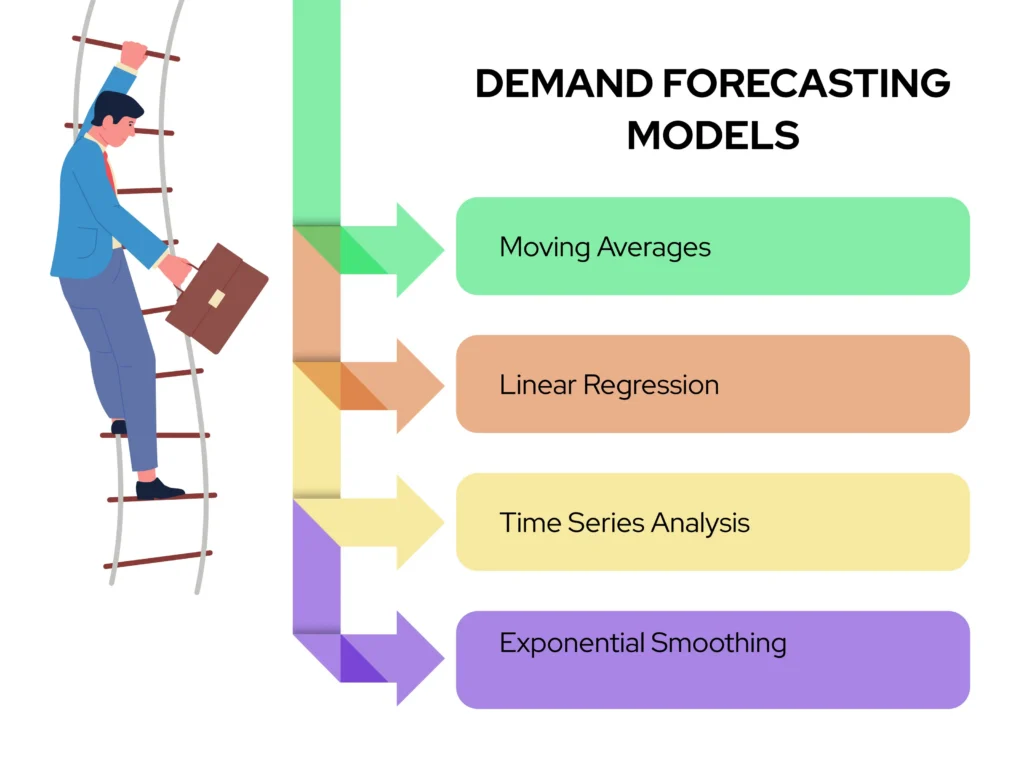
Not all forecasting methods are created equal, and choosing the right approach makes a significant difference in accuracy and operational efficiency. Several models have been widely used in supply chains — each with a distinct way of reading demand data. Understanding them helps teams evaluate what they’re working with today and what a more sophisticated, agentic approach makes possible. These models are the foundation. Agentic AI doesn’t replace them — it selects, combines, and continuously improves them based on what’s actually happening in your supply chain.
Moving Averages
Overview: Moving averages smooth out demand fluctuations by averaging consumption over a defined period. This method highlights stable patterns, making it simple and effective for products with consistent demand. It struggles to capture seasonality or sudden spikes, which limits its use in highly variable or seasonal markets.
Best For: Products with steady, predictable demand and minimal seasonality.
Strengths:
- Easy to calculate and interpret
- Provides a reliable baseline for short-term planning
- Reduces noise from random fluctuations
Limitations:
- Not suited for volatile demand or products with strong seasonal trends
- Cannot adapt quickly to sudden market changes
Linear Regression
Overview: Linear regression establishes a relationship between demand and a variable such as time, price, or promotional activity. It works well when demand follows a clear linear trend but is less effective for non-linear, complex, or rapidly changing patterns.
Best For: Products where demand is measurably influenced by specific, trackable variables like pricing or marketing campaigns.
Strengths:
- Quantifies how specific variables affect demand
- Supports scenario analysis and planning
- Helps align business actions with expected demand
Limitations:
- Requires clean and consistent historical data
- Sensitive to outliers or sudden market shifts
Time Series Analysis (AR, ARIMA)
Overview: Time series models account for trends, seasonality, and noise in historical demand data. AR and ARIMA models are more sophisticated than simple averages and remain widely used for short-term forecasting. They help organizations anticipate recurring patterns and cyclical demand effectively.
Best For: Products with identifiable historical trends or seasonal demand cycles.
Strengths:
- Captures recurring cycles and long-term trends
- Supports planning for seasonal peaks and slow periods
- Useful for scheduling production and managing inventory
Limitations:
- Less effective for new products with limited historical data
- Can struggle in highly volatile or rapidly shifting markets
Exponential Smoothing
Overview: Exponential smoothing is a refined version of moving averages that gives progressively more weight to recent data. This responsiveness allows forecasts to adapt to short-term changes while still grounding predictions in historical patterns.
Best For: Products with moderate demand variability where recent trends matter more than long historical baselines.
Strengths:
- Reacts more quickly to recent changes than moving averages
- Smooths random fluctuations while preserving meaningful trends
- Supports short-term operational planning
Limitations:
- Can overreact to sudden anomalies if not carefully calibrated
- Assumes demand will broadly follow historical patterns — less reliable in highly dynamic markets
ConverSight and Athena: From Demand Signal to Autonomous Action
For many organizations, demand forecasting data exists across multiple systems — ERP, MRP, POS, IMS, and WMS — each holding a piece of the picture, none holding all of it. The forecast gets built. The decision still waits for a human. ConverSight closes that gap — unifying data into a single intelligent layer and connecting every demand signal directly to execution through Athena, ConverSight’s AI Employee.
Here’s how ConverSight closes the loop from demand signal to autonomous action:
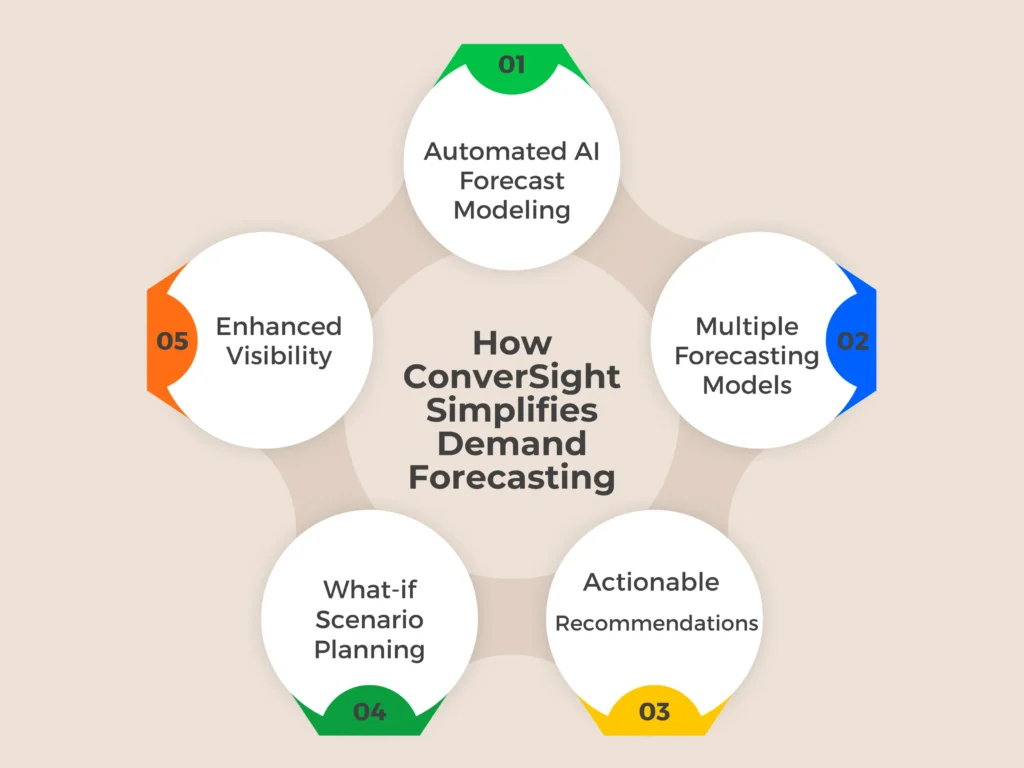
AI Forecast Modeling — Multi-Model, Continuously Improving:
ConverSight’s decision models run multiple forecasting approaches simultaneously — selecting and weighting them by product type, demand pattern, location, and customer segment. The platform continuously adapts to changing demand trends, seasonality, promotions, and market conditions. And because every forecast outcome feeds back into the learning loop, forecast accuracy improves with every cycle — without manual retuning or additional headcount.
The Right Model for Every Scenario:
ConverSight supports multiple forecasting algorithms across different products, locations, and customer segments — applying the right approach for every scenario, from stable SKUs to volatile, high-turnover items. No single model is forced across the entire catalog.
Execution That Connects to Your Systems:
Beyond generating forecasts, ConverSight converts demand projections into concrete execution. Recommended purchase orders and work orders integrate directly with ERP, MRP, IMS, and WMS — not as exports requiring manual entry, but as system actions Athena initiates within the approval thresholds your team has configured. The forecast and the action happen in the same loop.
Cross-Functional Alignment on One Platform:
Teams across procurement, production, sales, and finance simulate scenarios, run what-if analyses, and align plans from a single shared view of demand. Everyone works from the same real-time data — reducing misalignment, eliminating conflicting assumptions, and improving coordination across every function that touches demand.
Continuous Monitoring and Autonomous Response:
ConverSight monitors demand performance continuously — tracking actuals against forecast, flagging deviations, and identifying emerging risks before they become operational problems. When demand drifts, Athena doesn’t wait for the weekly review meeting. She surfaces what changed, explains why, and executes the corrective action — within the guardrails your team has set.
See how ConverSight closes the loop on demand forecasting. Explore Demand Forecasting solution →
Closing the Loop on Demand Forecasting
Effective demand forecasting is no longer just a planning activity — it is a strategic cornerstone that shapes how organizations operate, compete, and grow. When forecasts are accurate and connected to execution, businesses reduce waste, avoid stockouts, and maintain consistent service levels across every stage of the supply chain.
But accuracy alone isn’t enough. The organizations winning today aren’t just forecasting better — they’ve closed the gap between what the forecast says and what the supply chain does. Every demand signal flows into a decision. Every decision flows into action. And every outcome feeds back to sharpen the next forecast. That is the closed loop — and it is what separates supply chains that react from supply chains that lead.
ConverSight brings that loop to life. By unifying data from ERP, MRP, POS, and every other system that touches demand, ConverSight gives every function — procurement, production, sales, and finance — a single, real-time view of what’s ahead. Athena doesn’t just surface the forecast. She acts on it: adjusting inventory, triggering reorders, aligning production, and keeping stakeholders informed — continuously, within the guardrails your team has defined.
Strong demand forecasting also builds organizational confidence beyond the supply chain. Leaders make informed decisions on financial planning and resource allocation grounded in demand projections they can trust. Cross-functional teams stop debating the numbers and start coordinating around them — breaking down silos and improving execution at every level.
Supply chains have a decision problem, not a data problem. ConverSight solves it.
From data to decision to done.
Ready to close the loop on demand forecasting? Request a Demo →