Explore How AI is Revolutionizing Inventory, Logistics, and Operations Across Industries
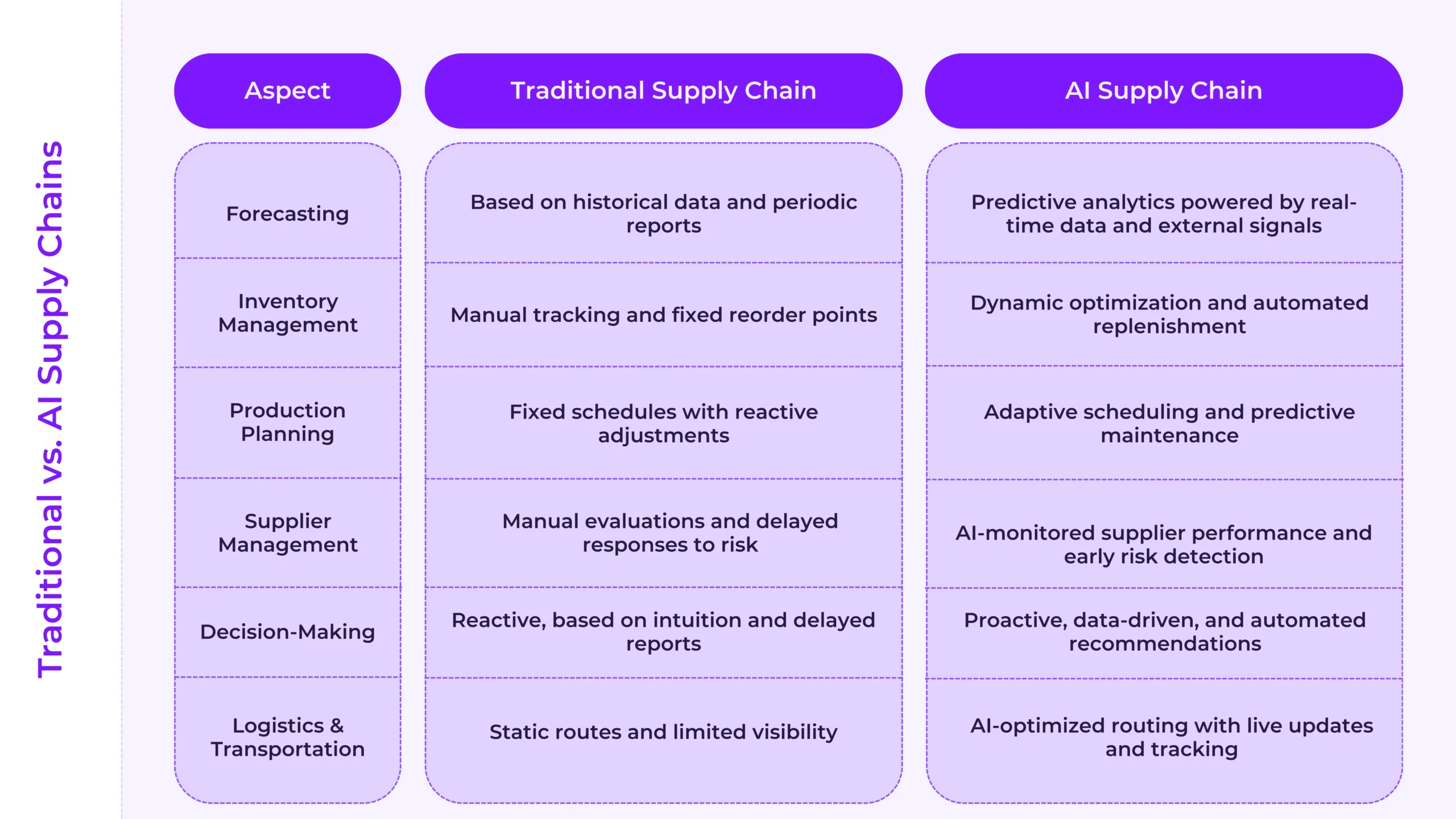
Organizations must manage rising customer expectations, fluctuating demand, supplier instability, transportation disruptions, labor shortages, inflationary pressure, and increasing operational complexity — all at the same time. At the same moment, supply chains are becoming more global, interconnected, and data intensive than ever before.
A single disruption in one region can create cascading effects across production, inventory, logistics, and customer fulfillment worldwide. Traditional supply chain systems were never designed for this level of volatility.
Many organizations still depend on disconnected ERP systems, spreadsheets, manual forecasting methods, and siloed reporting tools that slow decision-making and reduce visibility. The issue is no longer a lack of data. The issue is turning data into decisions quickly enough to respond to change.
This is exactly where AI is transforming supply chain operations.
AI enables organizations to:
- Predict disruptions before they occur – AI identifies potential supply chain risks early so teams can act before operations are affected.
- Identify operational inefficiencies automatically – AI detects bottlenecks and process gaps to improve efficiency and reduce costs.
- Optimize inventory continuously – AI adjusts inventory levels in real time to prevent overstocking and stock shortages.
- Improve transportation decisions in real time – AI recommends the most efficient delivery routes and logistics actions based on live data.
- Detect supplier risks proactively – AI monitors supplier performance and external factors to flag potential risks before they escalate.
- Accelerate operational decision-making – AI delivers instant insights and recommendations that help teams make faster, smarter decisions.
Discover how ConverSight helps businesses harness AI for end-to-end visibility and smarter decision-making.
Top AI Supply Chain Examples Across Industries
As AI capabilities continue to mature, organizations across manufacturing, retail, logistics, automotive, food distribution, and e-commerce are using AI to build more adaptive and resilient supply chains.
Let’s explore some of the most impactful real-world AI in supply chain examples transforming operations today.
1. AI Demand Forecasting
At the heart of every supply chain lies a simple but critical question: how much inventory should we produce, purchase, or replenish next?
For decades, demand forecasting depended heavily on spreadsheets, historical averages, and static planning models. These approaches often struggled to keep pace with rapid market volatility and changing customer behavior.
Modern AI forecasting systems continuously analyze historical sales patterns alongside real-time signals such as:
- Weather trends
- Local events
- Social sentiment
- Promotional activity
- Economic indicators
- Seasonal fluctuations
- Market demand shifts
This allows organizations to generate forecasts that adapt dynamically as conditions evolve.
For example, retailers can predict product demand spikes before they occur, allowing procurement and production teams to adjust inventory levels proactively. Manufacturers can identify regional demand shifts early and rebalance production schedules before shortages or overstocks develop.
AI forecasting helps organizations:
- Reduce stockouts
- Improve service levels
- Minimize excess inventory
- Improve production planning accuracy
- Reduce waste and markdowns
Instead of relying solely on historical reporting, organizations can make forward-looking planning decisions with greater confidence and speed.
2. Inventory Optimization with AI
Inventory management is a delicate balancing act — too much stock ties up cash, too little leads to missed revenue.
AI inventory optimization systems take the guesswork out. By continuously analyzing demand trends, supplier reliability, and lead times, AI recommends ideal reorder quantities in real time.
Unlike traditional static models, AI adapts dynamically as conditions change. A delayed shipment, sudden demand spike, or market disruption triggers automatic recalibration of reorder points and stock targets.
This continuous, data-driven adjustment reduces carrying costs while maintaining top service levels — a true win-win for financial efficiency and customer satisfaction.
3. Predictive Maintenance in Manufacturing
In manufacturing, downtime is costly — every minute of halted production can mean thousands in lost revenue.
AI predictive maintenance helps eliminate these surprises. By analyzing real-time sensor data — vibration, temperature, energy consumption — AI can detect early warning signs that a machine may fail.
Maintenance teams are alerted before breakdowns occur, allowing them to schedule repairs proactively. This reduces downtime, extends equipment life, and boosts operational efficiency — turning reactive maintenance into a predictive science.
4. AI Logistics Optimization
Logistics is where the complexity of supply chains truly converges — fleets, routes, warehouses, and delivery schedules all intertwine.
AI simplifies that complexity. Using data from GPS, weather forecasts, and live traffic feeds, AI systems determine optimal delivery routes, schedule shipments efficiently, and even adjust in real time as conditions evolve.
AI can also forecast transportation costs, suggest the most efficient carriers, and reduce “empty miles” — the bane of logistics profitability. The result is not only faster deliveries but also lower fuel costs and reduced carbon emissions.
AI Supply Chain Examples in the Food Industry
Few industries demand supply chain precision like food and beverage. Perishable inventory, strict compliance requirements, changing consumer preferences, and transportation sensitivity make operational efficiency critical. AI is helping food supply chains improve both responsiveness and sustainability.
- Predicting Shelf Life and Freshness: AI analyzes temperature, humidity, and transit data to estimate product freshness. Distributors can prioritize shipments to reduce spoilage and ensure quality.
- Demand Forecasting to Minimize Waste: AI predicts consumption patterns based on local events, weather, and seasonality — aligning production with actual demand.
- Supplier Reliability and Quality Tracking: AI monitors supplier delivery accuracy and quality metrics to identify potential risks early.
Beyond efficiency, these innovations foster sustainability by reducing food waste and energy consumption across the supply chain.
Learn how ConverSight enhances visibility and efficiency in food logistics and distribution.
AI Supply Chain Examples in Retail
The retail sector has become a proving ground for AI innovation. With omni-channel selling, same-day delivery expectations, and global fulfillment networks, AI has become indispensable.
- Forecasting Seasonal and Promotional Demand: Retailers use AI to analyze years of sales data and market trends, predicting peak demand periods with remarkable accuracy.
- Optimizing Inventory Allocation: AI identifies where products should be stocked to meet local demand, avoiding costly imbalances between stores or warehouses.
- Dynamic Pricing: AI adjusts prices in real time based on inventory levels, demand shifts, and competitor pricing — ensuring competitive positioning while protecting margins.
These capabilities allow retailers to stay agile, maximize revenue, and deliver seamless shopping experiences both online and in-store.
AI in Manufacturing Supply Chains
Manufacturers are embracing AI to make factories smarter, more connected, and more efficient.
- Production Scheduling and Resource Optimization: AI evaluates production capacity, material availability, and order urgency to build optimized schedules that minimize idle time.
- Supplier Collaboration and Risk Detection: AI monitors suppliers for signs of disruption — from late shipments to financial instability — allowing manufacturers to respond proactively.
This integration transforms production environments into intelligent ecosystems that self-adjust and continuously improve.
AI in Pharmaceutical Supply Chains
In the pharmaceutical industry, precision and reliability are mission-critical. AI strengthens both.
- Cold Chain Monitoring: AI monitors storage and transit conditions for sensitive medicines. When temperature deviations occur, alerts trigger immediate intervention — protecting product efficacy.
- Demand Prediction and Shortage Prevention: AI identifies emerging health trends and predicts demand surges, ensuring life-saving drugs remain available when needed most.
These tools safeguard patient safety while optimizing efficiency in one of the world’s most regulated supply chains.
AI in E-Commerce and Fulfilment
E-commerce has redefined speed expectations — and AI is making it possible to deliver.
- Warehouse Automation: AI-driven robots and vision systems streamline picking, packing, and sorting. They continuously learn from order trends, improving layout and speed over time.
- Personalized Fulfilment: AI anticipates which items customers will buy together and prepositions them for faster dispatch. This same data informs recommendation engines, boosting sales and satisfaction.
In a world where same-day shipping is the norm, AI ensures efficiency doesn’t come at the expense of accuracy.
AI in Automotive Supply Chains
Automotive supply chains span thousands of components and suppliers across the globe — a perfect environment for AI-driven optimization.
- Predictive Supplier Monitoring: AI scans global data — financial reports, news, weather — to spot early warning signs of potential supplier risks.
- Optimizing Production Flow: AI aligns part availability with production schedules, keeping assembly lines synchronized and efficient.
This predictive oversight enables manufacturers to maintain consistency even when disruptions ripple through the global supply base.
AI for Sustainability and Carbon Optimization
Sustainability has become a cornerstone of modern supply chain strategy — and AI is a key enabler.
AI calculates emissions across transport routes, warehouses, and manufacturing facilities, recommending greener alternatives such as consolidated shipments or low-emission carriers.
As sustainability moves from compliance to competitive advantage, AI ensures environmental goals align with operational efficiency.
AI for Circular Supply Chains and Waste Reduction
AI also powers the shift from linear to circular supply chains — systems designed for reuse and regeneration.
By tracking material flows and analyzing product life cycles, AI identifies opportunities for recycling, refurbishing, and resource recovery.
This approach not only reduces environmental waste but also unlocks new economic value through reclaimed materials and extended product lifespans.
AI for Real-Time Visibility and Decision-Making
In modern supply chains, visibility is everything — yet data often sits fragmented across systems.
AI unifies this data into a single, real-time view of operations. When disruptions occur — a late shipment, production delay, or supplier issue — AI immediately highlights the problem and suggests corrective actions.
This shift from reactive management to proactive decision-making is what makes AI the foundation of modern supply chain resilience.
How ConverSight Powers AI Supply Chains
While AI’s potential is vast, realizing it requires the right tools — and that’s where ConverSight comes in.
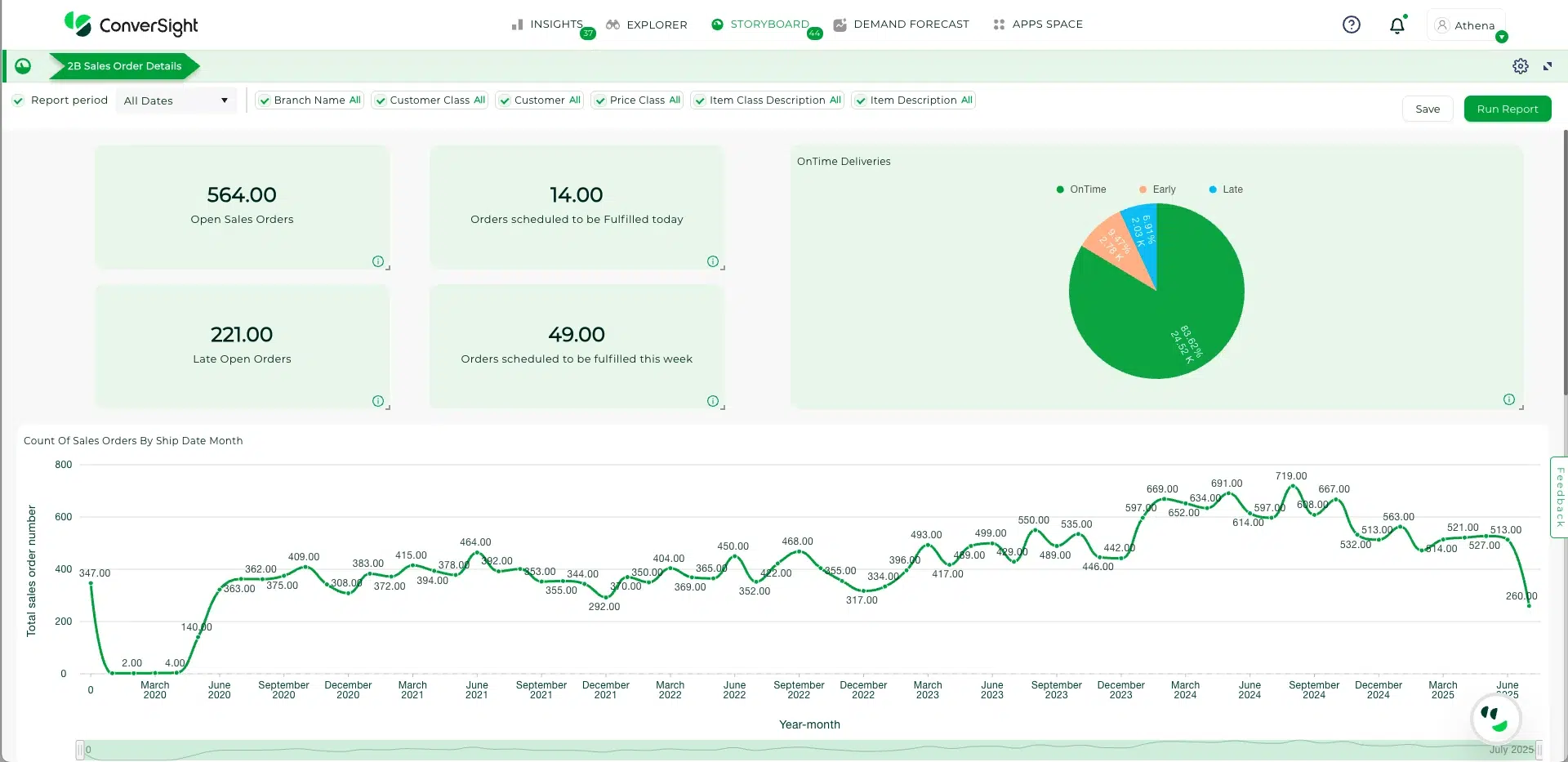
ConverSight integrates data from ERP, CRM, logistics, and production systems into a unified, intelligent platform that transforms raw data into actionable insights.
Real-time answers through Athena, your Supply Chain AI Agent
At the heart of ConverSight is Athena, your Supply Chain AI Employee — ask a question in plain language and get an instant, contextual answer. No dashboards. No waiting for a report to run.
- “Which products are trending this quarter?”
- “Where are our inventory bottlenecks?”
- “Which suppliers are at risk of delays?”
Athena doesn’t just answer — it recommends a next-best action and, within your defined guardrails, executes it. From data to decision to done.
Proactive intelligence — detect, recommend, act
ConverSight monitors trends and detects anomalies — extended lead times, cost fluctuations, demand shifts — before they impact performance. Athena surfaces the risk, recommends a response based on what has worked before, and closes the loop back into your source systems. Every decision is traceable from data to recommendation to action to outcome.
Grows with your AI maturity — no rip-and-replace
ConverSight extends your existing ERPs and MRPs — never replaces them. Start with Athena as an AI assistant on Monday. Same platform, same data, same governance — one path from AI assistant to copilot to automation to autonomous agents, at a fraction of the cost and time of building from scratch.
Request a demo to explore how ConverSight brings AI intelligence to your supply chain.
The Future of AI in Supply Chains
The evolution of AI is only accelerating — and the future of supply chain management will be defined by autonomy, adaptability, and sustainability.
- Autonomous Warehouses: AI robots will handle everything from sorting to replenishment, reducing errors and boosting speed.
- Drone & Autonomous Vehicle Deliveries: Drones and self-driving trucks are already testing last-mile delivery, cutting fuel costs and improving efficiency.
- AI-Enabled Sustainability: AI will help track and reduce emissions, optimize resource consumption, and support circular economy models.
The next generation of supply chains won’t just respond to change — they’ll anticipate and adapt to it automatically.
Start Leveraging AI in Your Supply Chain Today
The future of supply chains is unfolding now — and AI is leading the charge.
Across industries, companies are discovering that AI doesn’t just optimize operations; it unlocks new levels of agility, profitability, and resilience.
From smarter forecasting to predictive maintenance and real-time visibility, the example above show how AI turns complexity into clarity.
And with platforms like ConverSight, AI is no longer just for the enterprise — it’s accessible, scalable, and ready to deliver impact.
Start transforming your supply chain today.
Watch the ConverSight AI Supply Chain Webinar to see predictive analytics and real-time intelligence in action.