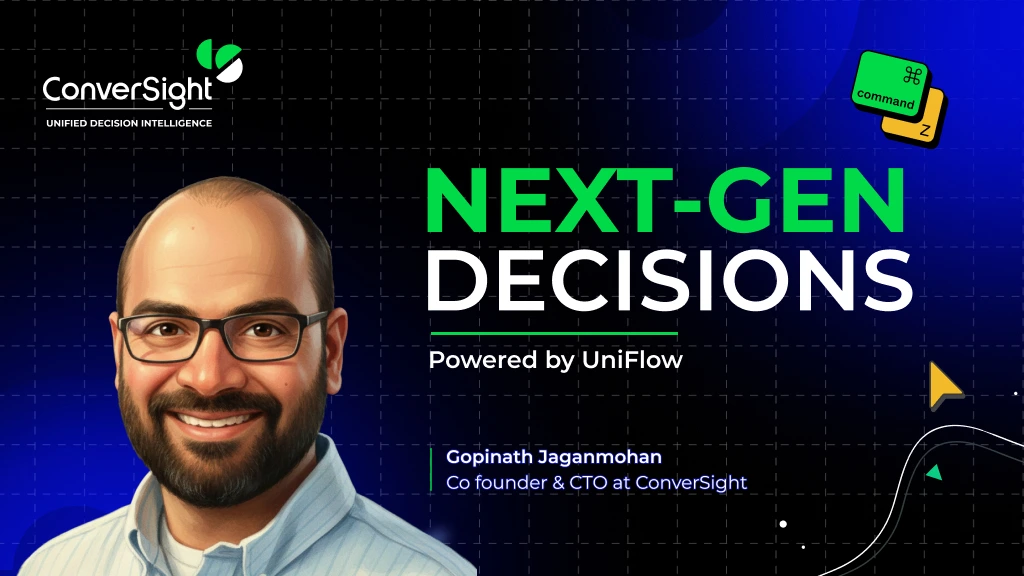
By Gopi, CTO at ConverSight
The Shift to LLMs and Agentic AI: Why We Built UniFlow
Over the past few years, we’ve witnessed a massive shift in how organizations consume insights—from static dashboards to dynamic, context-aware conversational experiences powered by AI. At ConverSight, our mission has always been to stay ahead of this curve, building technology that not only meets today’s analytical needs but anticipates tomorrow’s decision-making challenges.
As we push toward a truly agentic future in analytics, where large language model (LLM) agents automate end-to-end decision workflows, one challenge stands above all: infrastructure. The kind that can power intelligent agents, process data efficiently, run customizable pipelines, and remain agile for real-time needs. That’s why we’ve built UniFlow – a unified backend framework that transforms how agents, analytics, and data engineering coexist and collaborate.
The Current Landscape: Fragmented Systems, Inefficient Workflows
Traditionally, analytics systems have grown in silos—one stack for data engineering, another for data science, a separate orchestration layer for analytics, and yet another for real-time agentic experiences. While this architecture can work for proofs of concept or limited use cases, it becomes unmanageable at scale.
For agent-based platforms like ConverSight, we needed a different approach. Agentic systems require infrastructure that can support real-time, event-driven, and workflow-based operations. They need deterministic outputs, seamless integration with analytical nodes, and the flexibility to adjust flows dynamically.
The reality is this:
LLM agents are not just answering questions—they’re orchestrating complex decisions. And we need to give them an environment where they can operate like autonomous analysts. That’s what UniFlow delivers.
Introducing UniFlow: One Backend to Power Agentic Intelligence
UniFlow (short for Unified Flow) is the foundation of our future-ready analytics platform. It’s a Rust-powered backend architecture that brings together agentic runtime, data science pipelines, and analytics workflows into a single, modular engine.
Here’s what makes UniFlow truly revolutionary:
- Agent-First Architecture: Designed from the ground up for LLM-based agents, UniFlow enables agents to construct, manipulate, and execute analytical workflows in real time.
- Workflow Engine with State Machines: Whether it’s a persistent workflow or a real-time conversational interaction, UniFlow supports both stateless and stateful execution models.
- Built-In Intelligence Nodes: Forecasting, optimization, and supply chain modeling aren’t add-ons—they’re embedded natively into UniFlow. This allows agents like Athena to tap into analytical power instantly.
- Unified Execution Layer: Gone are the days of managing separate infrastructures for agents, pipelines, and dashboards. UniFlow runs it all—streamlining operations and reducing architectural complexity.
- Built for Scale and Efficiency: Using Rust, we’ve ensured UniFlow is not just powerful, but also highly performant and cost-effective for production use.
Key Benefits of UniFlow
With UniFlow as our core engine, we’re enabling major advancements across the platform:
- Lower Total Cost of Ownership: One framework reduces infrastructure sprawl and simplifies maintenance.
- Accelerated Development: Agents can now self-orchestrate analytical tasks without waiting on backend custom coding.
- Deeper Intelligence: Integrated forecasting and optimization nodes make it easier to drive actionable insights at scale.
- Greater Customization: As we expose flow-building to users in the future, they’ll be able to create, visualize, and modify their own agentic workflows.
- Athena Integration: Our flagship conversational AI, Athena, now operates natively on UniFlow, offering even richer, more autonomous decision support.
What Lies Ahead
Eventually, users will not only benefit from faster and smarter insights—but may also get the tools to build their own agentic flows via an intuitive UI.
UniFlow isn’t just a backend change. It’s a bold step in our journey to redefine how businesses interact with data, insights, and intelligent decision systems. It exemplifies our belief that the future of analytics is not just visual—it’s agentic, autonomous, and deeply intelligent.
Stay tuned—this is just the beginning.
How do you see agentic AI changing the way your organization approaches decision-making? What would you want your ideal intelligent agent to do for you?