From Chatbots to AI Employee
Understanding Agentic AI
Artificial Intelligence (AI) has rapidly transformed from a futuristic concept into a practical tool that organizations use daily. Over the last few years, most conversations about AI have focused on Generative AI with tools like ChatGPT or Copilot that create text, images, or code on demand. While these technologies are powerful, they mostly generate outputs rather than drive outcomes.
This is where Agentic AI comes in. Imagine this: a Generative AI tool can draft a report, but an Agentic AI system can go further filing the report in the correct system, routing it for approval, alerting the right stakeholders, and scheduling a follow-up automatically.
That’s the promise of Agentic AI. It moves beyond answering questions or creating drafts; it takes action, coordinates workflows, and acts like a digital employee who is embedded in your team.
In this blog, we’ll explore what Agentic AI is, how agentic AI differs from Generative AI, benefits, and real-world agentic applications. By the end, you’ll see why Agentic AI represents the next frontier in enterprise technology—and why now is the time to start experimenting with it.
Agentic AI Definition
At its core, Agentic AI refers to AI systems that can think, decide, and act autonomously in pursuit of specific goals. Instead of waiting for instructions, these AI “agents” can:
- Understand objectives
- Break them into tasks
- Take action across multiple systems
- Learn from outcomes and improve over time
Think of it like hiring a digital coworker. Just as a new employee needs training, context, and access to tools, Agentic AI requires data, workflows, and integrations. Once operational, it doesn’t just provide information; it executes work alongside human teammates.
Watch how Agentic AI turns insights into action and automates smarter workflows → Agentic AI for Supply Chains | Webinar – ConverSight
What is AI Agent
AI Agents Explained
These digital coworkers are called AI agents. Each agent is:
- Goal-driven – focused on achieving a specific outcome, like reconciling invoices or managing procurement orders
- Autonomous – capable of making decisions without human intervention
- Adaptive – learning from mistakes and adjusting strategies over time
- Collaborative – able to interact with humans or other agents
For example, an AI procurement agent might monitor supplier availability, automatically place reorders, and negotiate based on historical pricing.
A Short Glimpse at Agentic Architecture
Behind the scenes, Agentic AI uses a layered architecture:
- Perception Layer – receives inputs from users, systems, and environments
- Reasoning Layer – evaluates goals, applies logic, and makes decisions
- Action Layer – executes tasks across business applications (ERP, CRM, supply chain tools, etc.)
- Feedback Loop – monitors outcomes, learns from results, and improves performance
This architecture makes Agentic AI proactive, not just reactive. on.
Why Agentic AI is Different: Agentic AI vs Generative AI
A lot of confusion comes from lumping Generative AI and Agentic AI together. But they’re not the same thing.
- Generative AI is like a brilliant writer or designer: it can draft text, images, or ideas. But it stops at creation.
- Agentic AI is like a proactive coworker: it not only drafts the work but also ensures it’s delivered, processed, and acted upon.

This distinction matters because businesses don’t just need content – they need results. Agentic AI closes the loop from idea → action → outcome.
How Agentic AI Works
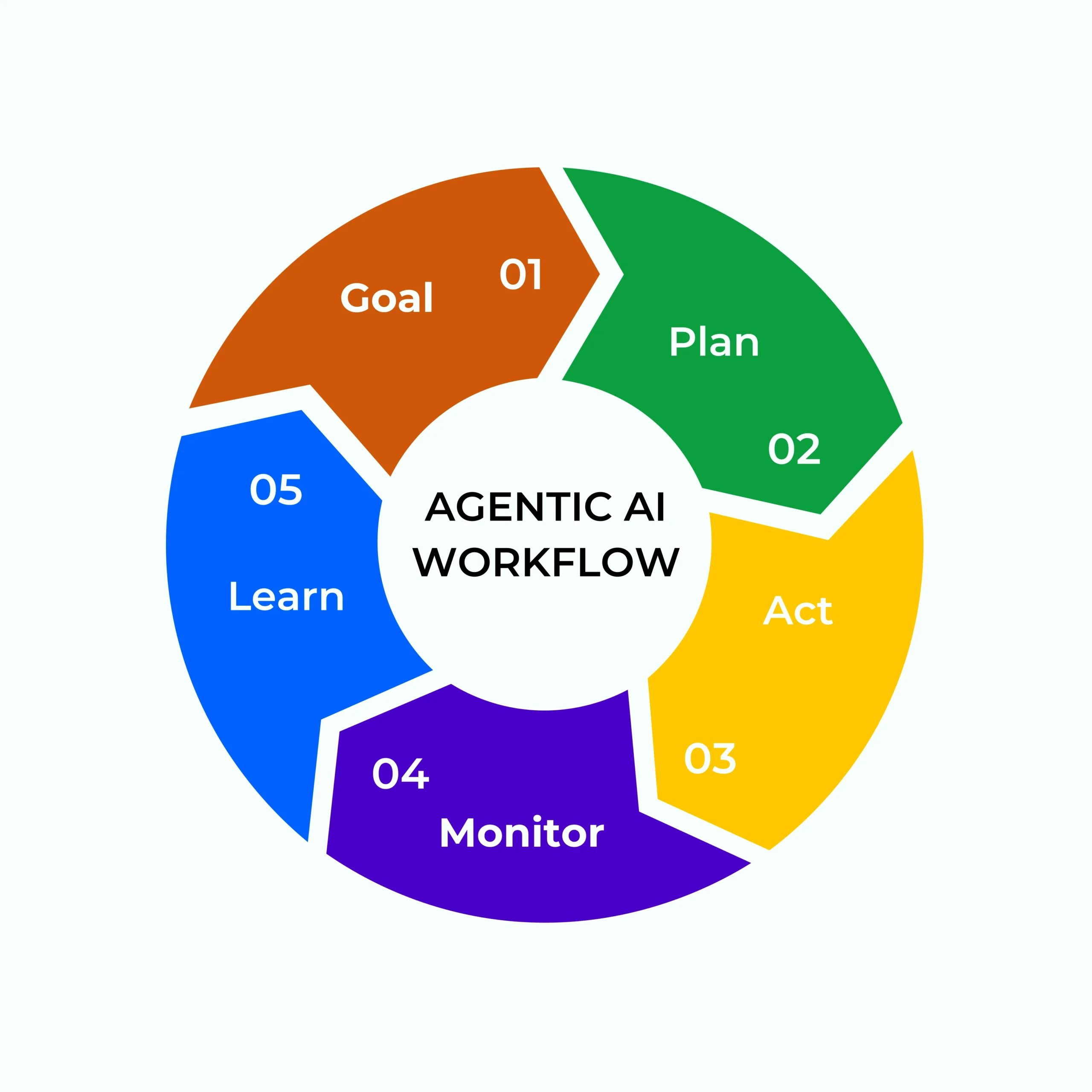
Although Agentic AI may sound like an advanced or futuristic concept, its workflow follows a clear and logical structure. Much like a human employee, an AI agent operates in a continuous cycle of goal setting, planning, execution, monitoring, and learning.
1. Goal Setting – Defining the Objective
The process begins with a clear objective. A goal provides the agent with direction, boundaries, and measurable outcomes. By anchoring its operations to a defined objective, the agent aligns its decisions and actions with the priorities of the business.
2. Planning – Breaking Goals into Tasks
Once a goal is set, the AI agent develops a plan by breaking the objective into smaller, actionable steps. This planning phase includes identifying tasks, prioritizing them, and mapping dependencies. The ability to generate a structured plan allows the agent to act with autonomy rather than waiting for detailed, step-by-step instructions.
3. Action Execution – Taking Initiative
After planning, the agent moves into execution. It interacts with digital systems through integrations such as APIs, RPA, or workflow automation platforms. At this stage, the AI agent is not simply producing outputs—it is actively completing tasks, updating records, and carrying out processes across multiple systems in real time.
4. Monitoring – Ensuring Progress and Accuracy
Execution is followed by continuous monitoring. The AI agent tracks the status of tasks, evaluates whether they are proceeding as intended, and identifies deviations or risks. This oversight ensures that workflows remain aligned with the original goal and allows the system to maintain consistency, reliability, and responsiveness.
5. Feedback & Learning – Refining Future Actions
The final stage is feedback and learning. The AI agent evaluates the results of its actions, identifies successes or failures, and uses these insights to improve future performance. This learning loop allows the system to evolve over time, refining strategies, adjusting priorities, and optimizing processes to achieve goals more effectively.
Why Supply Chains Should Care: The Benefits of Agentic AI
The rise of Agentic AI represents more than just a technological upgrade—it is a structural shift in how organizations operate. While previous AI tools have provided insights and recommendations, Agentic AI directly transforms those insights into actions, creating real, measurable impact. Supply chains that embrace this technology can unlock advantages across efficiency, resilience, growth, and competitive performance.
Efficiency – Automating What Slows Teams Down
Modern organizations are burdened with repetitive, manual tasks, data entry, reporting, document processing, and system updates. These activities, while essential, often consume valuable time and introduce the risk of human error.
Agentic AI automates such processes end-to-end. Instead of requiring human intervention at every step, AI agents carry out routine tasks continuously and consistently. This allows teams to reclaim significant amounts of time, redirecting their focus toward higher-value activities. The result is a workforce that is not only more productive but also less prone to error, since automated execution reduces mistakes that can arise from fatigue, oversight, or workload pressures.
Resilience – Adapting to Change in Real Time
Business environments are rarely static. Market conditions shift, customer demands fluctuate, and supply chains experience disruptions. Traditional systems, which rely on pre-set rules, often struggle to keep pace with these changes.
Agentic AI introduces adaptive resilience by monitoring operations in real time and responding dynamically to emerging challenges. Instead of waiting for human intervention, AI agents can detect deviations, adjust processes, and maintain continuity. This flexibility provides organizations with a safety net when circumstances change, the business doesn’t stall or react too late. Workflows remain intact, and critical operations stay aligned with organizational objectives even under pressure.
Growth – Freeing Humans for Strategy and Innovation
One of the most significant benefits of Agentic AI is the shift it enables in how human talent is allocated. When repetitive, transactional tasks are automated, employees can devote their attention to areas that require creativity, judgment, and strategic thinking.
This reallocation of focus fosters innovation. Teams can spend more time on designing new products, improving customer experiences, and shaping long-term strategies. Over time, this creates an organizational culture centered around innovation rather than administration, paving the way for sustainable growth. Agentic AI doesn’t replace people; it enhances their capacity to contribute where they can deliver the most value. The outcome is a workforce empowered to do work that is more meaningful and impactful.
Competitive Edge – Moving Faster and Serving Better
In highly competitive markets, speed and agility are critical. Businesses that make faster, more informed decisions gain advantages over those slowed down by manual processes or fragmented systems.
Agentic AI accelerates decision-making by eliminating delays between insight and action. Workflows that previously required human approvals, cross-system coordination, or manual updates are streamlined into seamless, automated processes. This enables businesses to move with greater agility, respond to opportunities more quickly, and deliver superior customer experiences. The cumulative effect is a clear competitive edge. Organizations that harness Agentic AI not only operate more efficiently but also differentiate themselves in the market by being faster, more responsive, and more customer focused.
Agentic AI Vendors: Who’s Shaping the Future
The Agentic AI landscape is still in its early stages, but momentum is accelerating as technology leaders and innovators race to define the future. Across the market, several groups are shaping how Agentic AI is adopted and scaled:
Big Tech Leaders
Large technology providers are embedding agentic capabilities into their platforms, ensuring enterprises can begin experimenting with autonomous AI within familiar ecosystems:
- Microsoft – Expanding beyond Generative AI with Copilot, Microsoft is weaving agentic architectures into its productivity and enterprise tools. Integrated with Azure AI services, these systems enable organizations to go from conversational insights to automated workflows.
- Google – Through Vertex AI and DeepMind, Google is advancing research in autonomous AI agents that can plan, reason, and act across complex tasks. Their work focuses not only on scalability but also on safety and interpretability.
- AWS – Amazon Web Services is providing agent frameworks and building blocks that enterprises can customize for their own use cases. By combining cloud-scale infrastructure with modular AI tools, AWS supports organizations in developing industry-specific agent solutions.
These big players bring scale, infrastructure, and enterprise integration, making them crucial in accelerating adoption across industries.
Specialized Startups
Alongside big tech, an energetic wave of startups is innovating rapidly. Unlike generalized platforms, these companies are focusing on AI agents tailored to unique industries and functions.
- Finance – Startups are building AI agents to automate expense reporting, reconciliation, and regulatory compliance.
- Supply Chain & Manufacturing – Agentic AI startups are addressing demand forecasting, order management, and logistics optimization.
- Healthcare – Specialized agents are being developed to manage clinical documentation, scheduling, and patient support.
- Customer Experience – Conversational agents are evolving into fully autonomous digital employees that resolve tickets, process refunds, and personalize service at scale.
These startups often move faster than big tech, experimenting with new architectures and quickly delivering proof-of-value solutions. Many are also becoming attractive acquisition targets as the market consolidates.
Enterprise-Ready Vendors
ConverSight stands out as a vendor offering agentic AI solutions tailored to enterprise workflows. The platform integrates conversational AI with autonomous decision-making, enabling businesses to deploy digital employees that manage procurement, logistics, and finance tasks seamlessly.
AI Agent Platforms
If AI agents are the digital coworkers of tomorrow, then platforms are their operating systems. A single agent can add value, but true transformation happens when businesses deploy many agents working together. This requires a structured foundation—an AI agent platform.
Platform Definition
An AI agent platform provides the environment where agents can operate, collaborate, and scale. Instead of isolated tools, platforms enable enterprises to build and manage a digital workforce.
Core capabilities include:
- Multi-Agent Orchestration – coordinating multiple agents so they can collaborate across tasks and prevent duplication of effort.
- Scalability – expanding workflows seamlessly as business needs grow, without losing performance or reliability.
- Future-Proofing – adapting to new AI models and evolving technologies, ensuring investments stay relevant.
Why Businesses Should Think Platform-First
Point solutions may solve immediate challenges but can lead to silos. A platform-first strategy creates a unified foundation that supports long-term growth, flexibility, and efficiency. In practice, platforms act as the operating system for digital employees, making it possible to scale from one agent to a coordinated team that drives enterprise-wide impact.
ConverSight: Bringing Agentic AI to Business Workflows
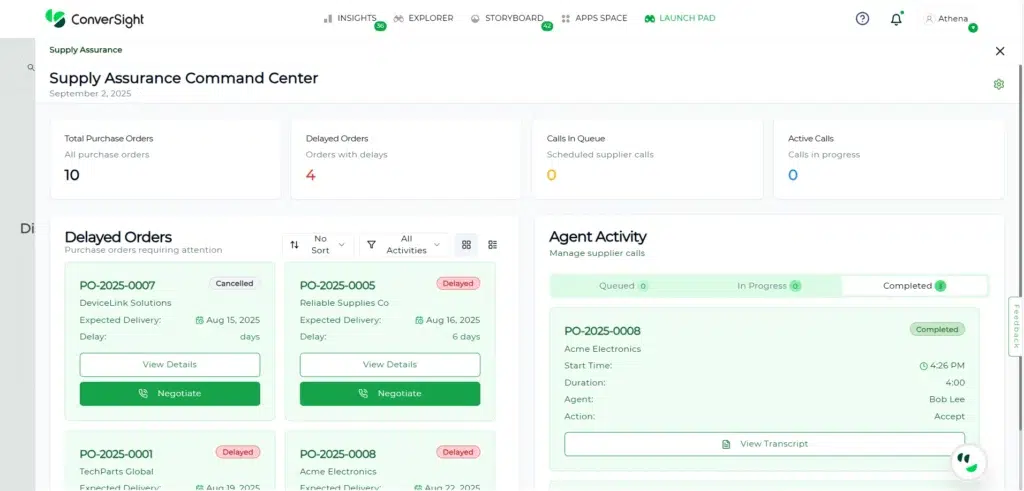
While many organizations are still experimenting with AI in isolated use cases, ConverSight has been pioneering the integration of Agentic AI into everyday business operations. Unlike generic AI tools that focus on generating insights, ConverSight’s platform embeds autonomous AI agents directly into workflows—turning insights into actions and conversations into outcomes.
What Sets ConverSight Apart
- Agentic AI at the Core – ConverSight’s platform isn’t just built for analytics; it is designed around agentic principles, enabling AI agents to not only answer questions but also take action, automate workflows, and deliver measurable results.
- Enterprise-Ready – With seamless integration into ERP, CRM, and supply chain systems, ConverSight ensures businesses can adopt Agentic AI without disrupting existing operations.
- Conversational + Actionable – The platform combines natural language interfaces with action-oriented automation, empowering teams to interact with AI in everyday language while relying on it to execute processes in the background.
- Scalable Digital Workforce – Beyond a single agent, ConverSight enables organizations to deploy a team of digital coworkers across procurement, logistics, finance, and operations—creating a truly scalable AI workforce.
Real Business Impact
By embedding Agentic AI into core workflows, ConverSight helps enterprises achieve:
- Reduced manual workload through end-to-end task automation
- Increased accuracy and speed in decision-making
- Greater agility in adapting to operational changes
- A clear competitive edge through faster execution and improved customer outcomes
Discover how ConverSight is advancing its platform with Agentic AI at the core—staying ahead of the curve and building future-ready enterprises → Watch Now!
Agentic AI Examples in Action
Agentic AI moves beyond generating insights to taking autonomous action, coordinating workflows, and delivering real business outcomes. Here are some practical examples across industries and functions:
Procurement & Supply Chain
AI agents can autonomously monitor supplier performance, place orders, and optimize inventory levels. For example, a multi-agent system can predict demand spikes, reallocate stock, and reroute shipments to prevent delays, ensuring smooth supply chain operations without manual intervention.
Finance & Accounting
In finance, AI agents reconcile invoices, approve routine expenses, and ensure regulatory compliance. A finance agent might detect discrepancies in accounts payable and automatically escalate exceptions while processing standard transactions autonomously, saving time and reducing errors.
Customer Support & Experience
AI agents enhance customer experience by resolving tickets, providing personalized recommendations, and proactively following up. For instance, an AI agent can identify high-priority issues, route them to the right team, and close routine tickets without human involvement, improving response times and satisfaction.
HR & Employee Operations
AI agents streamline HR processes by managing onboarding, scheduling interviews, tracking employee requests, and processing payroll updates. A digital HR assistant, for example, can automatically schedule training sessions, update employee records, and notify managers of key milestones.
Sales & Marketing
AI agents in sales and marketing analyze leads, recommend next steps, and execute follow-ups. For example, an AI sales agent can identify high-potential leads, send personalized outreach, and log outcomes in the CRM system, accelerating sales cycles and improving conversion rates.
IT & Operations
In IT and operations, AI agents monitor system health, resolve routine issues, and automate maintenance tasks. A digital operations agent might detect anomalies in network traffic, trigger alerts, and execute predefined remediation workflows automatically, maintaining system uptime and efficiency.
The Future: Multi-Agent AI Teams
Today, most businesses might experiment with a single AI agent—for example, a chatbot assistant. But the future is multi-agent AI teams working in parallel:
- A procurement agent managing supplier contracts
- A logistics agent monitoring delivery
- A finance agent reconciling payments
- A customer service agent resolving tickets proactively
This evolution mirrors how human organizations scale. Instead of one employee wearing multiple hats, you’ll have a team of digital employees, each specializing in a domain, collaborating seamlessly.
Future-Ready with Multi-Agent Systems: As businesses evolve toward multi-agent AI teams, ConverSight’s platform provides the foundation for orchestration, ensuring that agents collaborate seamlessly across departments. This prepares organizations not just for today’s challenges but for the next generation of digital workforce transformation.
Conclusion
Agentic AI represents the next leap forward in enterprise AI. It transforms AI from a conversational partner into an execution powerhouse, capable of managing workflows, taking decisions, and driving measurable business outcomes.
Companies that begin experimenting with Agentic AI today will be better prepared for tomorrow’s digital workforce revolution.
Ready to bring digital employees into your business? ConverSight can help. To Know more click here!