Unlock smarter, faster, and more resilient business decisions with Decision Intelligence—the next evolution in data-driven strategy.
What Is Decision Intelligence?
In today’s fast-paced business environment, inventory can make or break a company. Customers expect fast delivery, In today’s volatile, fast-paced, and information-rich environment, making the right decision at the right time is no longer optional—it is a critical business necessity. From economic uncertainties and supply chain disruptions to AI regulation and sustainability pressures, leaders are confronted with complex decisions that demand both speed and precision. Enter Decision Intelligence (DI)-a game-changing evolution in how organizations leverage data, technology, and human expertise to make better decisions faster.
Why now? Because traditional decision-making methods—relying on intuition, historical trends, and fragmented analytics—can’t keep up. Decision Intelligence empowers organizations to cut through noise, uncover actionable insights, and simulate outcomes before they occur. As businesses strive to become more resilient, responsive, and responsible, Decision Intelligence emerges as the backbone of competitive advantage and operational agility.
Definition:
Decision Intelligence (DI) is an interdisciplinary approach that brings together elements from data science, artificial intelligence and machine learning (AI/ML), decision theory, and behavioral science to fundamentally improve how decisions are made within organizations. Rather than simply analyzing data for retrospective insights, DI is focused on turning those insights into actionable, forward-looking decisions.
At its core, DI goes beyond traditional business intelligence (BI), which typically tells you what happened in the past. Instead, Decision Intelligence is concerned with what you should do next, and why. It models the entire decision-making process end-to-end—including goals, constraints, risks, and trade-offs—while incorporating real-time data, predictive models, and contextual awareness.

Because it integrates both machine and human reasoning, DI enables decision-makers to operate with greater clarity and confidence—even in complex or rapidly changing environments. It transforms raw data into intelligent, purpose-driven guidance that supports everything from operational tweaks to high-stakes strategic moves.
Key Components of Decision Intelligence
- Data Analysis: At the foundation of decision intelligence lies robust data analysis. This involves extracting meaningful insights from both structured data (like spreadsheets or databases) and unstructured data (such as emails, documents, and sensor readings). Advanced AI and machine learning algorithms, along with traditional statistical methods, are applied to identify patterns, detect anomalies, and uncover correlations. The goal is to transform raw data into an intelligent narrative that informs decision-makers about current states, root causes, and potential opportunities.
- Decision Modeling: Decision modeling is the process of mapping out the logic and structure of decisions. It involves representing key variables, relationships, and outcomes in a way that allows for simulation and analysis. These models help stakeholders visualize the decision space, test different scenarios, and evaluate the impact of various choices before they are made. By modeling uncertainty, risk factors, dependencies, and constraints, organizations can make more strategic and resilient decisions.
- Predictive Analytics: Predictive analytics leverages historical data and machine learning models to forecast future events, trends, and behaviors. Whether it’s anticipating customer churn, estimating demand fluctuations, or identifying supply chain disruptions, this component helps decision-makers act proactively rather than reactively. By surfacing probable outcomes, predictive analytics enables better planning and resource allocation aligned with future conditions.
- Ethical Governance: As data-driven decisions increasingly affect people, processes, and societies, ethical governance becomes a non-negotiable component of decision intelligence. This includes ensuring that decision-making frameworks are fair, transparent, accountable, and free from bias. Ethical governance also means documenting how and why decisions are made, building trust in AI systems, and aligning outcomes with broader organizational values and regulatory standards. This is especially critical in sectors like healthcare, finance, and public services.
Why Decision Intelligence Matters Now
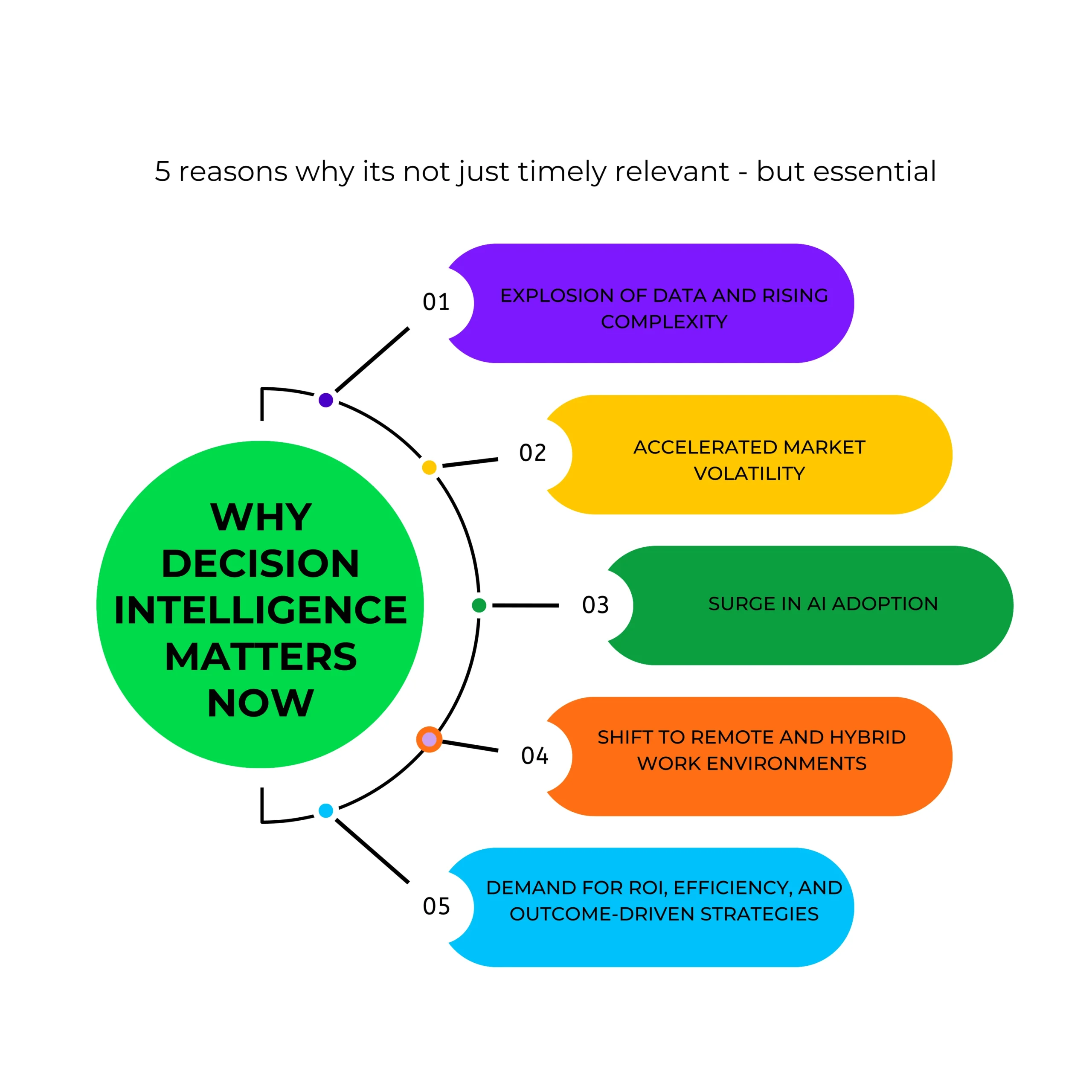
The demand for smarter, faster, and more ethical decisions is at an all-time high as business evolves rapidly. Decision Intelligence (DI) is emerging as a critical framework to meet these demands by merging analytics with action. Here’s the top 5 reasons why its not just timely relevant – but essential:
- Explosion of Data and Rising Complexity: We’re living in a world where data is growing exponentially from IoT devices and customer interactions to market and supply chain signals. However, the abundance of data doesn’t automatically translate into better decisions. In fact, information overload can paralyze action. Decision Intelligence brings structure to chaos, applying AI and analytics to distil signal from noise. It equips leaders to extract clear, actionable insights from large, complex datasets and focus on the variables that truly influence outcomes.
- Accelerated Market Volatility: Global markets are being reshaped by geopolitical tensions, economic instability, climate change, and lingering disruptions from the COVID-19 pandemic. These factors have made long-term planning more difficult and decision timelines shorter. DI enables agile, real-time decision-making, empowering organizations to adjust strategies on the fly, respond swiftly to emerging risks, and maintain resilience amidst constant change.
- Surge in AI Adoption: AI technologies are now embedded in everything from customer service to logistics. But with this adoption comes the responsibility to ensure these systems make decisions that are transparent, ethical, and accountable. Decision Intelligence embeds governance structures into the decision-making pipeline—making it possible to audit AI decisions, identify unintended biases, and align outcomes with human intent and organizational values.
- Shift to Remote and Hybrid Work Environments: With teams spread across cities, countries, and time zones, the traditional model of in-person decision-making is no longer viable. In this distributed context, silos and communication breakdowns become significant threats to alignment and productivity. DI platforms like ConverSight serve as a centralized decision hub, where data, logic, and collaborative input converge—ensuring that decisions are made consistently, inclusively, and with full context, regardless of where team members are located.
- Demand for ROI, Efficiency, and Outcome-Driven Strategies: Today’s business leaders are under growing pressure to maximize return on investment and justify every strategic move with tangible outcomes. DI offers a data-driven pathway to improved performance by optimizing resource allocation, identifying operational inefficiencies, and continuously monitoring KPIs. It enables organizations to not just track performance—but to improve it with each decision cycle, driving smarter investments and leaner operations.
Decision Intelligence vs Business Intelligence
While business intelligence (BI) has long been the backbone of data-driven organizations, it primarily answers questions about what happened in the past. BI tools consolidate historical data into dashboards and reports, providing descriptive insights.
Decision Intelligence (DI), on the other hand, goes a step further. Instead of only explaining past performance, DI helps leaders decide what to do next and why. It models decision pathways, incorporates predictive analytics, and simulates outcomes under different scenarios. This makes DI more actionable and forward-looking than BI, helping businesses not just understand their history but also shape their future with confidence.
In short, Business Intelligence informs — Decision Intelligence transforms.
Decision Intelligence AI
Artificial Intelligence (AI) is the engine that powers modern Decision Intelligence. By combining AI with data science, machine learning, and decision theory, organizations can automate routine decision-making while also enhancing complex, high-stakes strategic choices with deeper insights.
Unlike traditional analytics, which often stop at describing what happened, Decision Intelligence AI interprets patterns, learns from historical outcomes, and adapts to new data streams in real time. This adaptability transforms decision-making from a static process into a living, evolving system.
How Decision Intelligence AI Works in Practice
- Real-Time Anomaly Detection: AI can continuously monitor operations and alert decision-makers when something deviates from normal patterns—whether it’s a sudden drop in sales, an unexpected spike in energy usage, or suspicious financial transactions.
- Predictive Modeling: By simulating countless “what-if” scenarios, AI helps organizations anticipate outcomes before they happen—such as forecasting customer churn, projecting demand surges, or identifying market risks.
- Prescriptive Recommendations: Beyond predicting what might occur, AI embedded in DI frameworks suggests the best possible course of action while weighing risks, trade-offs, and constraints.
- Context-Aware Insights: AI integrates external signals (market conditions, competitor activity, or regulatory changes) with internal data, ensuring that decisions are not made in isolation but are fully informed by context.
Benefits of Decision Intelligence AI
- Speed and Agility: Decisions that once took weeks of analysis can now be made in hours or even minutes.
- Accuracy and Consistency: Machine-driven insights reduce human error and bias while standardizing decision quality across teams.
- Scalability: AI makes it possible to apply Decision Intelligence to thousands of micro-decisions simultaneously, whether in customer personalization, pricing, or supply chain adjustments.
- Human-AI Collaboration: Instead of replacing human judgment, Decision Intelligence AI enhances it, allowing leaders to focus on creativity, strategy, and ethical considerations while AI handles the data-heavy lifting.
Decision Intelligence Models and Frameworks
Decision Intelligence (DI) models serve as blueprints for enhancing the entire decision lifecycle—from problem recognition to action and refinement. These models aren’t just theoretical—they operationalize data science and AI to make decision-making systematic, repeatable, and scalable across the enterprise.
A typical Decision Intelligence framework includes:
- Data Collection: Aggregating structured and unstructured data from internal systems (ERP, CRM, IoT) and external sources (market trends, competitor activity, regulatory data).
- Data Analysis: Using advanced analytics, machine learning, and AI algorithms to identify patterns, correlations, and anomalies that would otherwise go unnoticed.
- Decision Modeling: Creating structured representations of decision paths, including variables, constraints, and possible outcomes—often via simulations or optimization models.
- Validation: Running stress tests, what-if analyses, and historical back testing to verify that the decision models perform well under real-world and extreme conditions.
- Execution and Feedback: Implementing decisions and feeding results back into the system, ensuring that every outcome informs and improves future decision cycles.

By embedding AI throughout this cycle, Decision Intelligence frameworks evolve beyond static dashboards. They become living systems that learn continuously, make decisions more context-aware, and adapt dynamically to new data and business conditions.
Decision Intelligence in Action
Decision Intelligence (DI) is reshaping the way organizations approach operational strategy and problem-solving. By merging advanced analytics with decision-making frameworks, DI empowers businesses to act with speed, accuracy, and agility. This transformation is not confined to any one industry—it’s a cross-sector evolution that’s helping organizations bridge the gap between data insight and operational execution.
Manufacturing & Distribution: Smarter Supply Chains and Leaner Operations
Manufacturers and distributors face constant pressure to adapt to supply chain disruptions and changing demand. DI helps these organizations align production schedules with predictive demand models, minimizing overproduction and avoiding stockouts. Through real-time inventory monitoring, businesses can maintain optimal stock levels and reduce carrying costs.
Predictive maintenance powered by IoT and machine learning also identifies equipment issues before failures occur, preventing costly downtime. Furthermore, DI enhances logistics efficiency by optimizing routes and delivery windows, resulting in faster shipping and lower fuel expenses. These capabilities collectively lead to leaner operations and stronger customer satisfaction.
Healthcare: Enhancing Patient Care and Operational Efficiency
In the healthcare sector, the ability to make fast, informed decisions can significantly impact patient outcomes and operational performance. Decision Intelligence (DI) empowers hospitals and healthcare systems to shift from reactive care to proactive management.
By forecasting patient inflow using historical data and local health trends, healthcare providers can better manage admissions and resource planning. DI also optimizes staff scheduling, ensuring personnel are efficiently allocated based on real-time needs. Additionally, AI-assisted decision trees help standardize treatment protocols, leading to improved clinical results. This not only enhances patient care but also reduces emergency room congestion and operational costs.
E-commerce: Real-Time Personalization and Intelligent Retailing
In e-commerce, delivering a personalized and seamless customer experience is key to growth. DI enables online retailers to analyze user behavior in real time and serve hyper-personalized product recommendations. It dynamically adjusts pricing strategies based on demand, inventory status, and competitor activity to stay competitive.
By predicting customer churn and recommending tailored retention offers, DI helps reduce attrition and increase lifetime value. Additionally, marketing campaigns benefit from scenario simulation, allowing brands to test and launch the most effective messaging. As a result, businesses experience improved conversion rates, optimized marketing spend, and stronger brand loyalty.
Finance: Real-Time Risk Mitigation and High-Performance Decisioning
Financial institutions operate in a high-stakes, fast-moving environment where split-second decisions can drive or derail profitability. DI equips banks, asset managers, and fintech firms with tools to process vast volumes of market data in real time. These systems support high-frequency trading by identifying and acting on profitable patterns within milliseconds. Decision models also simulate potential outcomes for market events, helping portfolio managers assess risk and allocate assets more strategically.
Beyond investment decisions, DI enhances credit risk evaluations through AI-powered analysis of traditional and alternative data sources. Fraud detection systems are also strengthened by identifying anomalies and behavioral triggers, bolstering security and compliance. Together, these capabilities help institutions maximize returns while managing risk more effectively.
Decision Intelligence Supply Chain
Supply chains today face unprecedented levels of volatility — from raw material shortages and transportation delays to sudden shifts in customer demand. Traditional planning methods struggle to keep pace.
Decision Intelligence in supply chain management empowers organizations to anticipate disruptions, simulate multiple scenarios, and identify the best possible responses in real time. By integrating data from IoT devices, market trends, and logistics systems, DI creates a holistic view of the entire supply chain.
This allows businesses to:
- Forecast demand more accurately
- Optimize inventory and production planning
- Reduce operational costs through leaner processes
- Build resilience against global uncertainties
With DI, the supply chain evolves from being a cost center to a strategic advantage that fuels agility and competitiveness.
Decision Intelligence Software
The adoption of Decision Intelligence software is accelerating as enterprises seek tools that bridge the gap between analytics and action. Unlike conventional BI tools that stop at visualization, DI software enables simulation, collaboration, and explainable decision-making.
Key capabilities of leading platforms include:
- Natural language interfaces for easier interaction with data
- Predictive modeling and scenario planning for proactive strategies
- Collaboration features so cross-functional teams can align on critical decisions
- Explainability tools to ensure transparency and trust in AI-driven recommendations
One standout example is ConverSight, a Unified Decision Intelligence platform designed to unify data, analytics, and human expertise into a single decision-making hub. ConverSight provides real-time insights through natural language queries, enabling users across all levels of the organization to access context-rich intelligence without needing deep technical expertise. Its built-in predictive and prescriptive analytics help simulate scenarios, optimize outcomes, and ensure that decisions are aligned with organizational goals.
Organizations using DI software like ConverSight report not just faster decision cycles, but also more resilient, transparent, and outcome-driven strategies. In essence, these platforms act as the operating system for intelligent decision-making.
The Gartner View
Gartner, one of the world’s most respected research and advisory firms, has spotlighted Decision Intelligence (DI) as one of the top strategic technology trends. According to Gartner’s forecasts, by 2025, over 33% of large organizations will adopt Decision Intelligence to drive better, faster, and more explainable decisions. This acknowledgment places DI at the forefront of digital transformation conversations across industries.
Gartner’s recognition isn’t just a passing mention. In key reports such as the Magic Quadrant and Hype Cycle, Gartner is now evaluating platforms based on their ability to offer integrated, scalable, and interpretable decision support. Traditional analytics tools that stop at descriptive insights are no longer enough. Enterprises are seeking solutions that go further—connecting data to action through intelligent automation, scenario modeling, and continuous learning.
Implement Decision Intelligence in Your Organization
Implementing Decision Intelligence (DI) is a transformative journey that goes beyond adopting a new technology—it redefines how decisions are made, measured, and improved across the organization. It involves aligning data infrastructure, people, and processes around a unified decision-making framework.
- Assess Your Decision Ecosystem and Readiness
The first step is to understand your organization’s current decision-making environment. Identify key business decisions across departments and assess where gaps or inefficiencies exist. This includes mapping out who makes the decisions, what data they rely on, and how outcomes are tracked. Evaluate the maturity of your data systems—is your data accessible, clean, and connected across functions? Just as important is gauging your organization’s cultural readiness: are teams open to using AI-assisted tools and embracing a more structured, insight-driven approach to decisions?
- Establish a Cross-Functional Task Force
Decision Intelligence is not the responsibility of one team—it requires collaboration between business, analytics, and technology units. Create a task force that includes business leaders who understand strategic priorities, subject matter experts who bring domain knowledge, and data scientists or analysts who can build models. Involving stakeholders from different levels ensures that DI solutions are aligned with business goals and can be adopted more effectively across departments.
- Integrate and Govern Data Sources
The success of Decision Intelligence hinges on the ability to access and harmonize data from disparate sources. Centralize your data by integrating information from ERP, CRM, supply chain systems, and external datasets into a unified architecture. Data governance is equally crucial—develop standards to ensure data accuracy, privacy, and compliance.
- Select the Right Tools and Platform
Choosing a Decision Intelligence platform is a pivotal decision. The ideal tool should combine advanced analytics with usability. Look for platforms that offer natural language processing (so business users can interact with data easily), predictive modeling, scenario planning, and explainability features. Platforms like ConverSight are designed to unify data access, deliver contextual insights, and support real-time collaboration, enabling both technical and non-technical users to contribute to smarter decision-making.
- Start with High-Impact Use Cases
Rather than launching DI organization-wide from the outset, focus on a few high-value, high-frequency use cases. For example, optimize inventory levels in your supply chain, forecast customer demand, refine pricing models, or improve workforce scheduling. Select areas where quick wins can demonstrate measurable value. Early success not only validates the approach but also builds momentum and internal support for broader adoption.
- Train, Iterate, and Scale
Once deployed, it’s essential to ensure that users understand how to engage with the new system. Provide training sessions that go beyond tool usage—focus on interpreting insights, understanding model outputs, and acting confidently on recommendations. Capture feedback continuously and use it to refine models. Measure performance improvements using KPIs tied to business outcomes. As trust in the system grows, gradually expand DI use to more decisions, departments, and scenarios, creating a scalable model for enterprise-wide intelligence.
- Foster a Culture of Data-Driven Decision-Making
Ultimately, Decision Intelligence thrives in organizations that value transparency, accountability, and collaboration. Encourage a culture where decisions are backed by evidence, where teams share a common understanding of goals, and where feedback is used to improve future outcomes. Promote cross-functional dialogue, ensure leadership buy-in, and celebrate data-driven wins. As DI becomes part of the organizational culture, it shifts decision-making from reactive to proactive, empowering teams to make faster, smarter, and more aligned choices.
The Time for Decision Intelligence Is Now
Organizations are increasingly challenged to make rapid, high-impact decisions in environments marked by complexity, volatility, and constant change. Traditional dashboards and static reports, while foundational in past decades, no longer meet the evolving demands of real-time decision-making. These tools typically offer a rearview mirror perspective—summarizing what has already happened—without providing the forward-looking, context-aware guidance needed to drive immediate and strategic action.
Decision Intelligence (DI) fills this gap. It represents a paradigm shift in how businesses think, act, and respond. By merging the analytical power of data science with the structured logic of decision theory and the nuance of human behavior, DI becomes more than a tool—it becomes the operating system for modern decision-making. It enables organizations to navigate uncertainty, evaluate trade-offs, and align decisions with strategic goals while incorporating ethical and contextual considerations.
Platforms like ConverSight are at the forefront of this transformation. They don’t just help businesses respond to market shifts—they enable them to anticipate change, model future scenarios, and make context-rich decisions at scale. Through natural language interfaces, predictive insights, and continuous feedback loops, ConverSight empowers every stakeholder—from the executive suite to the operational floor—with accessible, actionable intelligence.
Ready to make smarter, faster decisions? Learn more with ConverSight.