What leaders need to know as the industry shifts to intelligent, autonomous factories
The Future Is Already in Motion
In 2025, the automotive sector faces mounting pressure to stay agile and competitive. From fluctuating demand to labour shortages and sustainability mandates, manufacturers are realizing that traditional systems can’t deliver the speed and precision the market now expects. Automation alone isn’t enough — intelligence is the new advantage.
That’s why forward-thinking automakers are integrating AI at every stage of production. Machine learning models forecast material demand and optimize scheduling. Computer vision detects minute defects in real time. Predictive analytics prevents costly equipment failures before they occur. Together, these technologies enable data-driven decision-making that powers greater efficiency, consistency, and adaptability across global plants.
This blog explores how AI in automotive manufacturing is driving that evolution — from smarter design and predictive maintenance to intelligent supply chains and sustainable production practices. It’s a transformation that’s not just revolutionizing manufacturing — it’s redefining mobility itself.
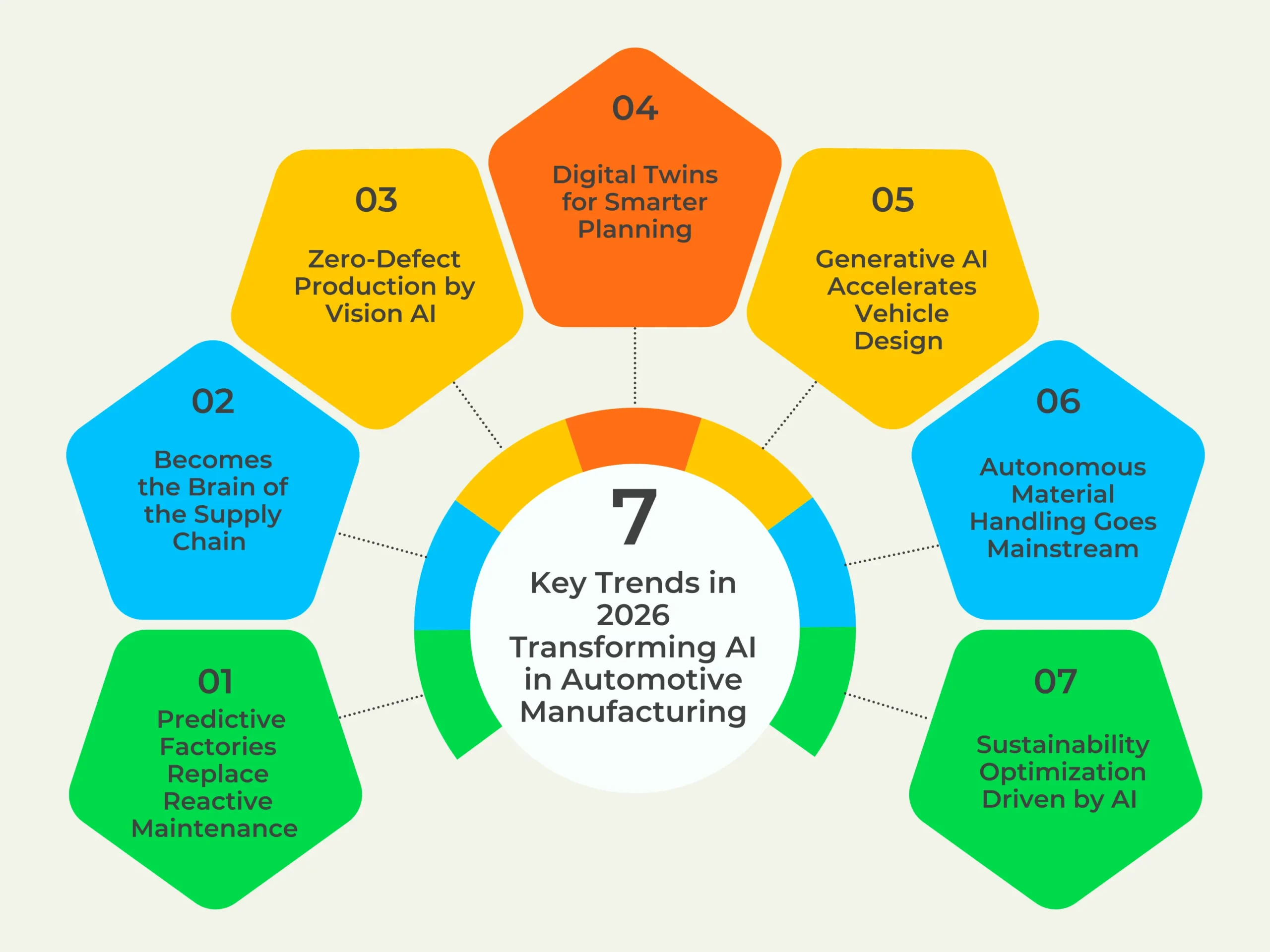
Key Trends in 2026 Transforming AI in Automotive Manufacturing
The automotive industry is on the verge of its most intelligent transformation yet. AI in automotive manufacturing is no longer a futuristic idea — it’s the foundation of how vehicles are designed, built, and delivered in 2026. From predictive maintenance to digital twins, AI is enabling a new era of agility, precision, and connected intelligence across production lines and supply chains.
Factories are evolving into dynamic ecosystems where every machine, robot, and sensor communicates seamlessly. These AI-powered manufacturing systems adapt in real time — learning from data, improving processes, and ensuring maximum efficiency with minimal human intervention.
What’s Changing
- The shift from rigid automation to intelligent, self-learning systems capable of adapting to unpredictable market and production changes.
- AI agents are becoming the decision-makers of the factory floor, optimizing workflows, predicting issues, and driving planning autonomously.
- Data from connected machines, vehicles, and suppliers now flows into a single intelligent network, enabling visibility and collaboration across the value chain.
Why It Matters
- Accelerates innovation cycles — AI helps automotive manufacturers bring products to market faster with smarter, data-backed design and testing.
- Reduces downtime and waste, optimizing every aspect of production and logistics.
- Improves safety, quality, and sustainability, setting the foundation for fully autonomous manufacturing ecosystems.
Predictive Factories Replace Reactive Maintenance
For decades, automotive manufacturing plants operated on scheduled checklists and manual inspections — a system that worked, but only until something broke. In 2026, that model is officially outdated. Today’s factories run on continuous machine intelligence, powered by AI in automotive manufacturing that predicts, prevents, and even plans maintenance before a single malfunction occurs.
Instead of technicians reacting to alerts or waiting for a breakdown, AI-powered predictive maintenance systems analyze thousands of data points every second — from motor vibrations and temperature spikes to acoustic patterns and energy usage. When an anomaly appears, the system doesn’t just raise a red flag; it diagnoses the issue, recommends a fix, and schedules a technician automatically — all without disrupting production.
This shift from reactive to predictive represents a leap toward self-healing factories. Machines no longer need constant supervision; they learn from operational history, spot patterns invisible to human eyes, and continuously improve uptime. As a result, manufacturers are seeing up to 50% reductions in unplanned downtime, with higher reliability across production lines.
The benefits go beyond efficiency. Predictive AI ensures automated safety and compliance, tracking equipment performance against standards and alerting teams before any safety thresholds are breached. This proactive approach not only keeps workers safe but also helps manufacturers avoid costly regulatory violations and production losses.
Why It Matters:
- Up to 50% reduction in unplanned downtime
- Automated safety and maintenance compliance
- Longer equipment life and reduced operational costs
AI Becomes the Brain of the Supply Chain
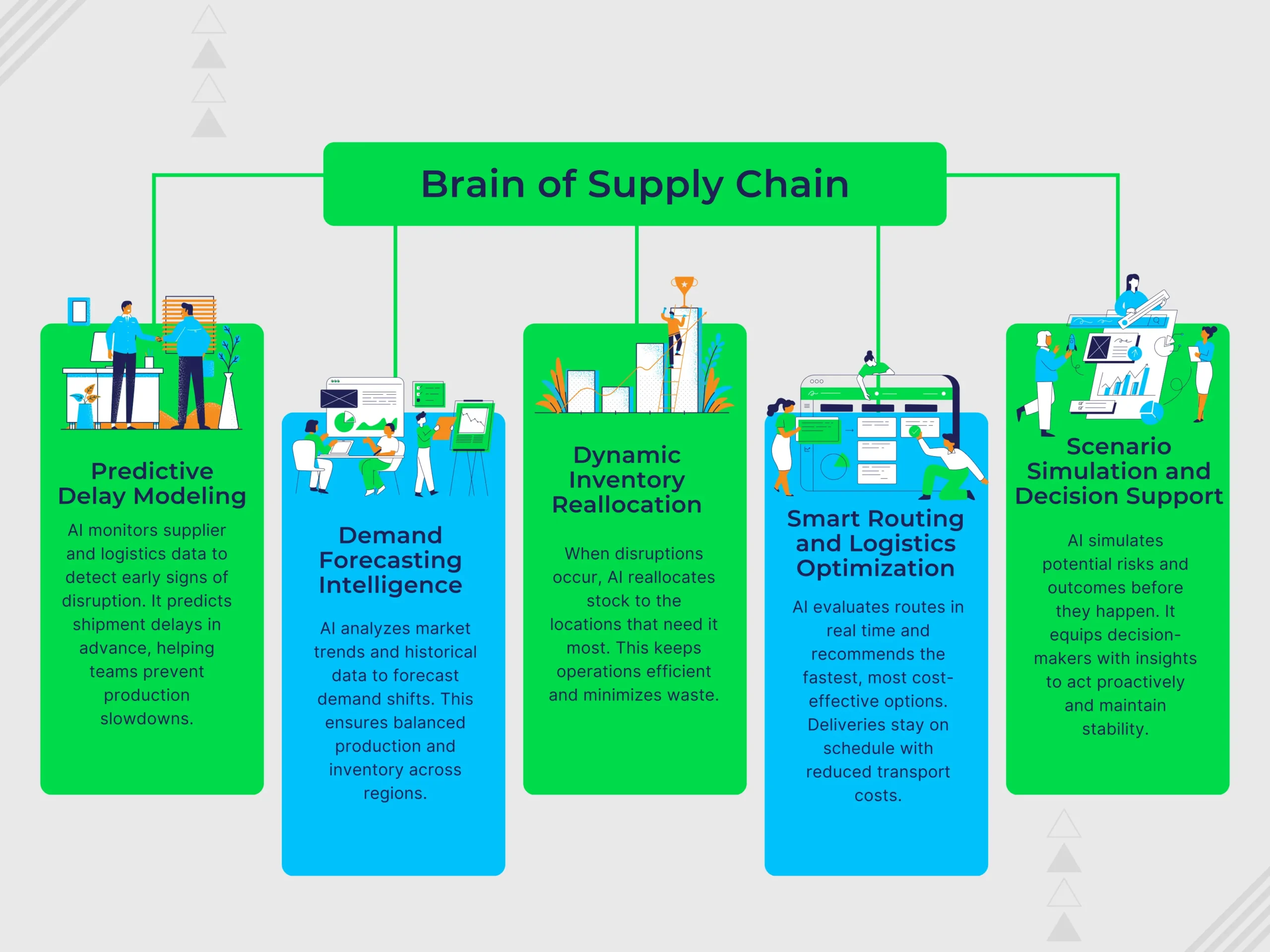
In the automotive world, the supply chain has always been a high-stakes balancing act — one late shipment or missing component can halt production across multiple plants. But in 2026, AI in automotive manufacturing is transforming this uncertainty into precision. No longer reactive or dependent on spreadsheets, the supply chain has evolved into a self-learning, predictive network — and AI is the brain behind it all.
Instead of waiting for disruptions to unfold, AI systems now forecast potential delays weeks in advance. By analyzing a constant stream of data from suppliers, logistics partners, and production schedules, AI identifies weak links before they cause slowdowns. Whether it’s a delay at a port, a raw material shortage, or a shift in demand, the system instantly recalculates and recommends optimized alternatives — rerouting shipments, reallocating inventory, or adjusting production priorities.
This intelligence creates a synchronized supply chain that adapts in real time. Inventory across global plants is continuously optimized, ensuring parts arrive exactly when and where they’re needed. For manufacturers, this means fewer stockouts, leaner inventory levels, and dramatically reduced waste.
Beyond logistics, AI-driven insights also enhance supplier risk management. Machine learning models track supplier reliability, financial health, and geopolitical factors — enabling automakers to act long before a potential disruption turns critical.
Ultimately, AI has become the strategic command center of modern automotive manufacturing — one that doesn’t just respond to challenges but anticipates and neutralizes them before they impact the production line.
Impact:
- Optimized inventory across global plants for leaner operations
- Faster supplier risk response through predictive analytics
- Smarter, proactive logistics routing that ensures on-time delivery
Digital Twins for Smarter Planning
Imagine being able to test every production decision, every design change, and every workflow — all before it ever happens in the real world. That’s the power of Digital Twins in AI-driven automotive manufacturing. These virtual replicas of factories, production lines, and even entire vehicles allow manufacturers to simulate operations in real time, helping them make smarter, safer, and more cost-efficient decisions.
A Digital Twin is more than just a 3D model; it’s a living, breathing virtual environment continuously fed with real data from sensors, IoT devices, and AI systems. This data allows manufacturers to test different scenarios — from how a new assembly line layout will impact throughput to how a new part design will perform under stress — without ever pausing production.
In 2026, automotive companies are using Digital Twins to plan entire plant launches virtually, saving months of setup time and millions in trial-and-error costs. Engineers can simulate “what-if” scenarios, predict outcomes, and optimize performance before a single robot moves or a part is assembled.
Beyond manufacturing, Digital Twins are transforming vehicle development too. Automakers can now run thousands of crash simulations, aerodynamics tests, and energy efficiency analyses digitally, enabling faster innovation cycles and safer, more sustainable vehicles.
By combining AI insights with real-world data, Digital Twins create a continuous feedback loop between design, production, and performance — helping manufacturers move from reactive planning to proactive intelligence.
Impact:
- Faster plant launches through virtual testing and optimization
- Safer and cheaper experimentation with no production downtime
- Data-driven decision-making for ongoing process improvement
Generative AI Accelerates Vehicle Design
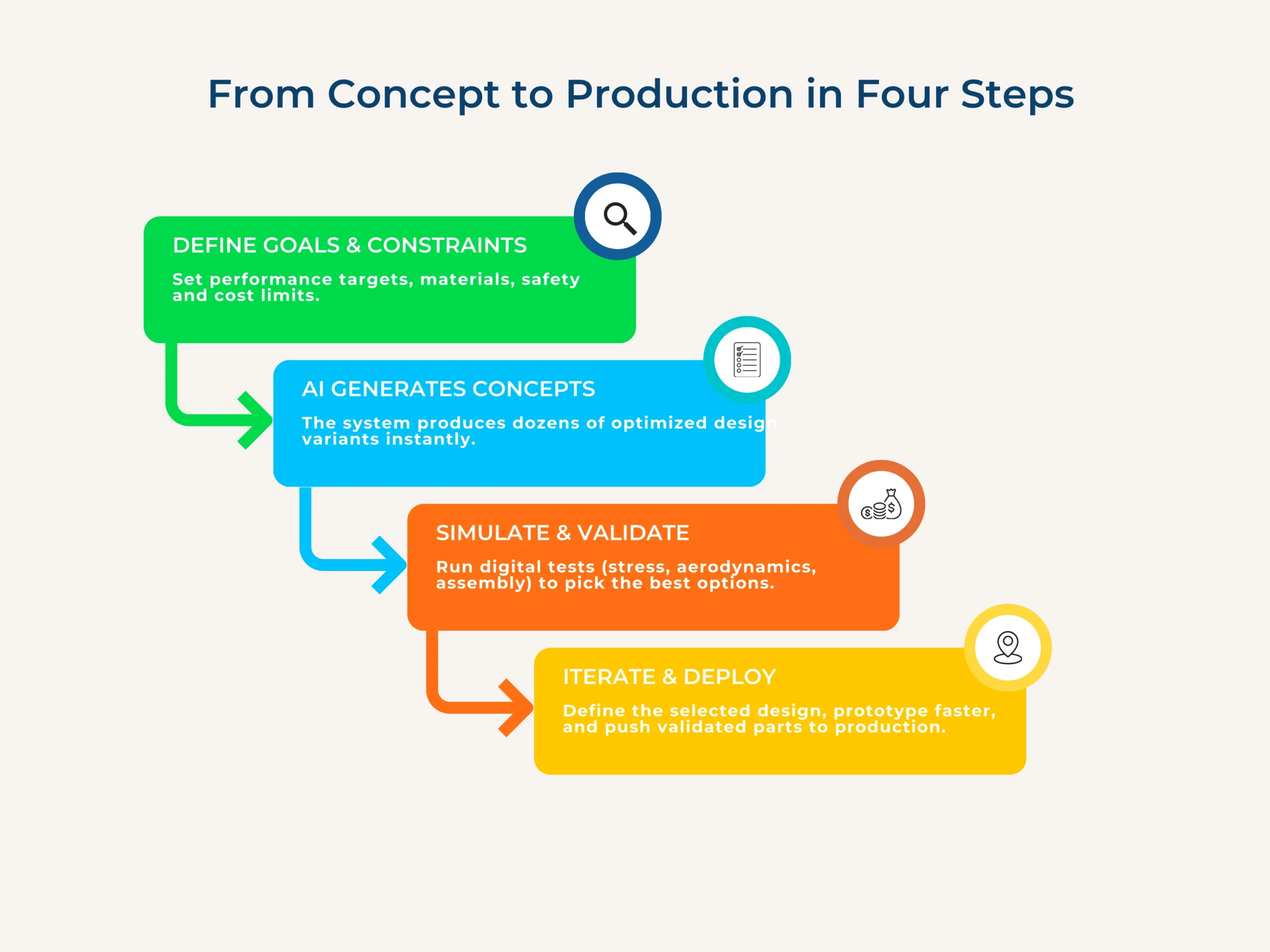
Vehicle design has always been a balance between creativity, engineering precision, and time. But in 2026, Generative AI is rewriting the design process — turning months of engineering work into weeks. Instead of engineers starting from a blank screen, AI now co-creates vehicle parts, components, and assembly workflows, exploring countless design possibilities in just a few hours.
Generative AI uses advanced algorithms to analyze performance requirements, material properties, and safety constraints. It then generates multiple optimized design options — each one balancing strength, weight, and cost. Engineers can simply choose the best version, fine-tune it, and send it to production.
This collaboration between human expertise and AI intelligence is transforming how vehicles are built, especially in the electric vehicle (EV) era. Generative design helps create lighter yet stronger components, improving battery range and overall efficiency — key priorities for EV manufacturers.
Beyond structural design, AI also optimizes assembly workflows by simulating how parts will fit, move, and function together on the production floor. The result? Reduced prototyping costs, faster production ramp-up, and more innovative product designs that push the boundaries of performance and sustainability.
In short, Generative AI doesn’t just speed up vehicle design — it amplifies creativity while ensuring precision. It enables engineers to explore what’s possible, not just what’s practical, giving automotive manufacturers a crucial edge in an increasingly competitive market.
Impact:
- Weeks of engineering time saved through rapid AI-driven design iterations
- Lighter and stronger designs that enhance EV efficiency and sustainability
- Reduced prototyping costs and faster time-to-market
Autonomous Material Handling Goes Mainstream
If you walk through an automotive plant in 2026, you’ll notice something striking — there are fewer forklifts and far more robots on the move. Autonomous Guided Vehicles (AGVs) and Autonomous Mobile Robots (AMRs) have moved beyond experimental stages to become an essential part of AI-powered automotive manufacturing. These intelligent movers are transforming how materials flow through production lines, creating faster, safer, and more efficient factories.
Unlike traditional material handling systems that follow fixed routes, AGVs and AMRs think for themselves. Powered by AI, sensors, and real-time mapping technologies, they analyze floor conditions, detect obstacles, and make instant route decisions to avoid congestion. The result is a dynamic, self-regulating logistics network that keeps production running smoothly — without human intervention.
This evolution is reshaping factory efficiency. Instead of waiting for manual transport or forklifts, materials are delivered just in time, precisely where and when they’re needed. Every movement is optimized for distance, energy use, and timing, ensuring that no part sits idle and no workstation ever goes empty.
Safety, too, has improved dramatically. With intelligent navigation and collision-avoidance systems, these robots reduce workplace accidents and create safer environments for human workers. Many plants now report a measurable decrease in incidents and insurance costs since adopting AI-driven material handling.
By integrating AGVs and AMRs into the broader smart factory ecosystem, automotive manufacturers are taking another step toward fully autonomous operations — where machines communicate, collaborate, and optimize continuously.
Impact:
- Real-time route decisions through AI-powered navigation
- Increased workplace safety with collision avoidance and route intelligence
- Just-in-time delivery accuracy to support continuous production
Sustainability Optimization Driven by AI
Sustainability is no longer just a corporate initiative — it’s a core driver of competitiveness in automotive manufacturing. As environmental regulations tighten and consumer expectations evolve, automakers are turning to AI-powered sustainability systems to monitor, manage, and minimize their environmental footprint in real time.
In 2026, AI in automotive manufacturing has become the catalyst for greener, more responsible operations. Every machine, sensor, and production line continuously generates data on energy consumption, emissions, and resource use. AI collects and analyzes this data, uncovering inefficiencies and suggesting immediate optimizations — whether it’s reducing power during non-peak hours, reusing heat from paint booths, or reconfiguring production schedules to cut waste.
These intelligent systems transform sustainability from a periodic review process into a real-time performance metric. Manufacturers can visualize their carbon footprint at any moment and instantly take corrective action when energy or material use exceeds targets.
Beyond factory walls, AI also helps optimize logistics and supply chains, reducing fuel consumption and improving transport efficiency through route prediction and smart load planning. This not only cuts emissions but also lowers operational costs — proving that sustainability and profitability can go hand in hand.
Most importantly, AI ensures that automakers stay ahead of Environmental, Social, and Governance (ESG) compliance standards. Automated tracking, reporting, and analytics make it easier to meet global sustainability goals and demonstrate transparency to stakeholders.
By embedding AI-driven sustainability into every process, automotive manufacturers are building factories that are not just intelligent — but also environmentally conscious and future-ready.
Impact:
- Reduced waste and power usage through data-driven energy optimization
- Improved compliance with ESG goals via automated monitoring and reporting
- Sustainable cost reduction across operations and logistics
The ConverSight Advantage in This New Era
As AI continues to redefine automotive manufacturing — from predictive maintenance to autonomous supply chains — one truth stands out: the future belongs to companies that can turn data into decisions instantly. While most AI and analytics platforms stop at dashboards and reports, ConverSight takes it several steps further with Agentic AI — an intelligent system that not only analyses data but also acts on it.
In an industry where speed, precision, and foresight determine success, ConverSight enables decision automation at every level of manufacturing and operations. It transforms the way automakers predict, plan, and perform — bridging the gap between insights and execution.
Here’s how ConverSight gives automotive manufacturers their competitive edge:
✔ Predict supply chain disruptions before they hit production – ConverSight continuously monitors supplier and logistics data, using AI-driven forecasting to identify potential bottlenecks weeks in advance. Manufacturers can reallocate resources, reroute shipments, or adjust production schedules proactively — avoiding downtime and costly halts.
✔ Automate demand-to-production alignment – With ConverSight, production lines become adaptive ecosystems. The platform connects demand signals, inventory data, and supplier inputs to automatically balance production volumes with real-time market trends. This ensures optimal output, minimal waste, and improved working capital efficiency.
✔ Deliver answers through natural language — no dashboard digging – Instead of sifting through complex dashboards, teams can simply ask questions like “What’s causing the delay in EV assembly?” or “How’s our supplier lead time trending this month?” and receive instant, contextual answers from Athena, ConverSight’s conversational AI. This makes decision-making faster, more intuitive, and accessible to every role — from plant operators to executives.
By combining conversational intelligence with autonomous decision-making, ConverSight empowers manufacturers to move beyond analytics and into true operational intelligence — where insight turns into action in seconds.
ConverSight isn’t just observing the transformation of AI in automotive manufacturing — it’s driving it.
Discover how ConverSight’s Agentic AI is redefining automotive decision-making – explore the Automotive AI Advantage.
Conclusion – 2026: The Year Factories Think for Themselves
The rise of AI in automotive manufacturing is no longer a distant vision — it’s the competitive transformation unfolding right now on factory floors across the world. What was once experimental is now essential. AI is powering predictive factories, autonomous logistics, and self-optimizing production lines that learn, adapt, and make decisions faster than ever before.
By 2026, factories will think for themselves — using data, sensors, and intelligent systems to anticipate problems, prevent downtime, and continually improve efficiency. Predictive, autonomous systems are not only driving operational excellence, but also advancing safety and sustainability, setting new industry benchmarks for innovation.
Manufacturers who embrace AI-led decision intelligence will unlock faster turnaround times, reduced costs, and superior product quality. Those who wait risk falling behind in a rapidly evolving landscape where intelligent automation defines success. The era of reactive manufacturing is over. The future belongs to factories that think — and act — intelligently.
Explore how ConverSight’s AI decision intelligence is powering the next generation of automotive manufacturing efficiency.