Optimizing manufacturing, procurement, and distribution with AI
Why AI Agents Are Revolutionizing the Automotive Industry
For decades, the automotive industry has relied on rigid, process-heavy systems to keep production lines moving, manage vendor relationships, and deliver vehicles worldwide.
But as global networks grow in complexity — spanning thousands of components, suppliers, and partners — the limits of traditional systems are becoming evident. Delayed insights, manual monitoring, and fragmented communication now stand in the way of efficiency and profitability.
The year 2025 marks a turning point. AI Agents are no longer a futuristic concept — they’re becoming the operational backbone of modern automotive enterprises. These intelligent entities interpret data, forecast events, and take contextual action faster than teams ever could manually. They enable leaders to operate proactively instead of reactively, minimizing downtime, eliminating bottlenecks, and empowering teams with instant clarity.
What’s driving adoption now?
Three critical shifts:
- Predictive capabilities that anticipate maintenance, demand, and disruptions before they escalate.
- Operational efficiency through automation of monitoring, scheduling, and reporting.
- Cost reduction achieved through optimized workflows and reduced waste across every process.
In short, AI Agents give automotive organizations the advantage they’ve long needed — speed, foresight, and confidence in every decision across manufacturing, procurement, and distribution.
AI Agents in the Automotive Industry
AI Agents in the automotive industry are intelligent systems that continuously learn, adapt, and act across the entire production ecosystem. Unlike static dashboards or rule-based automation, these agents understand data context, detect anomalies, and recommend or execute actions in real time.
They interact across multiple layers of the automotive operation:
- In manufacturing, they oversee production performance, predict equipment failures, and adjust schedules dynamically.
- In procurement, they track parts availability, vendor reliability, and cost fluctuations.
- In distribution, they coordinate order fulfillment, routing, and inventory visibility across regions.
The result is a seamless flow of insights and actions that connects every link — from raw materials to finished vehicles.
Difference from traditional systems
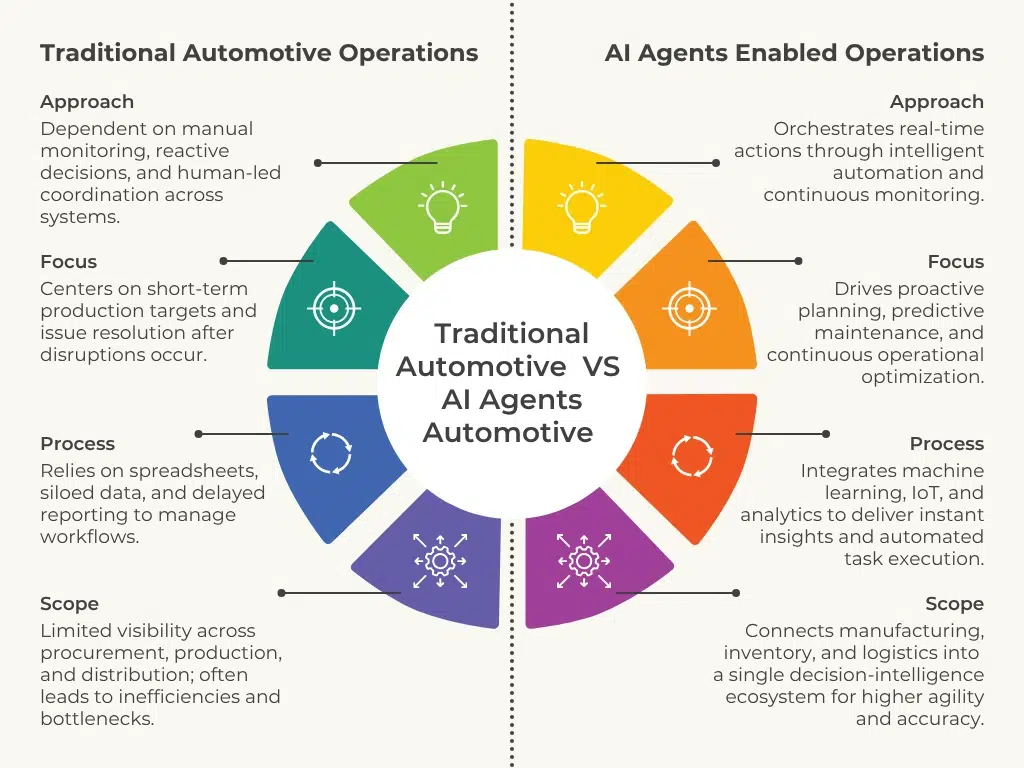
Traditional operations often depend on spreadsheets, manual dashboards, and isolated monitoring tools. Data from machines, suppliers, and dealers sit in separate systems, forcing leaders to make critical decisions based on partial information. This fragmentation causes delays, errors, and inefficiencies.
AI Agents/Assistants eliminate those silos. They connect with ERP, CRM, and IoT systems, pulling data together into a single intelligent network. Instead of teams spending hours consolidating reports, these agents provide instant, conversational access to answers like “Which plant has the highest idle time this week?” or “Which supplier’s delays will affect next month’s output?”
Key applications
- Predictive maintenance alerts – Detecting wear and anomalies in production equipment and vehicles before breakdowns occur, minimizing downtime.
- Automated scheduling – Reassigning production and maintenance tasks automatically based on capacity, demand, or resource availability.
- Intelligent inventory monitoring – Maintaining optimal stock levels by predicting shortages, overages, or obsolescence across plants and distribution centers.
- Customer and supplier engagement – Streamlining communication, tracking commitments, and identifying issues before they impact delivery.
Key Components That Make It “AI”
Behind every effective AI Agent lies a powerful technology stack that enables its intelligence, responsiveness, and adaptability.
- Machine Learning Models: Continuously trained on historical and live data, these models forecast production trends, maintenance needs, and part requirements with high accuracy.
- Natural Language Processing (NLP): Allows the AI to understand human language, enabling users to query data or receive insights through simple, conversational commands, making complex information accessible to all decision-makers.
- Automated Workflows: Once insights are generated, the agent initiates actions — from scheduling maintenance to notifying procurement teams or updating ERP systems.
Together, these components ensure that decision-making is not just faster, but grounded in data, patterns, and predictions.
Transforming Operations with AI Agents and AI Assistants
The automotive industry has always relied on precision, but today that precision is being redefined by AI Agents and AI Assistants. These systems are no longer just add-ons to analytics dashboards—they are becoming integral members of operational teams, continuously interpreting data, predicting shifts, and coordinating responses across production, procurement, and logistics. What makes this shift remarkable is the transition from reactive decision-making to an anticipatory, insight-led ecosystem, where every process—right from production planning to customer delivery—runs in sync.
Real-Time Production Visibility
AI Agents unify machine data, operator inputs, and logistics updates into a single connected environment. Leaders gain a live view of production cycles, bottlenecks, and resource utilization — turning reactive management into proactive control.
Predictive Maintenance Alerts
Downtime is no longer a surprise. AI Agents continuously monitor equipment and performance patterns, alerting teams before failures occur. This predictive foresight reduces production halts, extends asset life, and improves throughput.
Smarter Scheduling and Operations
From production sequencing to maintenance planning, AI Assistants optimize schedules based on demand, capacity, and constraints — ensuring efficiency and timely fulfillment without human micromanagement.
Streamlined Procurement Decisions
AI Assistants analyze part requirements, vendor lead times, and order patterns to anticipate shortfalls or delays. They recommend procurement actions that balance cost, time, and material flow — preventing disruptions before they occur.
Elevated Customer Experience
Beyond factory floors, AI Assistants extend to after-sales and service networks, helping dealerships and fleet managers anticipate maintenance needs, manage parts inventory, and engage customers more personally and efficiently.
How AI Agents/Assistants Enable Smarter Automotive Industry Operations
AI Agents/Assistants thrive when embedded within daily operations — empowering every role, from plant floor supervisors to procurement managers and logistics planners.
Role-based applications
- Production optimization: AI Agents monitor machine utilization, line efficiency, and part availability. When a performance dip is detected, they suggest or execute corrective actions — adjusting shifts, reallocating resources, or flagging upstream delays.
- Procurement excellence: Assistants track supplier reliability, lead times, and pricing fluctuations. They automatically alert teams to high-risk suppliers or materials likely to cause disruptions.
- Inventory intelligence: Continuous tracking of stock levels across plants and regional centers allows better planning, reduced excess, and faster fulfillment.
Advanced Enterprise Capabilities
Beyond monitoring, AI Agents/Assistants enhance decision-making with forward-looking intelligence:
- Scenario simulations: “What if” models let leaders evaluate potential outcomes — like a sudden demand spike or supplier delay — and make informed adjustments before issues arise.
- Intelligent alerts and recommendations: Instead of passive notifications, these assistants provide contextual guidance — suggesting actions, highlighting trade-offs, and prioritizing risks.
- Workflow optimization: By orchestrating data from manufacturing, procurement, and logistics systems, AI Agents/Assistants streamline end-to-end processes, improving both speed and reliability.
ConverSight: Supply Chain Decision Intelligence for AI Agents/Assistants
Modern automotive operations require more than raw data — they demand actionable intelligence that connects manufacturing, procurement, and distribution in real time. Executives need insights that translate immediately into decisions, whether it’s adjusting production schedules, reallocating resources, or anticipating potential delays. ConverSight delivers this capability by leveraging AI Agents/Assistants to streamline operations, reduce risk, and improve responsiveness.
Athena, ConverSight’s AI Agent, provides business leaders with a single, unified view of critical operational insights. Unlike traditional dashboards, Athena doesn’t simply display metrics — it interprets patterns, identifies risks, and surfaces actionable recommendations tailored to decision-makers.
How ConverSight enhances AI Agents/Assistants with actionable insights
Athena, ConverSight’s AI Agent, eliminates manual data hunting and fragmented reporting. By understanding business context, learning from data patterns, and engaging in natural language, Athena delivers immediate, actionable insights that keep operations synchronized and future-ready.
Unified Visibility: ConverSight integrates data from production systems, inventory management, procurement, and delivery networks to provide a single operational view. This enables leaders to replace manual, experience-based decisions with data-backed ones.
Proactive Planning: ConverSight uses forecasting, simulation, and scenario-driven modelling to anticipate supplier delays, parts shortages, and production bottlenecks. These capabilities let decision-makers act ahead of issues rather than after them.
Supplier Performance Analysis: ConverSight continuously evaluates supplier reliability, delivery performance, and quality consistency. By surfacing real-time insights into supplier metrics, ConverSight helps automotive manufacturers identify risks early, optimize sourcing strategies, and maintain production continuity with greater confidence.
Conversational Analytics: Through natural-language inquiries and AI-agent interaction, ConverSight enables users to ask complex questions like “Which part has the highest delivery risk this month?” and receive immediate, actionable insights. This turns data into dialogue and action.
Workflow Automation: ConverSight not only displays insights but also triggers workflows—alerts, recommendations, and task assignments—to close the gap between insight and execution.
How ConverSight Amplifies AI Agents/Assistants to Drive Smarter Automotive Operations -> Learn More
ConverSight in Action: Case Highlight
Daimler provides a strong example of how ConverSight transforms automotive operations in practice. By integrating ConverSight with its SAP ERP, the company moved from manual tracking and fragmented data systems to real-time, intelligence-driven insights across production, procurement, and critical parts management.
Key improvements included:
- Improved demand and production forecasting – Athena integrated multiple data sources, continuously updating supply requirements and recalibrating forecasts in real time, reducing inventory waste and shortening delivery windows by nearly 50%.
- Automated critical parts tracking – Tasks that once required three people hours per day were automated. Athena consolidated and analyzed data overnight, generating personalized risk reports for supplier managers and leaders, highlighting at-risk parts and recommended corrective actions.
- Proactive supplier coordination – Athena directly engaged suppliers to confirm urgent shipments and continuously updated internal teams with real-time information, preventing unexpected disruptions that could halt production lines.
- Natural language insights – Users could query Athena in natural language to get instant, actionable insights without IT intervention, enabling faster, data-driven responses across operations.
The combination of predictive analytics, automation, and real-time intelligence allowed Daimler to save 110 hours per week on manual data work, achieve 80% fewer line stoppages, and accelerate decision cycles by 60%.
Testimonial:
“Athena transformed our decision-making process. What once took hours now happens in minutes — with accuracy and reliability we didn’t have previously. Athena’s proactive insights ensure our teams stay informed, enabling faster action to mitigate risks and maintain production flow.”
— Senior Supply Chain Leader, Daimler
Learn how ConverSight helped Daimler optimize operations, reduce downtime, and accelerate enterprise decision-making -> Read Case Study
Business Benefits Across the Automotive Industry
The adoption of AI Agents/Assistants in the automotive industry is delivering tangible benefits across every operational layer. The true value lies not just in efficiency, but in how businesses can rethink their processes to be more responsive, resilient, and reliable.
- Optimized Fleet Operations: By predicting maintenance needs and potential delays, AI Agents help fleets stay on the move, reducing downtime and ensuring timely deliveries. Vehicle utilization is maximized, and logistics teams can make informed rerouting decisions before issues escalate.
- Enhanced Manufacturing Productivity: Real-time monitoring of equipment and production lines allows proactive adjustments that prevent line stoppages. Teams can allocate resources more efficiently, reducing idle time and increasing throughput without additional capital investment.
- Streamlined Procurement and Inventory Management: AI Agents forecast demand for parts and materials accurately, helping businesses avoid costly stockouts or excess inventory. Procurement teams gain visibility into supplier performance, enabling smarter negotiations and reduced operational risk.
- Improved Dealership and Service Experience: Intelligent assistants support service centers with parts availability, predictive maintenance alerts, and scheduling recommendations. Customers receive faster service with greater transparency, strengthening brand loyalty and retention.
- Data-Driven Enterprise Decisions: By consolidating insights across operations, leaders can act confidently on trends and anomalies. Whether it’s reallocating resources, adjusting production priorities, or managing vendor risk, AI Agents give managers the clarity to make fast, informed decisions.
In short, AI Agents/Assistants are no longer just “tools” — they are integral enablers that transform daily operations into strategic advantages, translating data into actionable, measurable outcomes.
Key Drivers for Widespread AI Agents/Assistants Adoption in the Automotive Industry
The shift toward AI Agents/Assistants isn’t happening in isolation — it’s being accelerated by macro trends, technological advancements, and market pressures that make traditional operations increasingly unsustainable.
- Rising Operational Complexity: Modern automotive organizations operate in a web of global suppliers, multi-tier manufacturing facilities, and distributed service networks. Managing these interdependencies manually is no longer viable.
- Escalating Customer Expectations: Consumers now demand faster delivery, transparent updates, and personalized service. Automotive companies must be agile to meet these expectations consistently.
- Intensifying Competition: The global market is crowded, with manufacturers competing on both cost and reliability. Those leveraging AI Agents gain faster insights, anticipate issues, and maintain an operational edge.
- Pressure to Control Costs: Resource allocation, maintenance, and logistics costs continue to rise. AI Agents allow companies to optimize utilization and reduce waste without compromising service or production quality.
- Data Explosion: Vehicles, machinery, and operations now generate massive amounts of telemetry and transactional data. Harnessing this data effectively requires intelligent agents that can translate information into actionable insights.
- Need for Strategic Agility: External disruptions — from supply delays to regulatory changes — demand rapid, informed responses. AI Agents enable enterprises to simulate scenarios, identify risks, and pivot strategies quickly.
In combination, these drivers explain why AI Agents/Assistants are no longer optional — they are becoming a standard for maintaining operational resilience, competitiveness, and growth in the automotive industry.
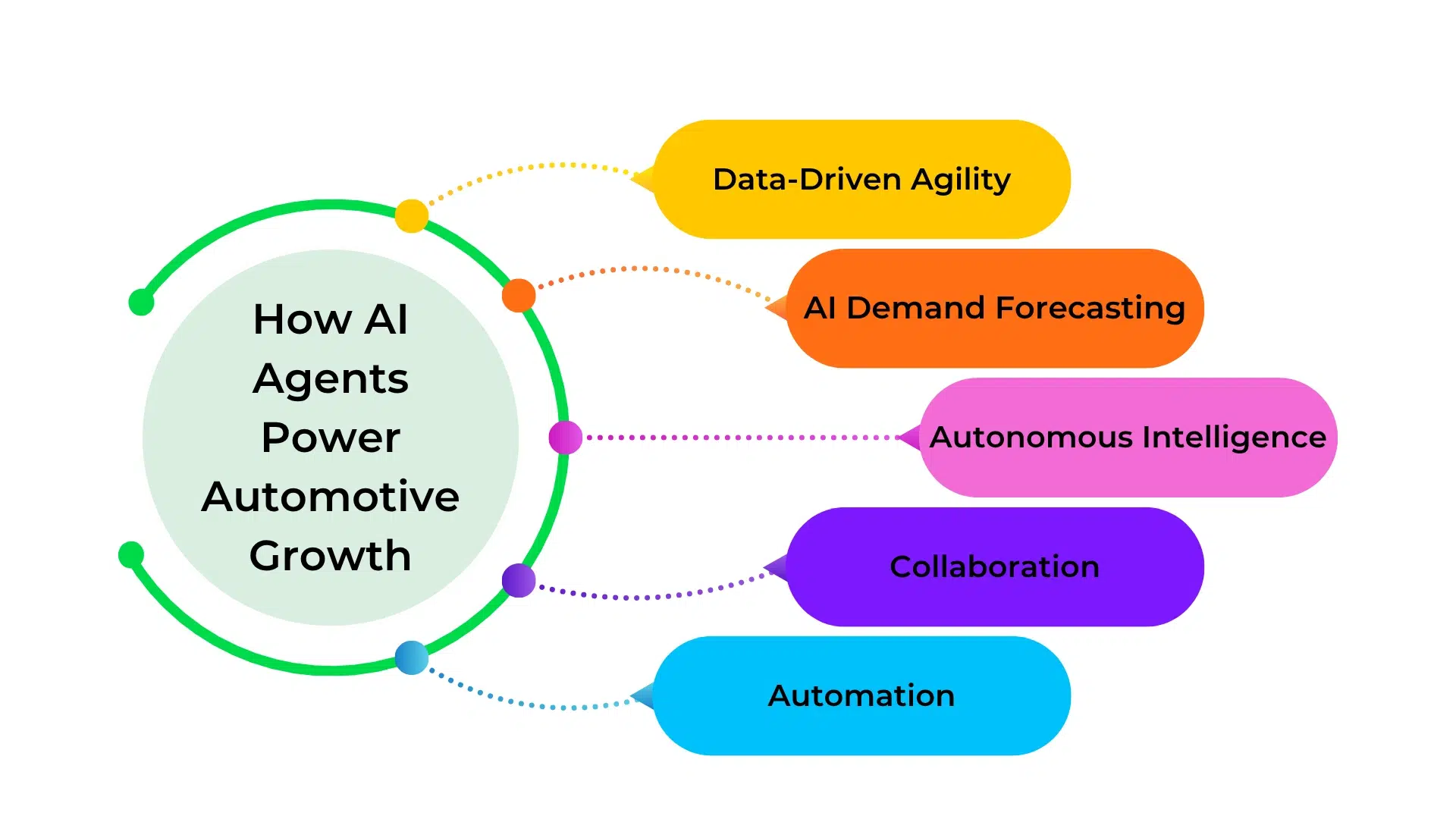
ROI Delivered by AI Agents/Assistants in the Automotive Industry
The measurable impact of AI Agents/Assistants extends across every corner of automotive operations. Here’s a breakdown of the key areas where they deliver tangible results:
1. Reduced Fleet and Production Downtime
AI Agents/Assistants anticipate maintenance needs and detect disruptions early, keeping production lines moving and fleets operational. The result: fewer stoppages, smoother workflows, and higher throughput.
2. Enhanced Operational Visibility and Predictive Insights
By consolidating data from machinery, inventory, and logistics systems, these assistants provide a unified view of operations. Leaders gain predictive insights that inform proactive decisions — turning uncertainty into confidence.
3. Cost Reductions in Manufacturing, Logistics, and Service Operations
Optimized scheduling, intelligent resource allocation, and reduced operational errors translate directly into lower costs. From production to delivery, AI Agents/Assistants streamline processes that once consumed time and budget unnecessarily.
4. Improved Customer Satisfaction and Engagement
With accurate production timelines, reliable service delivery, and faster issue resolution, end customers experience a higher level of service. This strengthens loyalty and reinforces the brand’s reputation in a competitive market.
5. Faster Decision-Making Across Operations
By delivering actionable insights in real time, AI Agents/Assistants shorten the decision cycle for managers and teams. Proactive recommendations reduce manual analysis, enable quick corrective actions, and help the enterprise respond immediately to changes in production or logistics conditions.
Conclusion
Operational transformation in the automotive sector is no longer optional — it is a strategic imperative. Companies that integrate AI Agents/Assistants into their manufacturing, procurement, and distribution operations gain a decisive edge: real-time visibility, predictive insights, and the ability to act with confidence before issues escalate.
By automating monitoring, forecasting disruptions, and streamlining workflows, AI Agents/Assistants not only reduce downtime and operational inefficiencies but also empower executives to make faster, more informed decisions. The result is measurable impact across the enterprise: optimized production schedules, lower costs, improved asset utilization, and elevated customer satisfaction.
Explore how Athena, ConverSight’s AI Agent, can transform your operations — delivering smarter insights, faster actions, and measurable business impact → Request a Demo Today