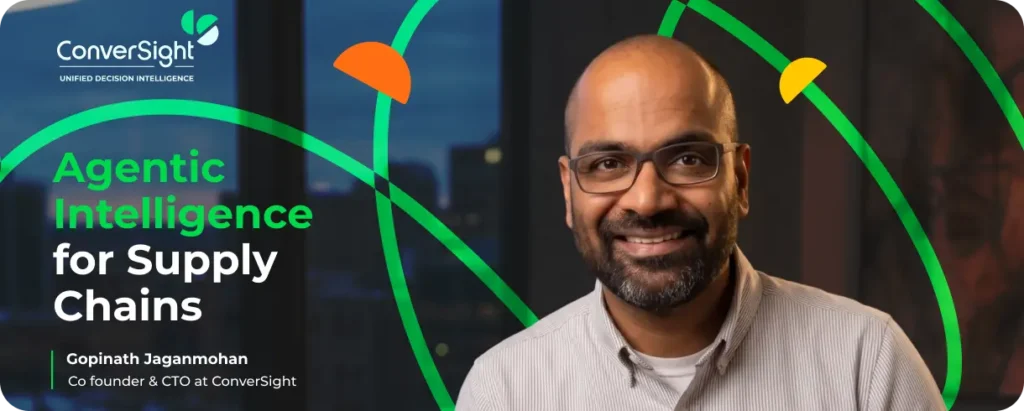
By Gopi, CTO at ConverSight
Every supply chain leader I speak with tells me the same thing: “We have more data than ever, and yet we’re still caught off guard.”
Inventory piles up in the wrong warehouse. A supplier goes dark and the ripple takes weeks to contain. A demand spike hits and the response is a frantic series of calls, spreadsheets, and gut calls. The tools are modern. The dashboards are beautiful. And somehow, the decisions are still late.
This is not a data problem. It is a decision problem. And the industry’s current generation of platforms — however sophisticated they appear — were never really built to solve it.
The Illusion of Intelligence
Supply chain platforms have attracted enormous investment. ERP giants bolted on planning modules. AI features appeared in every brochure. And yet, when disruption strikes, most organizations still default to war rooms.
Why? Because most platforms were designed to report on what happened — not reason about what to do next.
They show you inventory is low. They don’t tell you whether to expedite, substitute, or delay and what that choice costs across your network. They surface the alert. They leave the decision to you.
There’s a word for that: a dashboard.
What Decision Intelligence Actually Means
A true Decision Intelligence Platform doesn’t just aggregate signals — it reasons across them. It connects a retail demand signal to upstream supplier constraints, weighs it against your financial targets and service commitments, models the trade-offs, and surfaces ranked recommended actions with visible logic and measurable confidence.
Predictive analytics tells you what will happen. Prescriptive analytics tells you what could. Decision Intelligence tells you what to do and learns from what happens next.
Your planners stop being data analysts. They become decision executors.
Why Current Platforms Fall Short
Three fundamental gaps:
They’re built around data models, not decision models. Legacy platforms optimize for data completeness. A decision intelligence platform organizes around outcomes — what are we trying to achieve, what’s blocking us, and what moves us closer?
They require experts to extract value. Most supply chain software still needs a trained analyst to build reports and interpret output. In a world where decisions happen in hours, that model breaks.
They can’t hold a conversation. Supply chain decisions don’t happen in dashboards. They happen in conversations between planners, procurement heads, finance, and ops. A platform that can’t answer “why is our fill rate down in the Northeast?” in plain language isn’t a decision platform. It’s a reporting platform wearing a machine learning costume.
The Next Frontier: Agentic Decision Intelligence
Decision Intelligence was step one. The organizations pulling ahead are already on step two.
The difference is profound: a Decision Intelligence platform surfaces the right answer. An Agentic Decision Intelligence platform acts on it.
Imagine AI agents continuously monitoring your supply network not in daily batch runs, but in real time. A supplier’s lead time slips. The agent models downstream impact, identifies the best mitigation path, and within pre-approved parameters — executes: re-routing an order, triggering an alternative supplier, adjusting safety stock across the network. Before a human opens their dashboard.
This isn’t traditional automation. Traditional automation follows rules. Agentic AI reasons. It handles novelty, ambiguity, competing priorities and escalates to humans precisely when human judgment is required. Not for every routine call a well-calibrated agent can handle with confidence.
The planner’s role evolves from making decisions to governing the agents that make them. That’s a fundamentally different and far more strategic job.
The Standard Has to Change
Stop asking “does your platform have AI?”
Start asking: “Can your platform act with us and eventually, for us?”
The winners won’t be the organizations with the most data. They’ll be the ones who build the shortest, most intelligent path between a signal and a confident action and who have the courage to let AI agents walk that path on their behalf.
That future isn’t coming. It’s here.
This is the problem I work on every day. I’d love to hear how your organization is thinking about the shift from Decision Intelligence to Agentic AI in supply chain. Drop a comment or connect directly.